A circular loop of radius $0.0157\,m$ carries a current of $2.0\, amp$. The magnetic field at the centre of the loop is$({\mu _0} = 4\pi \times {10^{ - 7}}\,weber/amp - m)$
Easy
Download our app for free and get started
(b) $B = \frac{{{\mu _0}}}{{4\pi }}\frac{{2\pi i}}{r} = {10^{ - 7}} \times \frac{{2\pi \times 2}}{{0.0157}} = 8 \times {10^{ - 5}}\,Wb/{m^2}$

Download our appand get started for free
Experience the future of education. Simply download our apps or reach out to us for more information. Let's shape the future of learning together!No signup needed.*
Similar Questions
- 1The magnetic field $d\overrightarrow B $ due to a small current element $d\overrightarrow {l\,} $ at a distance $\overrightarrow {r\,} $ and element carrying current $i$ isView Solution
- 2View SolutionA charged particle is released from rest in a region of steady uniform electric and magnetic fields which are parallel to each other the particle will move in a
- 3An ammeter reads upto $1\, ampere$. Its internal resistance is $0.81\, ohm$. To increase the range to $10\, A$ the value of the required shunt is ............ $\Omega $View Solution
- 4View SolutionTwo parallel wires are carrying electric currents of equal magnitude and in the same direction. They exert
- 5A long straight wire of radius a carries a steady current I. The current is uniformly distributed across its cross section. The ratio of the magnetic field at $\frac{a}{2}$ and $2$a from axis of the wire is:View Solution
- 6A proton, a deuteron and an $\alpha$ particle are moving with same momentum in a uniform magnetic field. The ratio of magnetic forces acting on them is.......... and their speed is.................. in the ratio.View Solution
- 7Two moving coil meters $M_1$ and $M_2$ having the following particulars :-View Solution
$R_1 = 10\,\Omega , N_1 = 30, A_1 = 3.6\times10^{-3}\, m^2, B_1 = 0.25\, T$
$R_2 = 14\,\Omega , N_2 = 42, A_2 = 1.8\times10^{-3}\, m^2, B_2 = 0.50\, T$
(The spring constants are identical for the two meters). Determine the ratio of voltage sensitivity of $M_2$ and $M_1$ - 8A galvanometer of $50\, ohm$ resistance has $25$ divisions. A current of $4 \times 10^{-4}$ ampere gives a deflection of one division. To convert this galvanometer into a voltmeter having a range of $25\, volts$, it should be connected with a resistance ofView Solution
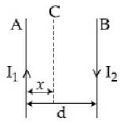
- 9Two wires $A$ and $B$ are carrying currents $I_1$ and $I_2$ as shown in the figure. The separation between them is $d$. A third wire $C$ carrying a current $I$ is to be kept parallel to them at a distance $x$ from $A$ such that the net force acting on it is zero. The possible values of $x$ areView Solution
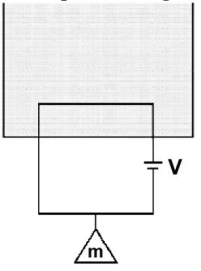
- 10A massless square loop, of wire of resistance $10\,\Omega$. supporting a mass of $1\,g$. hangs vertically with one of its sides in a uniform magnetic field of $10^3\, G$, directed outwards in the shaded region. A dc voltage $V$ is applied to the loop. For what value of V. the magnetic force will exactly balance the weight of the supporting mass of $1\,g$ ? (If sides of the loop $=10\,cm , g =10\,ms ^{-2}$ )View Solution