Question
A circular loop of string rotates about its axis on a frictionless horizontal plane at a uniform rate so that the tangential speed of any particle of the string is v. If a small transverse disturbance is produced at. a point of the loop, with what speed (relative to the string) will this disturbance travel on the string?
Answer

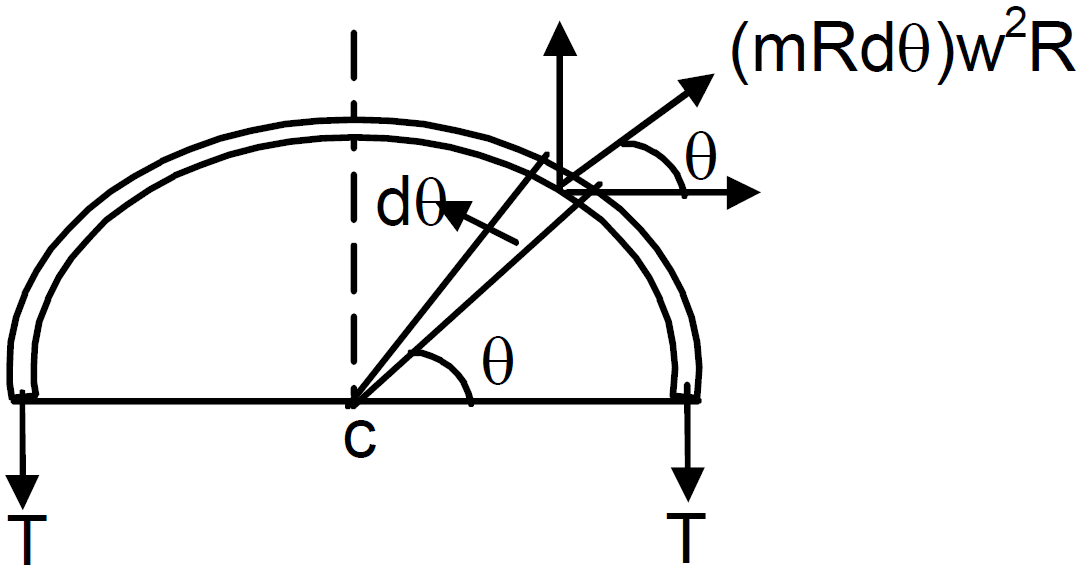
m = mass per unit length of the string R = Radius of the loop$\omega=$ angular velocity, V = linear velocity of the string
Consider one half of the string as shown in figure. The half loop experiences cetrifugal force at every point, away from centre, which is balanced by tension 2T. Consider an element of angular part $\text{d}\theta$ at angle $\theta.$ Consider another element symmetric to this centrifugal force experienced by the element $=(\text{mRd}\theta)\omega^2\text{R}.$$\big($Length of element $=\text{Rd}\theta,\ \text{mass}=\text{mRd}\theta\big)$
Resolving into rectangular components net force on the two symmetric elements,$\text{DF}=2\text{mR}^2\text{d}\theta\omega^2\sin\theta$ [horizontal components cancels each other]
So, total $\text{F}=\int\limits_0^{\frac{\pi}{2}}2\text{mR}^2\omega^2\sin\theta\text{d}\theta=2\text{mR}^2\omega^2[-\cos]\Rightarrow2\text{mR}^2\omega^2$ Again, $2\text{T}=2\text{mR}^2\omega^2\ \Rightarrow\text{T}=\text{mR}^2\omega^2$ Velocity of transverse vibration $\text{v}=\sqrt{\frac{\text{T}}{\text{m}}}=\omega\text{R}=\text{v}$

Need a full question paper?

Generate a complete, print-ready paper with questions like this in minutes — across 16+ boards, with answer keys.

Start Generating Free

Similar questions

The property of diamagnetism is said to be present in all materials. Then, why are some materials paramagnetic or ferromagnetic?
The bob of a pendulum at rest is given a sharp hit to impart a horizontal velocity $\sqrt{10\text{gl}},$ where l is the length of the pendulum. Find the tension in the string when,
  1. The string is horizontal.
  2. The bob is at its highest point.
  3. The string makes an angle of $60^\circ$ with the upward vertical.
Suppose the block of the previous problem is pushed down the incline with a force of 4N. How far will the block move in the first two seconds after starting from rest? The mass of the block is 4kg.
Explain construction and working of a nuclear reactor. State its utility also.
A converging lens of focal length $15\ cm$ and a converging mirror of focal length $10\ cm$ are placed $50\ cm$ apart. If a pin of length $2.0\ cm$ is placed $30\ cm$ from the lens farther away from the mirror, where will the final image form and what will be the size of the final image?
Two charged particles placed at a separation of 20cm exert 20N of Coulomb force on each other. What will be the force if the separation is increased to 25cm?
What is the difference between cathode rays and beta rays? When the two are travelling in space, can you make out which is the cathode ray and which is the beta ray?
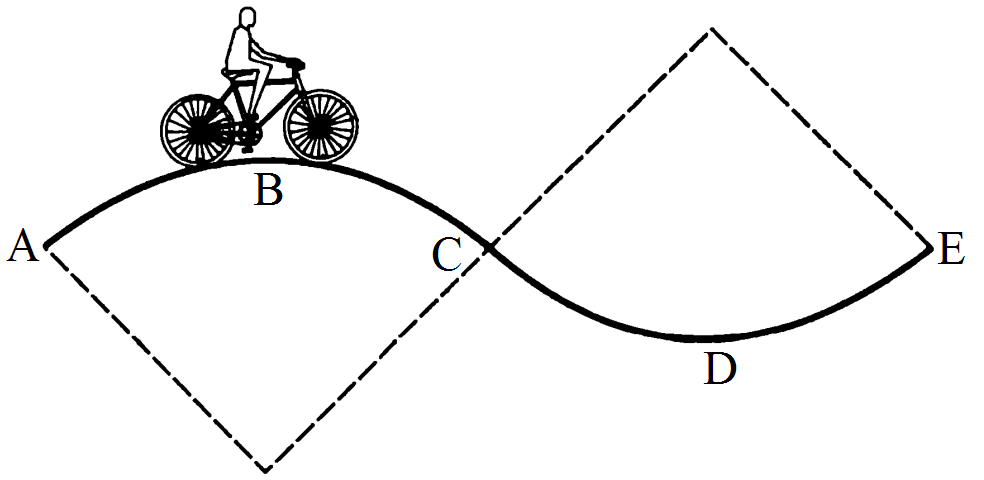
A track consists of two circular parts $\text{ABC}$ and $\text{CDE}$ of equal radius $100m$ and joined smoothly as shown in figure. Each part subtends a right angle at its centre. A cycle weighing $100 \ kg$ together with the rider travels at a constant speed of $18\ km/h$ on the track.
  1. Find the normal contact force by the road on the cycle when it is at $B$ and at $D.$
  2. Find the force of friction exerted by the track on the tyres when the cycle is at $B, C$ and $D.$
  3. Find the normal force between the road and the cycle just before and just after the cycle crosses $C.$
  4. What should be the minimum friction coefficient between the road and the tyre, which will ensure that the cyclist can move with constant speed? Take $g= 10m/s^2.$
  1. Draw a labelled diagram of a moving coil galvanometer. Describe briefly its principle and working.
  2. Answer the following:
  1. Why is it necessary to introduce a cylindrical soft iron core inside the coil of a galvanometer?
  2. Increasing the current sensitivity of a galvanometer may not necessarily increase its voltage sensitivity. Explain, giving reason.
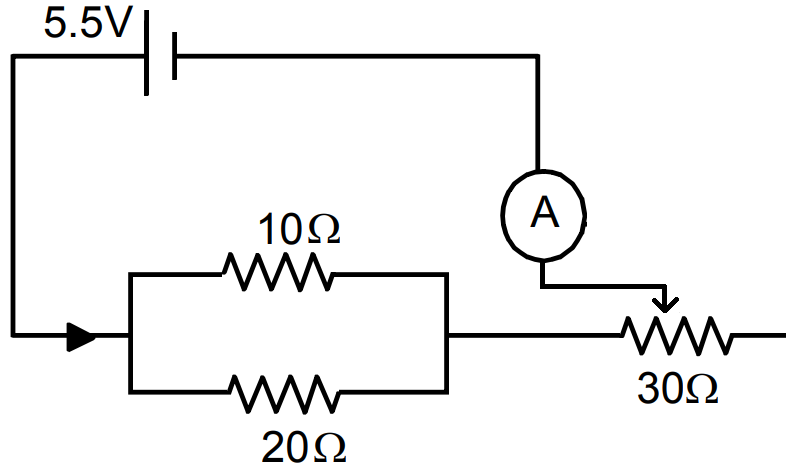
The resistance of the rheostat shown in the figure. is $30\Omega.$ Neglecting the meter resistance, find the minimum and maximum currents through the ammeter as the rheostat is varied.