A block is moving on an inclined plane making an angle $45^{\circ}$ with the horizontal and the coefficient of friction is $\mu$. The force required to just push it up the inclined plane is $3$ times the force required to just prevent it from sliding down. If we define $N=10 \ \mu$, then $N$ is
IIT 2011, Advanced
Download our app for free and get started
$F_1=3 F_2$
$mg \left(\sin 45^{\circ}+\mu \cos 45^{\circ}\right)=3 mg \left(\sin 45^{\circ}-\mu \cos 45^{\circ}\right)$
$\frac{1}{\sqrt{2}}(1+\mu)=\frac{3}{\sqrt{2}}(1-\mu)$
$\mu=0.5$
$\therefore \quad N=10 \mu$
$=10 \times 0.5$
$N=5$

Download our appand get started for free
Experience the future of education. Simply download our apps or reach out to us for more information. Let's shape the future of learning together!No signup needed.*
Similar Questions
- 1A rectangular block has a square base measuring $a \times a$ and its height is $h$. It moves on a horizontal surface in a direction perpendicular to one of the edges. The coefficient of friction is $\mu$. It will topple ifView Solution
- 2A lift is moving downwards with an acceleration equal to acceleration due to gravity. $A$ body of mass $M$ kept on the floor of the lift is pulled horizontally. If the coefficient of friction is $\mu $, if the lift is moving upwards with a uniform velocity, then the frictional resistance offered by the body isView Solution
- 3A block of mass $10\, kg$ starts sliding on a surface with an initial velocity of $9.8\, ms ^{-1}$. The coefficient of friction between the surface and bock is $0.5$. The distance covered by the block before coming to rest is: [use $g =9.8\, ms ^{-2}$ ].........$m$View Solution
- 4Two bodies of equal masses revolve in circular orbits of radii ${R_1}$ and ${R_2}$ with the same period. Their centripetal forces are in the ratioView Solution
- 5A lift is moving downwards with an acceleration equal to acceleration due to gravity. A body of mass $m$ kept on the floor of the lift is pulled horizontally. If the coefficient of friction is $\,\mu $, then the frictional resistance offered by the body isView Solution
- 6View SolutionA car sometimes overturns while taking a turn. When it overturns, it is
- 7View SolutionWhich one of the following is not used to reduce friction
- 8Aball of mass $m$ is thrown vertically upwards.Assume the force of air resistance has magnitude proportional to the velocity, and direction opposite to the velocity's. At the highest point, the ball's acceleration isView Solution
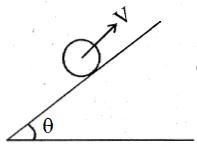
- 9View SolutionThe sphere is performing rolling up an inclined plane, the frictional force is
- 10For the given figure, if block remains in equilibrium position then find frictional force between block and wall ........ $N$View Solution