A disc with a flat small bottom beaker placed on it at a distance $R$ from its center is revolving about an axis passing through the center and perpendicular to its plane with an angular velocity $\omega$. The coefficient of static friction between the bottom of the beaker and the surface of the disc is $\mu$. The beaker will revolve with the disc if
JEE MAIN 2022, Medium
Download our app for free and get started
$f_{s}=m \omega^{2} R$
We know that $f_{ S } \leq f _{\text {smax }}$
$m \omega^{2} R \leq \mu m g$
$R \leq \frac{\mu g }{\omega^{2}}$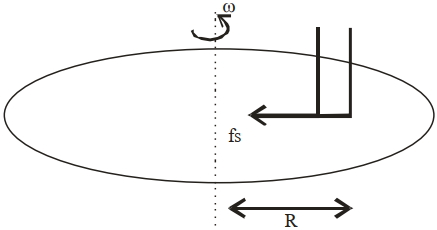

Download our appand get started for free
Experience the future of education. Simply download our apps or reach out to us for more information. Let's shape the future of learning together!No signup needed.*
Similar Questions
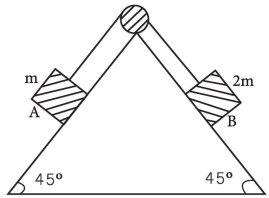
- 1Consider the diagram shown below in which two masses of $m$ and $2 m$ are placed on a fixed triangular wedge. The coefficient of friction between block $A$ and the wedge is $2 / 3$, while that for block $B$ and the wedge is $1 / 3$View Solution
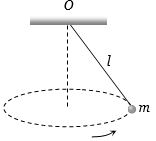
- 2A point mass $m$ is suspended from a light thread of length $l$, fixed at $O$, is whirled in a horizontal circle at constant speed as shown. From your point of view, stationary with respect to the mass, the forces on the mass areView Solution
- 3A $20\, kg$ block is initially at rest on a rough horizontal surface. A horizontal force of $75 \,N$ is required to set the block in motion. After it is in motion, a horizontal force of $60\, N$ is required to keep the block moving with constant speed. The coefficient of static friction isView Solution
- 4A body of mass $10$ kg slides along a rough horizontal surface. The coefficient of friction is $1/\sqrt 3 $. Taking $g = 10\,m/{s^2}$, the least force which acts at an angle of $30^o $ to the horizontal is ...... $N$View Solution
- 5A plank with a box on it at one end is gradually raised about the other end. As the angle of inclination with the horizontal reaches $30^o$, the box starts to slip and slides $4.0\, m$ down the plank in $4.0\,s$. The coefficients of static and kinetic friction between the box and the plank will be, respectivelyView Solution
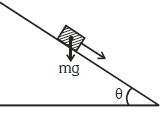
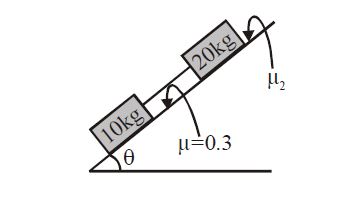
- 6Value of $\theta$ is increased gradually from $\theta = 0$ At $\theta=tan^{-1}(\frac{1}{2})$ both the block just start slipping. Then value of $\mu_2$ is : $(g = 10 m/s^2)$View Solution
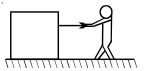
- 7View SolutionA man pulls a block heavier than himself with a light horizontal rope. The coefficient of friction is the same between the man and the ground, and between the block and the ground
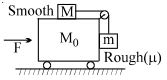
- 8Imagine $a$ situation in which the horizontal surface of block $M_0$ is smooth and its vertical surface is rough with $a$ coefficient of friction $\mu$ In above problem, the value $(s)$ of $F$ for which $M$ and $m$ are stationary with respect to $M_0 mg$View Solution
- 9A block of weight $W$ rests on a horizontal floor with coefficient of static friction $\mu .$ It is desired to make the block move by applying minimum amount of force. The angle $\theta $ from the horizontal at which the force should be applied and magnitude of the force $F$ are respectively.View Solution
- 10A particle of mass $m$ is executing uniform circular motion on a path of radius $r$. If $p$ is the magnitude of its linear momentum. The radial force acting on the particle isView Solution