Two lenses A and B have power of (i) + 2 D and (ii) -4D respectively. What is the nature and focal length of each lens?
Download our app for free and get started
$\text{P}_\text{A}=+20$$\text{f}_\text{A}=\frac{1}{\text{P}_\text{A}}=\frac{1}{2}=+0.5\text{m}=+50\text{cm}$
Lens A is a convex lens.
$\text{P}_\text{B}=-4\text{D}$
$\text{f}_\text{B}=\frac{1}{\text{f}_\text{B}}=\frac{1}{-4}=-0.25\text{m}=-25\text{cm}$
Lens B is a concave lens.
Lens A is a convex lens.
$\text{P}_\text{B}=-4\text{D}$
$\text{f}_\text{B}=\frac{1}{\text{f}_\text{B}}=\frac{1}{-4}=-0.25\text{m}=-25\text{cm}$
Lens B is a concave lens.

Download our appand get started for free
Experience the future of education. Simply download our apps or reach out to us for more information. Let's shape the future of learning together!No signup needed.*
Similar Questions
- 1View SolutionA convex lens has a focal length of 10cm. At what distance from the lens should the object be placed so that it forms a real and inverted image 20cm away from the lens? What would be the size of the image formed if the object is 2cm high? With the help of a ray diagram show the formation of the image by the lens in this case.
- 2View SolutionWhat is a lens? Distinguish between a convex lens and a concave lens. Which of the two is a converging lens : convex lens or concave lens?
- 3View Solution
- Draw a diagram to show how a converging lens focusses parallel rays of light?
- How would you alter the above diagram to show how a converging lens can produce a beam of parallel rays of light.
- 4a. What is the focal length of the lens used in sunglasses?View Solution
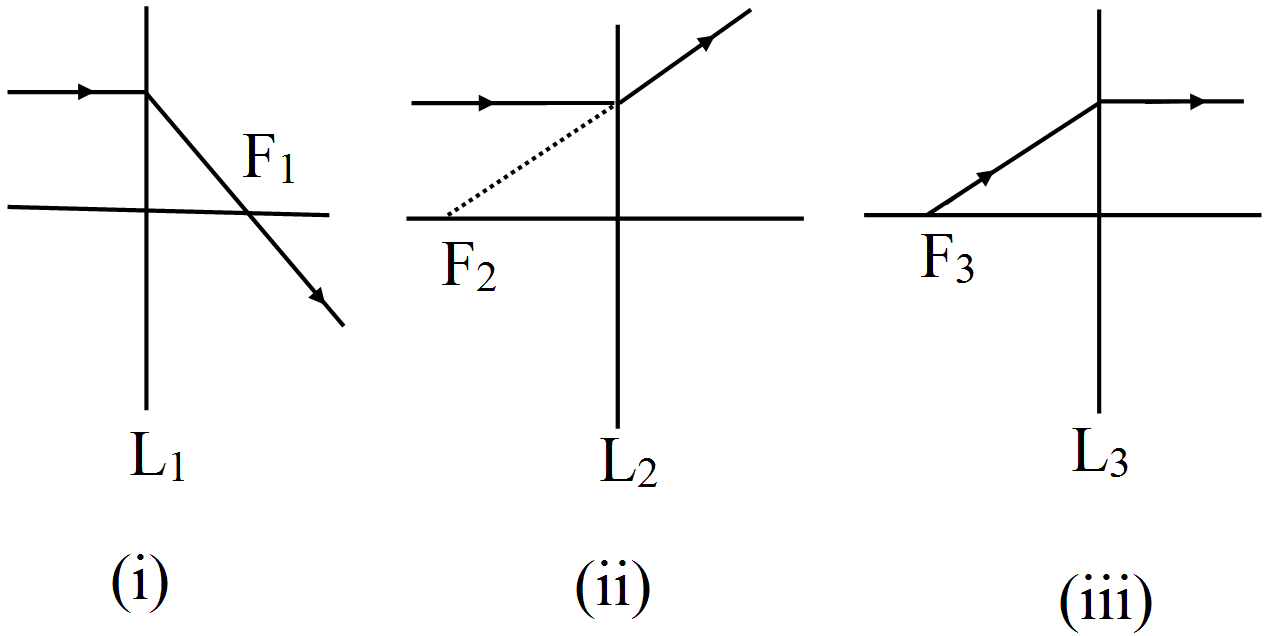
b. The following figures show the path of light rays through three lenses marked $L_1, L_2$, and $L_3$ and their focal points $F_1, F_2$, and $F_3$, respectively. Identify the nature of lenses.
- 5View SolutionDistinguish between a real and a virtual image of an object. What type of image is formed?
- By a plane mirror.
- On a cinema screen?
- 6View SolutionAn object 20cm from a spherical mirror gives rise to a virtual image 15cm behind the mirror. Determine the magnification of the image and the type of mirror used.
- 7View SolutionDescribe with the help of a ray-diagram, the formation of image of a finite object placed in front of a convex lens between f and 2f Give two characteristics of the image so formed.
- 8View SolutionState the types of mirrors used for,
- Headlights.
- Rear view mirrors, in cars and motorcycles.
- 9View SolutionWe wish to obtain an erect image of an object, using a concave mirror of focal length 15 cm. What should be the range of distance of the object from the mirror? What is the nature of the image? Is the image larger or smaller than the object? Draw a ray diagram to show the image formation in this case.
- 10View SolutionHow is the refractive index of a medium related to the speed of light? Obtain an expression for refractive index of a medium with respect to another in terms of speed of light in these two media?