A deutron of kinetic energy $50\, keV$ is describing a circular orbit of radius $0.5$ $metre$ in a plane perpendicular to magnetic field $\overrightarrow B $. The kinetic energy of the proton that describes a circular orbit of radius $0.5$ $metre$ in the same plane with the same $\overrightarrow B $ is........$keV$
AIPMT 1991, Medium
Download our app for free and get started
(d) $r = \frac{{\sqrt {2mK} }}{{qB}} \Rightarrow K \propto \frac{{{q^2}}}{m}$
$ \Rightarrow \frac{{{K_p}}}{{{K_d}}} = {\left( {\frac{{{q_p}}}{{{q_d}}}} \right)^2} \times \frac{{{m_d}}}{{{m_p}}} = {\left( {\frac{1}{1}} \right)^2} \times \frac{2}{1} = \frac{2}{1}$
$ \Rightarrow {k_p} = 2 \times 50 = 100\;keV.$
$ \Rightarrow \frac{{{K_p}}}{{{K_d}}} = {\left( {\frac{{{q_p}}}{{{q_d}}}} \right)^2} \times \frac{{{m_d}}}{{{m_p}}} = {\left( {\frac{1}{1}} \right)^2} \times \frac{2}{1} = \frac{2}{1}$
$ \Rightarrow {k_p} = 2 \times 50 = 100\;keV.$

Download our appand get started for free
Experience the future of education. Simply download our apps or reach out to us for more information. Let's shape the future of learning together!No signup needed.*
Similar Questions
- 1One of the two identical conducing wires of length $L$ is bent in the form of a circular loop and the other one into a circular coil of $N$ identical turns. If the same current is passed in both, the ratio of the magnetic field at the central of the loop $(B_L)$ to that at the centre of the coil $(B_C),$; $.\,\frac {B_L}{B_C}$ will beView Solution
- 2As shown in the figure, a metallic rod of linear density $0.45\,kg\,m ^{-1}$ is lying horizontally on a smooth incline plane which makes an angle of $45^{\circ}$ with the horizontal. The minimum current flowing in the rod required to keep it stationary, when $0.15\,T$ magnetic field is acting on it in the vertical upward direction, will be $....A$ $\left\{\right.$ Use $\left.g=10 m / s ^{2}\right\}$View Solution
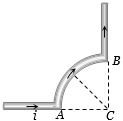
- 3A wire carrying current $i$ is shaped as shown. Section $AB$ is a quarter circle of radius $r$. The magnetic field is directedView Solution
- 4A coil is placed in $y-z$ plane making an angle of $30^{\circ}$ with $x$ -axis. The current through coil is $I,$ and number of turns are $N$. If a magnetic field of strength $'B'$ is applied in positive $x-$direction, then find the torque experienced by the coil (Radius of coil is $R$) (in $N \cdot m$)View Solution
$\left(N=100, I=1 A, R=2\, m, B=\frac{1}{\pi} T\right)$
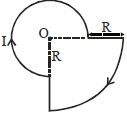
- 5A current $I$ flowing through the loop as shown in the adjoining figure. The magnetic field at centre $O$ isView Solution
- 6In an experiment, electrons are accelerated, from rest, by applying, a voltage of $500 \,V.$ Calculate the radius of the path if a magnetic field $100\,mT$ is then applied. [Charge of the electron $= 1.6 \times 10^{-19}\,C$ Mass of the electron $= 9.1 \times 10^{-31}\,kg$ ]View Solution
- 7$\alpha $ particle, proton and duetron enters in a uniform (transverse) magnetic field $'B'$ with same acceleration potential find ratio of radius of path followed by these particles.View Solution
- 8View SolutionA uniform electric field and a uniform magnetic field are acting along the same direction in a certain region. If an electron is projected in the region such that its velocity is pointed along the direction of fields, then the electron
- 9A proton, an electron, and a Helium nucleus, have the same energy. They are in circular orbitals in a plane due to magnetic field perpendicular to the plane. Let $r_p, r_e$ and $r_{He}$ be their respective radii, thenView Solution
- 10A $90\, cm$ long solenoid has six layers of windings of $450\, turns$ each. If the diameter of solenoid is $2.2\, cm$ and current carried is $6\, A$, then the magnitude of magnetic field inside the solenoid, near its centre isView Solution