One of the two identical conducing wires of length $L$ is bent in the form of a circular loop and the other one into a circular coil of $N$ identical turns. If the same current is passed in both, the ratio of the magnetic field at the central of the loop $(B_L)$ to that at the centre of the coil $(B_C),$; $.\,\frac {B_L}{B_C}$ will be
JEE MAIN 2019, Medium


Download our appand get started for free
Experience the future of education. Simply download our apps or reach out to us for more information. Let's shape the future of learning together!No signup needed.*
Similar Questions
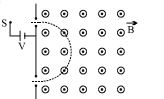
- 1A mass spectrometer is a device which select particle of equal mass. An iron with electric charge $q > 0$ and mass $m$ starts at rest from a source $S$ and is accelerated through a potential difference $V$. It passes $\rho$ through a hole into a region of constant magnetic field $\vec B\,$ perpendicular to the plane of the paper as shown in the figure. The particle is deflected by the magnetic field and emerges through the bottom hole at a distance $d$ from the top hole. The mass of the particle isView Solution
- 2The magnetic field at the center of current carrying circular loop is $B _{1}$. The magnetic field at a distance of $\sqrt{3}$ times radius of the given circular loop from the center on its axis is $B_{2}$. The value of $B_{1} / B_{2}$ will be.View Solution
- 3In an experiment, electrons are accelerated, from rest, by applying, a voltage of $500 \,V.$ Calculate the radius of the path if a magnetic field $100\,mT$ is then applied. [Charge of the electron $= 1.6 \times 10^{-19}\,C$ Mass of the electron $= 9.1 \times 10^{-31}\,kg$ ]View Solution
- 4A particle of mass $m$ carrying charge $q$ is accelerated by a potential difference $V$. It enters perpendicularly in a region of uniform magnetic field $B$ and executes circular arc of radius $R$, then $\frac{q}{m}$ equalsView Solution
- 5View SolutionA strong magnetic field is applied on a stationary electron, then
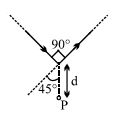
- 6Find the magnetic field at $P$ due to the arrangement shownView Solution
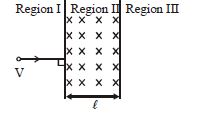
- 7A particle of mass $m$ and charge $q$ , moving with velocity $V$ enters region $II$ normal to the boundary as shown in the figure. Region $II$ has a uniform magnetic field $B$ perpendicular to the plane of the paper. The length of the region $II$ is $l$ . Choose the not correct choiceView Solution
- 8An ammeter gives full scale deflection when current of $1.0\, A$ is passed in it. To convert it into $10\, A$ range ammeter, the ratio of its resistance and the shunt resistance will beView Solution
- 9When a current of $5\ mA$ is passed through a galvanometer having a coil of resistance $15\ \Omega$, it shows full scale deflection. The value of the resistance to be put in series with the galvanometer to convert it into to voltmeter of range $0 - 10\ V$ isView Solution
- 10A thin disc of radius $R$ and mass $M$ has charge $q$ uniformly distributed on it. It rotates with angular velocity $\omega$. The ratio of magnetic moment and angular momentum for the disc isView Solution