Question
A device used to measure very high temperature is

Answer

(a)Pyrometer is used to measure very high temperature.

Need a full question paper?

Generate a complete, print-ready paper with questions like this in minutes — across 16+ boards, with answer keys.

Start Generating Free

Similar questions

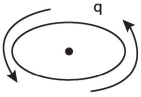
Assertion $(A):$ A charge moving in a circular orbit can produce electromagnetic wave.

Reason $(R):$ The source of electromagnetic wave should be in accelerated motion.
A police jeep is chasing with, velocity of $45\, km/h$ a thief in another jeep moving with velocity $153\, km/h$. Police fires a bullet with muzzle velocity of $180 \,m/s$. The velocity it will strike the car of the thief is........$m/s$
A capacitor with air as the dielectric is charged to a potential of $100\;volts$. If the space between the plates is now filled with a dielectric of dielectric constant $10$, the potential difference between the plates will be......$volts$
In a hypothetical system a particle of mass $m$ and charge $-3\,q$ is moving around a very heavy particle having cahrge $q$. Assuming Bohr’s model to be true to this system, the orbital velocity of mass $m$ when it is nearest to heavy particle is 
One end of a taut string of length $3 \ m$ along the $x$-axis is fixed at $x=0$. The speed of the waves in the string is $100 \ m / s$. The other end of the string is vibrating in the $y$-direction so that stationary waves are set up in the string. The possible waveform$(s)$ of these stationary waves is (are)

$(A)$ $y(t)=A \sin \frac{\pi x}{6} \cos \frac{50 \pi t}{3}$

$(B)$ $y(t)=A \sin \frac{\pi x}{3} \cos \frac{100 \pi t}{3}$

$(C)$ $y(t)=A \sin \frac{5 \pi x}{6} \cos \frac{250 \pi t}{3}$

$(D)$ $y(t)=A \sin \frac{5 \pi x}{2} \cos 250 \pi t$

Consider a situation in which reverse biased current of a particular $P-N$ junction increases when it is exposed to a light of wavelength $\le 621\, {nm}$. During this process, enhancement in carrier concentration takes place due to generation of hole-electron pairs. The value of band gap is nearly. (In ${eV}$)
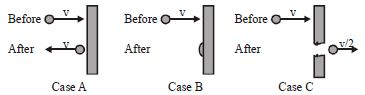
Three different projectiles, each with the same mass, are fired with speed $v$ at a wall. In case $A,$ the projectile bounces straight back with speed $v.$ In case $B$, the projectile sticks to the wall. In case $C$, the projectile crashes through the wall and emerges with half its original speed. These three cases are shown here.

Place the impulse exerted by the wall on the projectile in each of these three cases in the correct order.
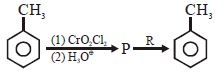
$P$ and $R$ respectively are
If Gravitational constant is decreasing in time, what will remain unchanged in case of a satellite orbiting around earth
If a Carnot engine works between $127^{\circ} C$ and $527^{\circ} C$, then its efficiency is ...... $\%$