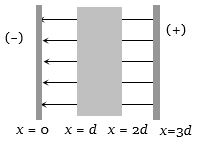
A dielectric slab of thickness $d$ is inserted in a parallel plate capacitor whose negative plate is at $x = 0$ and positive plate is at $x = 3d$. The slab is equidistant from the plates. The capacitor is given some charge. As one goes from $0$ to $3d$
IIT 1998, Medium
Download our app for free and get started
(d) Even after introduction of dielectric slab, direction of electric field will be perpendicular to the plates and directed from positive plate to negative plate.
Further, magnitude of electric field in air $ = \frac{\sigma }{{{\varepsilon _0}}}$
Magnitude of electric field in dielectric $ = \frac{\sigma }{{K{\varepsilon _0}}}$
Similarly electric lines always flows from higher to lower potential, therefore, electric potential increases continuously as we move from $x = 0$ to $x = 3d$.
Further, magnitude of electric field in air $ = \frac{\sigma }{{{\varepsilon _0}}}$
Magnitude of electric field in dielectric $ = \frac{\sigma }{{K{\varepsilon _0}}}$
Similarly electric lines always flows from higher to lower potential, therefore, electric potential increases continuously as we move from $x = 0$ to $x = 3d$.

Download our appand get started for free
Experience the future of education. Simply download our apps or reach out to us for more information. Let's shape the future of learning together!No signup needed.*
Similar Questions
- 1Four identical charges $ + \,50\,\mu C$ each are placed, one at each corner of a square of side $2\,m$. How much external energy is required to bring another charge of $ + \,50\,\mu C$ from infinity to the centre of the square......$J$ $\left( {{\rm{Given}}\frac{{\rm{1}}}{{{\rm{4}}\pi {\varepsilon _{\rm{0}}}}} = 9 \times {{10}^9}\,\frac{{N{m^2}}}{{{C^2}}}} \right)$View Solution
- 2To obtain $3\,\mu F$ capacity from three capacitors of $2\,\mu F$ each, they will be arrangedView Solution
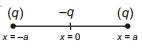
- 3Three charges are placed along $x$-axis at $x=-a, x=0$ and $x=a$ as shown in the figure. The potential energy of the system isView Solution
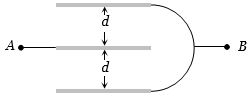
- 4Three plates of common surface area $A$ are connected as shown. The effective capacitance will beView Solution
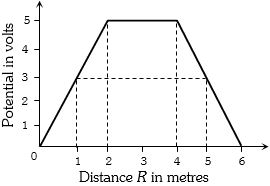
- 5The variation of potential with distance $R$ from a fixed point is as shown below. The electric field at $R = 5\,m$ is......$volt/m$View Solution
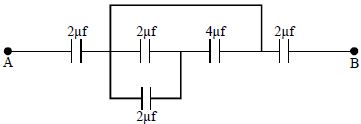
- 6Find the equivalent capacitance between $A$ and $B$.......$\mu f$View Solution
- 7View SolutionTwo equal capacitors are first connected in series and then in parallel. The ratio of the equivalent capacities in the two cases will be
- 8An electric dipole is placed on the $x-$axis as shown in the figure. Consider a spherical closed surface around it. ThenView Solution
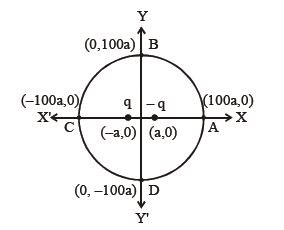
- 9Two large vertical and parallel metal plates having a separation of $1 \ cm$ are connected to a $DC$ voltage source of potential difference $X$. A proton is released at rest midway between the two plates. It is found to move at $45^{\circ}$ to the vertical $JUST$ after release. Then $X$ is nearlyView Solution
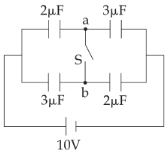
- 10In figure a system of four capacitors connected across a $10\, V$ battery is shown. Charge that will flow from switch $S$ when it is closed isView Solution