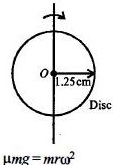
A disc rotates about its axis of symmetry in a hoizontal plane at a steady rate of $3.5$ revolutions per second. A coin placed at a distance of $1.25\,cm$ from the axis of rotation remains at rest on the disc. The coefficient of friction between the coin and the disc is $(g\, = 10\,m/s^2)$
JEE MAIN 2018, Difficult
Download our app for free and get started
Using, $\mu mg =\frac{m v^2}{r}=m r \omega^2$
$\omega=2 \pi n=2 \pi \times 3.5=7 \pi rad / \sec$
Radius, $r=1.25 \ cm=1.25 \times 10^{-2} m$
Coefficient of friction, $\mu=$ ?
$\mu m g=\frac{m(r \omega)^2}{r}(v=r \omega)$
$\Rightarrow \mu=\frac{r \omega^2}{g}=\frac{1.25 \times 10^{-2} \times\left(7 \times \frac{22}{7}\right)^2}{10}$
$=\frac{1.25 \times 10^{-2} \times 22^2}{10}=0.6$
$\omega=2 \pi n=2 \pi \times 3.5=7 \pi rad / \sec$
Radius, $r=1.25 \ cm=1.25 \times 10^{-2} m$
Coefficient of friction, $\mu=$ ?
$\mu m g=\frac{m(r \omega)^2}{r}(v=r \omega)$
$\Rightarrow \mu=\frac{r \omega^2}{g}=\frac{1.25 \times 10^{-2} \times\left(7 \times \frac{22}{7}\right)^2}{10}$
$=\frac{1.25 \times 10^{-2} \times 22^2}{10}=0.6$

Download our appand get started for free
Experience the future of education. Simply download our apps or reach out to us for more information. Let's shape the future of learning together!No signup needed.*
Similar Questions
- 1For a body moving in a circular path, a condition for no skidding if $\mu $ is the coefficient of friction, isView Solution
- 2View SolutionMaximum value of static friction is called
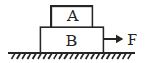
- 3In figure, the coefficient of friction between the floor and the block $B$ is $0.1$. The coefficient of friction between the blocks $B$ and $A$ is $0.2$. The mass of $A$ is $\frac{m}{2}$ and of $B$ is $m$. ........ $mg$ is the maximum horizontal force $F$ can be applied to the block $B$ so that two blocks move together ?View Solution
- 4A rectangular block has a square base measuring $a \times a$ and its height is $h$. It moves on a horizontal surface in a direction perpendicular to one of the edges. The coefficient of friction is $\mu$. It will topple ifView Solution
- 5Two blocks $A$ and $B$ are released from the top of a rough inclined plane so that $A$ slides along the plane and $B$ falls down freely. Which will have higher velocity on reaching the ground ?View Solution
- 6If a block moving up an inclined plane at $30^{\circ}$ with a velocity of $5 \,m / s$, stops after $0.5 s$, then coefficient of friction will be nearlyView Solution
- 7A block slides down on an inclined surface of inclination $30^o$ with the horizontal. Starting from rest it covers $8\, meter$ in the first two seconds. The coefficient of friction is $(g = 10\, ms^{-2})$View Solution
- 8A stone weighing $1$ kg and sliding on ice with a velocity of $2$ m/s is stopped by friction in $10$ sec. The force of friction (assuming it to be constant) will be ......... $N$View Solution
- 9A block of mass $M$ slides down on a rough inclined plane with constant velocity. The angle made by the incline plane with horizontal is $\theta$. The magnitude of the contact force will be.View Solution
- 10View SolutionWhich of the following statements is not true