Two blocks $A$ and $B$ are released from the top of a rough inclined plane so that $A$ slides along the plane and $B$ falls down freely. Which will have higher velocity on reaching the ground ?
Easy
Download our app for free and get started
As the block $A$ slides down along the rough inclined plane, it will lose energy due to opposing frictional force. Hence, the block $B$, which is falling freely, will reach the ground with higher velocity.

Download our appand get started for free
Experience the future of education. Simply download our apps or reach out to us for more information. Let's shape the future of learning together!No signup needed.*
Similar Questions
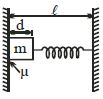
- 1A block of mass $m$ is pressed against a vertical surface by a spring of unstretched length $l$ . If the coefficient of friction between the block and the surface is $\mu $. Choose the correct statement.View Solution
- 2View SolutionMaximum force of friction is called
- 3A body of mass $100\, g$ is sliding from an inclined plane of inclination $30^°$. What is the frictional force experienced if $\mu = 1.7$View Solution
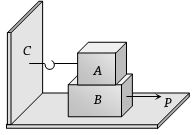
- 4Block $A$ weighing $100$ kg rests on a block $B$ and is tied with a horizontal string to the wall at $C$. Block $B$ weighs $200 \,kg$. The coefficient of friction between $A$ and $B$ is $0.25$ and between $B$ and the surface is $1/3$. The horizontal force $P$ necessary to move the block $B$ should be ........ $N$ $(g = 10\,m/{s^2})$View Solution
- 5A marble block of mass $2\, kg$ lying on ice when given a velocity of $6\, m/s$ is stopped by friction in $10s$. Then the coefficient of friction is-View Solution
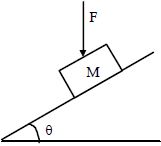
- 6A block of mass $M$ is sliding down the plane. Coefficient of static friction is $\mu _s$ and kinetic friction is $\mu _k.$ Then friction force acting on the block is :-View Solution
- 7A person with his hand in his pocket is skating on ice at the rate of $10 m / s$ and describes a circle of radius $50 m$. What is his inclination to vertical: $\left( g =10 m / sec ^2\right)$View Solution
- 8A uniform wooden stick of mass $1.6 \mathrm{~kg}$ and length $l$ rests in an inclined manner on a smooth, vertical wall of height $h( < l)$ such that a small portion of the stick extends beyond the wall. The reaction force of the wall on the stick is perpendicular to the stick. The stick makes an angle of $30^{\circ}$ with the wall and the bottom of the stick is on a rough focr. The reaction of the wall on the stick is equal in magnitude to the reaction of the floor on the st $ck$. The ratio $h / l$ and the frictional force $f$ at the bottom of the stick are $\left(g=10 \mathrm{~m} \mathrm{~s}^{-2}\right)$View Solution
- 9Two balls of masses ${m_1}$ and ${m_2}$ are separated from each other by a powder charge placed between them. The whole system is at rest on the ground. Suddenly the powder charge explodes and masses are pushed apart. The mass ${m_1}$ travels a distance ${s_1}$ and stops. If the coefficients of friction between the balls and ground are same, the mass ${m_2}$ stops after travelling the distanceView Solution
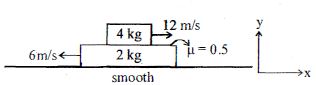
- 10The blocks are given velocity in the direction shown in figure. Co-efficient of friction between two blocks shown in figure is $μ = 0.5$. Take $g = 10\ m/s^2$View Solution
(considering $4\ kg$ block doesn't fall on ground)
Consider the following statements
$(i)$ Time when relative motion between them is stopped is $1.4\ second$.
$(ii)$ Time when relative motion between them is stopped in $1.2\ second$
$(iii)$ The common velocity of the two blocks is $8\ m/s$, towards right.
$(iv)$ The displacement of the $4\, kg$ block when relative motion stopped is$10.8\ m$.
Which of the fstatements is/are correct