A rectangular block has a square base measuring $a \times a$ and its height is $h$. It moves on a horizontal surface in a direction perpendicular to one of the edges. The coefficient of friction is $\mu$. It will topple if
Medium
Download our app for free and get started
$\mathrm{C}:$ center of mass
$\tau_{C}=\mathrm{f} \frac{\mathrm{h}}{2}-\mathrm{N} \frac{\mathrm{a}}{2} \geq 0$ for toppling
$\mu \mathrm{N} \frac{\mathrm{h}}{2}>\mathrm{N} \frac{\mathrm{a}}{2}$ $\mu>\frac{\mathrm{a}}{\mathrm{h}}$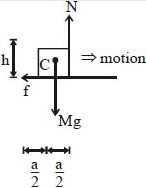

Download our appand get started for free
Experience the future of education. Simply download our apps or reach out to us for more information. Let's shape the future of learning together!No signup needed.*
Similar Questions
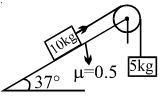
- 1The blocks are in equilibrium. The friction force acting on $10 kg$ block is :View Solution
- 2Two blocks $A$ and $B$ are released from the top of a rough inclined plane so that $A$ slides along the plane and $B$ falls down freely. Which will have higher velocity on reaching the ground ?View Solution
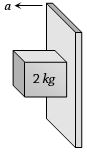
- 3A rough vertical board has an acceleration $‘a’$ so that a $2$ kg block pressing against it does not fall. The coefficient of friction between the block and the board should beView Solution
- 4View SolutionWhen two surfaces are coated with a lubricant, then they
- 5View SolutionWhich of the following statements is not true
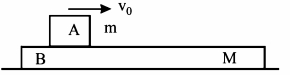
- 6The masses of blocks A and B are $m$ and $M$ respectively. Between $A$ and $B$, there is a constant frictional force $F$ and $B$ can slide on a smooth horizontal surface. A is set in motion with velocity while $B$ is at rest. What is the distance moved by A relative to $B$ before they move with the same velocity?View Solution
- 7A block of mass $5\, kg$ is on a rough horizontal surface and is at rest. Now a force of $24\, N $is imparted to it with negligible impulse. If the coefficient of kinetic friction is $0.4$ and $g = 9.8\,m/{s^2}$, then the acceleration of the block is ........ $m/s^2$View Solution
- 8A block of mass $5\,kg$ is placed at rest on a table of rough surface. Now, if a force of $30\,N$ is applied in the direction parallel to surface of the table, the block slides through a distance of $50\,m$ in an interval of time $10\,s$. Coefficient of kinetic friction is (given, $g =10\,ms ^{-2}$)View Solution
- 9A motor cyclist moving with a velocity of $72\, km/hour$ on a flat road takes a turn on the road at a point where the radius of curvature of the road is $20$ meters. The acceleration due to gravity is $10 m/sec^2$. In order to avoid skidding, he must not bend with respect to the vertical plane by an angle greater thanView Solution
- 10View SolutionIf the normal force is doubled, the coefficient of friction is