Question
A disc rotates about its axis with a constant angular acceleration of 4rad/s2. Find the radial and tangential accelerations of a particle at a distance of 1cm from the axis at the end of the first second after the disc starts rotating.

Answer

$\text{t}=1\text{sec},\ \text{r}=1\text{cm}=0.01\text{m}$

$\alpha=4\text{rad/s}^2$

Therefore $\omega=\alpha\text{t}=4\text{rad/s}$

Therefore radial acceleration,

$\text{A}_{\text{n}}=\omega^2\text{r}=0.16\text{m/s}^2=16\text{cm/s}^2$

Therefore tangential acceleration,

$\text{a}_{\text{r}}=0.04\text{m/s}^2=4\text{cm/s}^2.$

Need a full question paper?

Generate a complete, print-ready paper with questions like this in minutes — across 16+ boards, with answer keys.
Start Generating Free

Similar questions

The breaking stress of aluminium is 7.5 × 10⁸ dyne/ cm-2. Find the greatest length of aluminium wire that can hang vertically without breaking. Density of aluminium is 2.7 g/ cm-3. Given: g = 980cm/ s-2.
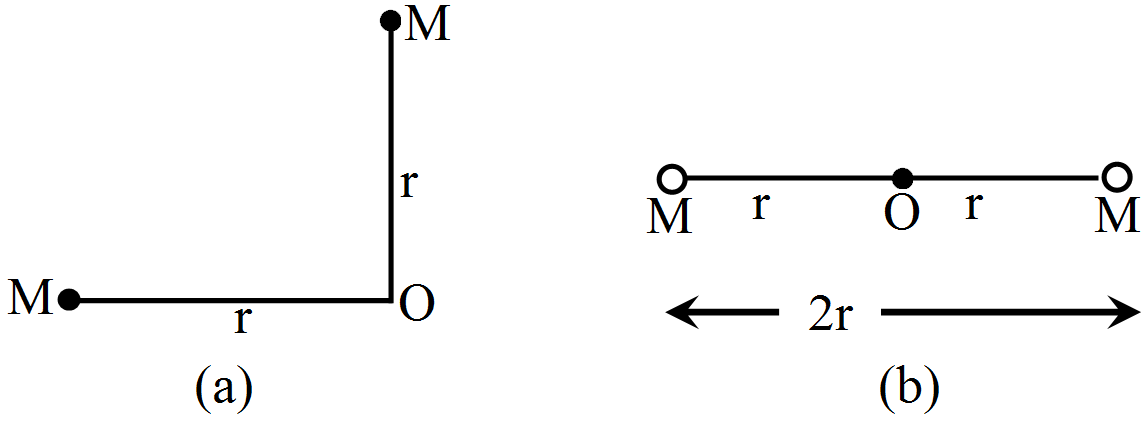
The masses M in the two figures are identical. Which of the two systems has the smaller gravitational potential energy? Why?

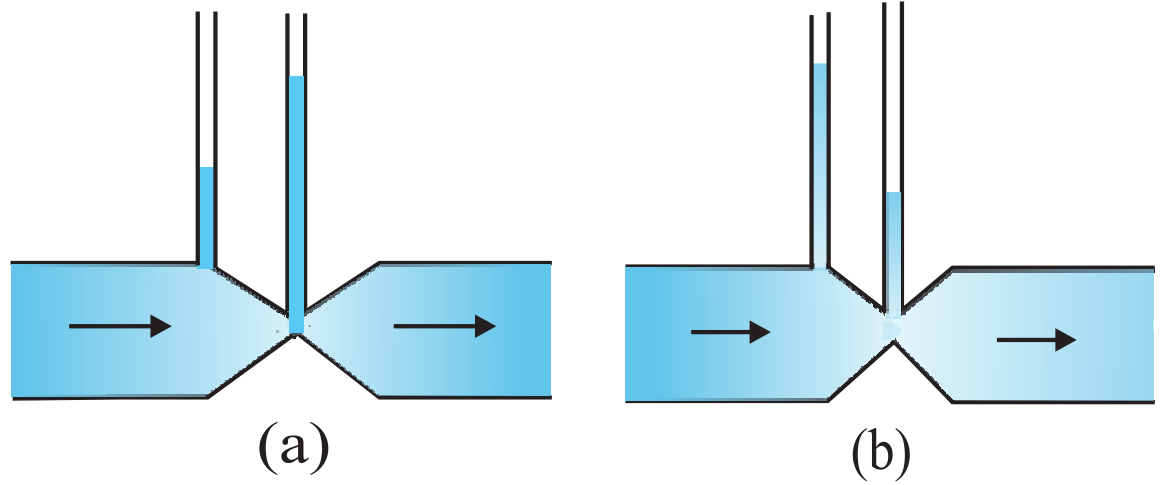
Figures(a) and (b) refer to the steady flow of a (non viscous) liquid. Which of the two figures is incorrect? Why?

A proton beam is going from east to west. Is there an electric current? If yes, in what direction?
A cyclist has to bend a little inwards from his vertical position while turning. Why?
A steel ring of radius r and cross-section area A is fitted onto a wooden disc of radius R(R > r). If Young's modulus be E, find the force with which the steel ring is expanded.
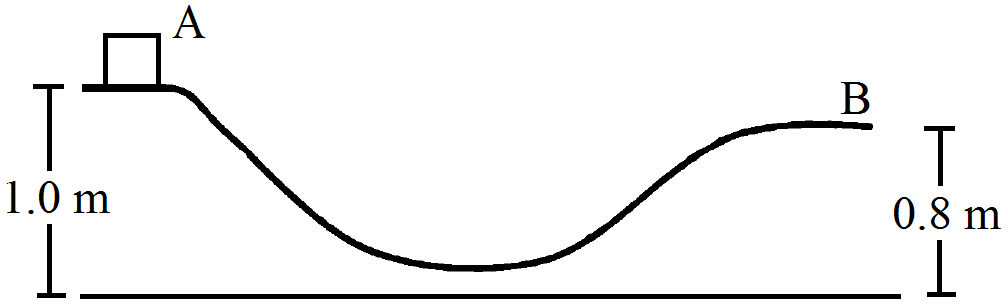
A block of mass 1kg is placed at the point A of a rough track shown in figure. If slightly pushed towards right, it stops at the point B of the track. Calculate the work done by the frictional force on the block during its transit from A to B.

Explain why
The blood pressure in humans is greater at the feet than at the brain.
Determine the speed with which the earth has to rotate on its axis so that a person on the equator weigh $\Big(\frac{3}{5}\Big)^{\text{th}}$ as much as at present. Take the equatorial radius as 6400km.
In an electrolyte, the positive ions move from left to right and the negative ions from right to left. Is there a net current? If yes, in what direction?