Question
A cyclist has to bend a little inwards from his vertical position while turning. Why?

Answer

By bending, a component of normal reaction of the ground is spared to provide him the necessary centripetal force for turning.

Need a full question paper?

Generate a complete, print-ready paper with questions like this in minutes — across 16+ boards, with answer keys.
Start Generating Free

Similar questions

Explain why (or how):
in a sound wave, a displacement node is a pressure antinode and vice versa,
A carnot engine absorbs 100 calories per cycle from its source at 1600K. Its efficiency is 60%. Find the temperature of the sink and work done per cycle. Given J = 4.2J/ cal.
The weather report reads, "Temperature 20°C : Relative humidity 100%". What is the dew point?
On what factors does the critical velocity of the liquid depend?
A cylindrical metal tube has a length of 50cm and is open at both ends. Find the frequencies between 1000Hz and 2000Hz at which the air column in the tube can resonate. Speed of sound in air is 340m/s.
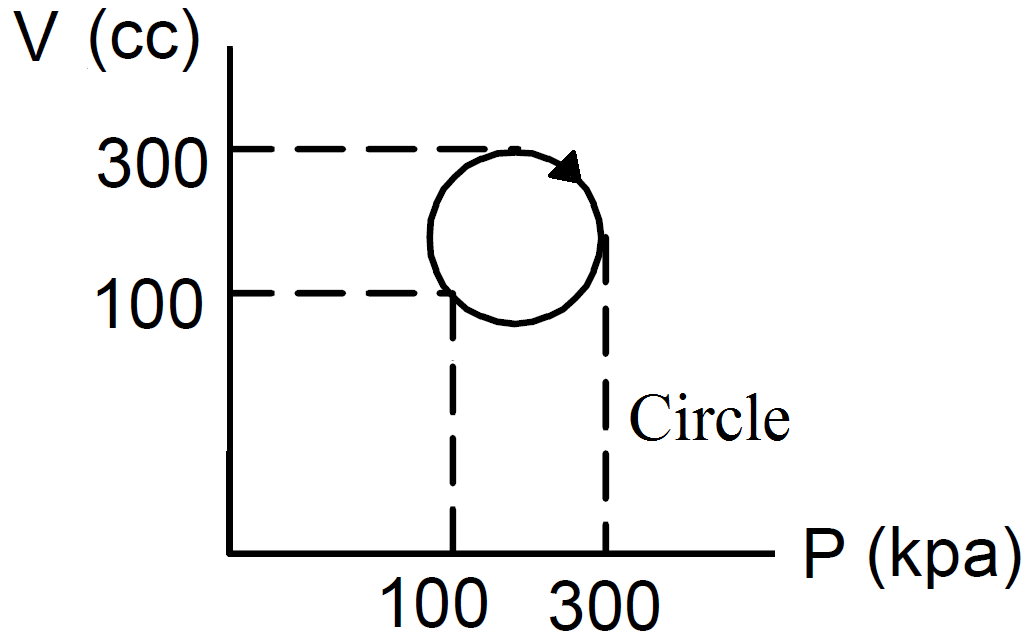
Calculate the heat absorbed by a system in going through the cyclic process shown in figure.

Why is the luminous efficiency small for a filament bulb as compared to a mercury vapour lamp?
Show that the internal energy of the air (treated as an ideal gas) contained in a room remains constant as the temperature changes between day and night. Assume that the atmospheric pressure around remains constant and the air in the room maintains this pressure by communicating with the surrounding through the windows, doors, etc.
A high jumper successfully clears the bar. Is it possible that his centre of mass crossed the bar from below it? Try it with appropriate figures.
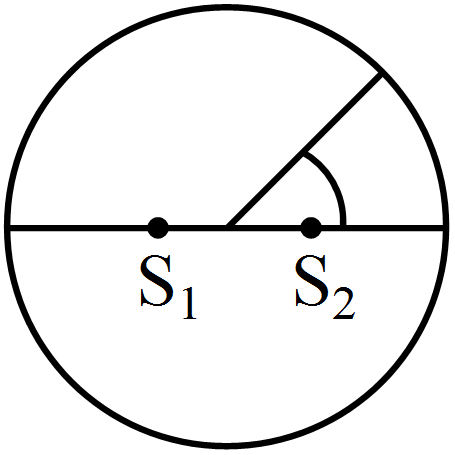
Figure, shows two coherent sources S1 and S2 which emit sound of wavelength $\lambda$ in phase. The separation between the sources is $3\lambda.$ A circular wire of large radius is placed in such a way that S1S2 lies in its plane and the middle point of S1S2 is at the centre of the wire. Find the angular positions $\theta$ on the wire for which constructive interference takes place.