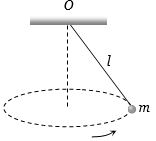
A point mass $m$ is suspended from a light thread of length $l$, fixed at $O$, is whirled in a horizontal circle at constant speed as shown. From your point of view, stationary with respect to the mass, the forces on the mass are
Easy
Download our app for free and get started
(c) $T =$ tension, $W =$ weight and $F =$ centrifugal force.

Download our appand get started for free
Experience the future of education. Simply download our apps or reach out to us for more information. Let's shape the future of learning together!No signup needed.*
Similar Questions
- 1A block of mass $2\,kg$ moving on a horizontal surface with speed of $4\,ms ^{-1}$ enters a rough surface ranging from $x =0.5\,m$ to $x =1.5\,m$. The retarding force in this range of rough surface is related to distance by $F =- kx$ where $k =12\,Nm ^{-1}$. The speed of the block as it just crosses the rough surface will be ........... $\,ms ^{-1}$View Solution
- 2A piece of ice slides down a rough inclined plane at $\theta=45^{\circ}$ inclination in twice the time that it takes to slide down an identical but frictionless inclined plane. What is the coefficient of friction between ice and incline ?View Solution
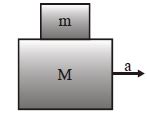
- 3A block of mass $m$ is placed on the top of another block of mass $M$ as shown in the figure. The coefficient of friction between them is $\mu $. What is the maximum acceleration with which the block $M$ may move so that m also moves along with it ?View Solution
- 4Two blocks $A$ and $B$ of masses $5 \,kg$ and $3 \,kg$ respectively rest on a smooth horizontal surface with $B$ over $A$. The coefficient of friction between $A$ and $B$ is $0.5$. The maximum horizontal force (in $kg$ wt.) that can be applied to $A$, so that there will be motion of $A$ and $B$ without relative slipping, isView Solution
- 5A mass is supported on a frictionless horizontal surface. It is attached to a string and rotates about a fixed centre at an angular velocity ${\omega _0}$. If the length of the string and angular velocity are doubled, the tension in the string which was initially ${T_0}$ is nowView Solution
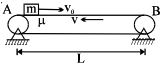
- 6With what minimum velocity should block be projected from left end $A$ towards end $B$ such that it reaches the other end $B$ of conveyer belt moving with constant velocity $v$. Friction coefficient between block and belt is $\mu$ .View Solution
- 7View SolutionA cube is resting on an inclined plane. What must be the value of coefficient of friction between cube and plane so that cube topples before sliding
- 8View SolutionAmong the forces in nature, friction can be classified into
- 9A box of mass $m\, kg$ is placed on the rear side of an open truck accelerating at $4\, m/s^2$. The coefficient of friction between the box and the surface below it is $0.4$. The net acceleration of the box with respect to the truck is zero. The value of $m$ is :- $[g = 10\,m/s^2]$View Solution
- 10A block of mass $m$ rests on a rough inclined plane. The coefficient of friction between the surface and the block is $\mu$. At what angle of inclination $\theta$ of the plane to the horizontal will the block just start to slide down the plane?View Solution