Question
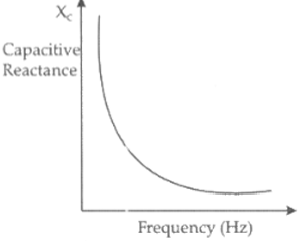
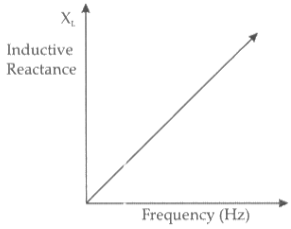
$a$. Draw graphs showing the variations of inductive reactance and capacitive reactance with the frequency of the applied ac source.
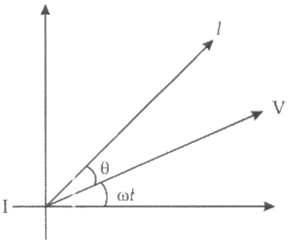
$b$. Draw the phasor diagram for a series $RC$ circuit connected to an ac source.
$c$. An alternating voltage of $220 V$ is applied across a device $X, $ a current of $0.25 A$ flows, which lag behind the applied voltage in phase by $\frac{\pi}{2}$ radian. If the same voltage is applied across another device $Y,$ the same current flows but now it is in phase with the applied voltage.
$i$. Name the devices $X$ and $Y$.
$ii$. Calculate the current flowing in the circuit when the same voltage is applied across the series combination of $X$ and $Y$.
Answer

$a$. Drawing the two graphs the graph shows the variation of capacitive resistance with frequency and inductive resistance with frequency.
The two graphs are as shown
Image

Image
$b$. Drawing the phaser diagram
$($the current leads the voltage by an angle $\theta$ where $0<\theta<\frac{\pi}{2} )$.
The required phaser diagram is as shown.​​​​​​​
Image
[Here, $\theta=\tan ^{-1}\left[\frac{1}{\omega C R}\right]$
$i$. In device $X$:
Current lags behind the voltage by $\frac{\pi}{2}$
$\therefore X$ is an inductor.
In device $Y$ :
Current in phase with the applied voltage.
$\therefore Y$ is resistor.
$ii$ . We are given that
$0.25=\frac{2 n 0}{X_L}$
$\text { or } X _{ L }=\frac{2 n 0}{02} \Omega=880 \Omega$
$\text { Also } 0.25=\frac{220}{X_R}$
$\therefore X_R=\frac{220}{0.25} \Omega=880 \Omega$
For the series combination of $X$ and $Y,$
Equivalent impedance $=\sqrt{X_L^2+X_R^2}=(880 \sqrt{2}) \Omega$
$\therefore$ Current flowing $ \frac{220}{880 \sqrt{2}} A=0.177 A$

Need a full question paper?

Generate a complete, print-ready paper with questions like this in minutes — across 16+ boards, with answer keys.

Start Generating Free

Similar questions

A metal rod of cross sectional area $1.0cm^2$ is being heated at one end. At one time, the temperature gradient is $5.0^\circ C/cm^{-1}$ at cross section A and is $2.5^\circ C/cm^{-1} $ at cross section B. Calculate the rate at which the temperature is increasing in the part AB of the rod. The heat capacity of the part $AB = 0.40J^\circ C^{-1}$, thermal conductivity of the material of the rod ${= 200Wm^{-1}}^\circ C^{-1}.$ Neglect any loss of heat to the atmosphere.
Two identical balls, each having a charge of $2.00 \times 10^{-7}C$ and a mass of 100g, are suspended from a common point by two insulating strings each 50cm long. The balls are held at a separation 5.0cm apart and then released. Find,
  1. The electric force on one of the charged balls.
  2. The components of the resultant force on it along and perpendicular to the string.
  3. The tension in the string.
  4. The acceleration of one of the balls. Answers are to be obtained only for the instant just after the release.
A current i is passed through a silver strip of width d and area of cross-section A. The number of free electrons per unit volume is n.
  1. Find the drift velocity v of the electrons.
  2. If a magnetic field B exists in the region, as shown in the figure, what is the average magnetic force on the free electrons?
  3. Due to the magnetic force, the free electrons get accumulated on one side of the conductor along its length. This produces a transverse electric field in the conductor, which opposes the magnetic force on the electrons. Find the magnitude of the electric field which will stop further accumulation of electrons.
  4. What will be the potential difference developed across the width of the conductor due to the electron-accumulation? The appearance of a transverse emf, when a current-carrying wire is placed in a magnetic field, is called Hall effect.
Determine the equivalent resistance of networks shown in Fig.

A 5mm high pin is placed at a distance of 15cm from a convex lens of focal length 10cm. A second lens of focal length 5cm is placed 40cm from the first lens and 55cm from the pin. Find
  1. The position of the final image.
  2. Its nature.
  3. Its size.
State Soddy-Fajan’s displacement laws for radioactive transformations.
Four long, straight wires, each carrying a current of 5.0A, are placed in a plane as shown in figure. The points of intersection form a square of side 5.0cm.
  1. Find the magnetic field at the centre P of the square.
  2. $Q_1, Q_2, Q_3,$ and $Q_4$ are points situated on the diagonals of the liquare and at a distance from P that is equal to the length of the diagonal of the square. Find the magnetic fields at these points.
If neutrons exert only attractive force, why don't we have a nucleus containing neutrons alone?
A uniform metre stick of mass 200g is suspended from the ceiling through two vertical strings of equal lengths fixed at the ends. A small object of mass 20g is placed on the stick at a distance of 70cm from the left end. Find the tensions in the two strings.
A particle is subjected to two simple harmonic motions given by $\text{x}_1=2.0\sin(100\pi\text{t})$ and $\text{x}_2=2.0\sin\Big(120\pi\text{t}+\frac{\pi}{3}\Big)$ where x is in centimeter and t in second. Find the displacement of the particle at
  1. t = 0.0125.
  2. t = 0.025.