MCQ
A fighter plane is flying horizontally at a height of $250\  m$ from ground with constant velocity of $500\  m/s$. It passes exactly over a cannon which can fire a shell at any time in any direction with a speed of  $100\  m/s$. Find the duration of time  for which the plane is in danger of being hit by a cannon shell
  • A
    $2\sqrt 3\ sec$
  • B
    $\frac{5}{{\sqrt 2 }}\ sec$
  • C
    $3\sqrt 2\ sec$
  • $2\sqrt 2\ sec$

Answer

Correct option: D.
$2\sqrt 2\ sec$
d
We first find the area in which the cannnon shell can reach. The equation of trajectory for cannon shell is

$y^{\prime}=x \tan \theta-\frac{\frac{1}{2} g x^{2}}{u^{2}} \sec ^{2} \theta \cdots \cdots(1)$

For maximum $y$ for a given value of $x -$

$\frac{d y}{d(\tan \theta)}=x-\frac{\frac{1}{2} g x^{2}}{u^{2}}(2 \tan \theta)=0$

$\Rightarrow \tan \theta=\frac{u^{2}}{g x}$

Putting in equation $(1)$

$y_{\max }=x \frac{u^{2}}{2 g}-\frac{\frac{1}{2} g x^{2}}{u^{2}}\left[1+\frac{u^{4}}{g^{2} x^{2}}\right]=\frac{u^{2}}{2 g}-\frac{\frac{1}{2} g x^{2}}{u^{2}}$

The cannon shell can hit an area given by

$y \leq \frac{u^{2}}{2 g}=\frac{\frac{1}{2} g x^{2}}{u^{2}}$

Given in the problem$\mathrm{y}=250 \mathrm{m}$

$\mathrm{u}=100 \mathrm{m} / \mathrm{s}, \mathrm{g}=10 \mathrm{m} / \mathrm{s}$

Putting these value we get,

$\frac{x^{2}}{2000} \leq 250 \Rightarrow-500 \sqrt{2} \leq x \leq 500 \sqrt{2}$

Plane in danger for a period of 

$\frac{{1000\sqrt 2 }}{{500}} = 2\sqrt 2 \,\sec $
Need a full question paper?

Generate a complete, print-ready paper with questions like this in minutes — across 16+ boards, with answer keys.

Start Generating Free

Similar questions

From the following statements, concerning ideal gas at any given temperature $T,$ select the correct one(s)
From amongst the following curves, which one shows the variation of the velocity v with time t for a small sized spherical body falling vertically in a long column of a viscous liquid
Water flows through a frictionless duct with a cross-section varying as shown in fig. Pressure $p$  at points along the axis is represented by
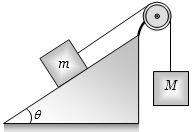
A wire of $9.8 \times {10^{ - 3}}kg{m^{ - 1}}$ passes over a frictionless light pulley fixed on the top of a frictionless inclined plane which makes an angle of $30°$ with the horizontal. Masses $m$ and $M$ are tied at the two ends of wire such that $m$ rests on the plane and $M$ hangs freely vertically downwards. The entire system is in equilibrium and a transverse wave propagates along the wire with a velocity of $100 ms^{-1}$. Chose the correct option $m =$ ..... $kg$
A uniform chain of length $L$ which hanges partially from a table, is kept in equilibrium by friction. The maximum length that can withstand without slipping is $l$ , then coefficient of friction between the table and the chain is
For a diatomic gas change in internal energy for unit change in temperature for constant pressure and constant volume is ${U_1}$ and ${U_2}$ respectively. ${U_1}:{U_2}$ is
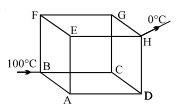
Twelve conducting rods form the riders of a uniform cube of side $'l'.$ If in steady state, $B$ and $H$ ends of the rod are at $100^o C$ and $0^o C$. Find the temperature of the junction $'A'$  ....... $^oC$ 
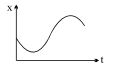
The graph of position $x$ versus time $t$ represents the motion of a particle. If $b$ and $c$ are both positive constants, which of the following expressions best describes the acceleration $a$ of the particle?
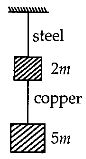
If the ratio of diameters, lengths and Young's modulus of steel and copper wires shown in the figure are $p, q$ and $s$ respectively, then the corresponding ratio of increase in their lengths would be
The adiabatic elasticity of a gas is equal to