MCQ
The adiabatic elasticity of a gas is equal to
  • A
    $\gamma \times $density
  • B
    $\gamma \times $volume
  • $\gamma \times $pressure
  • D
    $\gamma \times $specific heat

Answer

Correct option: C.
$\gamma \times $pressure
c
(c)Adiabatic elasticity ${K_a} = \gamma \,P$

Need a full question paper?

Generate a complete, print-ready paper with questions like this in minutes — across 16+ boards, with answer keys.
Start Generating Free

Similar questions

The velocity of a body can change:
Moment of inertia of a uniform hollow hemi-sphere about given axis is $I_A$ and $I_B$ then
An object is propelled vertically to a maximum height of $4 R$ from the surface of a planet of radius $R$ and mass $M$. The speed of object when it returns to the surface of the planet is
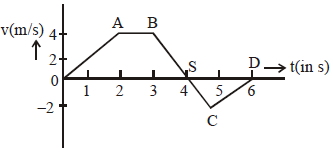
The velocity $(v)$ and time $(t)$ graph of a body in a straight line motion is shown in the figure. The point $S$ is at $4.333$ seconds. The total distance covered by the body in $6 \;s$ is$.......m$
A solid sphere of mass $m$ and radius $R$ is rotating about its diameter. A solid cylinder of the same mass and same radius is also rotating about its geometrical axis with an angular speed twice that of the sphere. The ratio of their kinetic energies of rotation $E_{sphere}/E_{cylinder}$ will be
Three particles each of mass $m$ are kept at vertices of an equilateral triangle of side $L.$ Th gravitational potential energy possessed by the system is:
The length of a uniform rod is $100.0 \,cm$ and radius is $1.00 \,cm$. If length is measured with a meter rod having least count $1 \,mm$ and radius is measured with vernier callipers having least count $0.1 \,mm$, the percentage error in calculated volume of cylinder is ............. $\%$
An electron is moving along the positive $x-$axis. You want to apply a magnetic field for a short time so that the electron may reverse its direction and move parallel to the negative $x-$axis. This can be done by applying the magnetic field along:
The equation $\overrightarrow {\phi \,} (x,\,t) = \overrightarrow {j\,} \sin \,\left( {\frac{{2\pi }}{\lambda }v\,t} \right)\cos \,\left( {\frac{{2\pi }}{\lambda }x} \right)$ represents
Figure shows an arrangement of a rod of length $l$ and mass $M$ and a bead of mass $m$ attached to a weightless string passing over a frictionless pulley. At $t = 0$ , the bead is in level with the lower end of the rod. The bead slides down the string with considerable friction and is opposite to the other end of the rod after $T\ second$ . Assuming friction between the beadand the string to be constant all through, the frictional force is