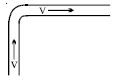
A fire hydrant delivers water of density $\rho$ at a volume rate $L$. The water travels vertically upward through the hydrant and then does $90^o $ turn to emerge horizontally at speed $V$. The pipe and nozzle have uniform crosssection throughout. The force exerted by the water on the corner of the hydrant is
Diffcult
Download our app for free and get started
Change in momentum in vertical direction in time $\mathrm{t}=$ momentum final$-$momentum
initial in vertical direction $=-\rho L V t$
Change in momentum in horizontal direction in time $\mathrm{t}=$ momentum final$-$momentum
initial in horizontal direction $=\rho L V t$
So net change in momentum in time $\mathrm{t}=\sqrt{(\rho L V t)^{2}+(\rho L V t)^{2}}=\sqrt{2} \rho L V t$
Force $=$ Change in momentum per time $=\sqrt{2} \rho L V$

Download our appand get started for free
Experience the future of education. Simply download our apps or reach out to us for more information. Let's shape the future of learning together!No signup needed.*
Similar Questions
- 1What is the pressure in $atm$ on a swimmer $10\; m$ below the surface of a lake?View Solution
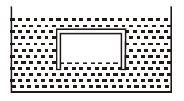
- 2View SolutionAn empty glass jar is submerged in tank of water with open mouth of the jar downwards, so that air inside the jar is trapped and cannot get out. As the jar is pushed down slowly, the magnitude of net buoyant force on the system of volume of gas trapped in the jar and the jar
- 3Two water pipes of diameters $ 2 cm $ and $4 cm $ are connected with the main supply line. The velocity of flow of water in the pipe of $ 2 cm$ diameter isView Solution
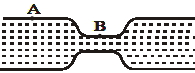
- 4Water flows in a horizontal tube (see figure). The pressure of water changes by $700\; \mathrm{Nm}^{-2}$ between $\mathrm{A}$ and $\mathrm{B}$ where the area of cross section are $40\; \mathrm{cm}^{2}$ and $20\; \mathrm{cm}^{2},$ respectively. Find the rate of flow of water through the tube. ........ $\mathrm{cm}^{3} / \mathrm{s}$View Solution
(density of water $=1000\; \mathrm{kgm}^{-3}$ )
- 5View SolutionAn open cubical tank was initially fully filled with water. When the tank was accelerated on a horizontal plane along one of its side it was found that one third of volume of water spilled out. The acceleration was
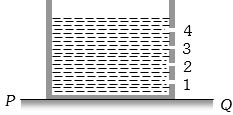
- 6A cylindrical vessel of $90 cm$ height is kept filled upto the brim. It has four holes $ 1, 2, 3, 4$ which are respectively at heights of $20 cm, 30 cm, 45 cm $ and $50 cm$ from the horizontal floor $PQ.$ The water falling at the maximum horizontal distance from the vessel comes fromView Solution
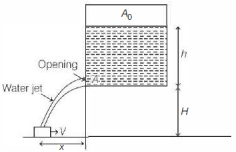
- 7Consider the configuration of a stationary water tank of cross-section area $A_{0}$ and a small bucket as shown in figure below; the speed $v$ is .......... $m/s$ of the bucket, so that the water leaking out of a hole of cross-section area $A$ (as shown) from the water tank does not fall outside the bucket? (Take, $h=5 \,m , H=5 \,m , g=10 \,m / s ^{2}, A=5 \,cm ^{2}$ and $\left.A_{0}=500 \,cm ^{2}\right)$.View Solution
- 8The graph between terminal velocity (along $y-axis$ ) and square of radius (along $x-axis$ ) of spherical body of density $\rho $ allowed to fall through a fluid of density $\rho $ is $a$View Solution
- 9View SolutionA viscous fluid is flowing through a cylindrical tube. The velocity distribution of the fluid is best represented by the diagram
- 10A rectangular vessel when full of water takes $10 $ minutes to be emptied through an orifice in its bottom. ......... $\min$ will it take to be emptied when half filled with waterView Solution