Question
(a) For circuits used for transporting electric power, a low power factor implies large power loss in transmission. Explain.
(b) Power factor can often be improved by the use of a capacitor of appropriate capacitance in the circuit. Explain.
Answer

(a) We know that $P=I V \cos \phi$ where $\cos \phi$ is the power factor. To supply a given power at a given voltage, if $\cos \phi$ is small, we have to increase current accordingly. But this will lead to large power loss $\left(I^2 R\right)$ in transmission.
(b)Suppose in a circuit, current $I$ lags the voltage by an angle $\phi$. Then power factor $\cos \phi=R / Z$.
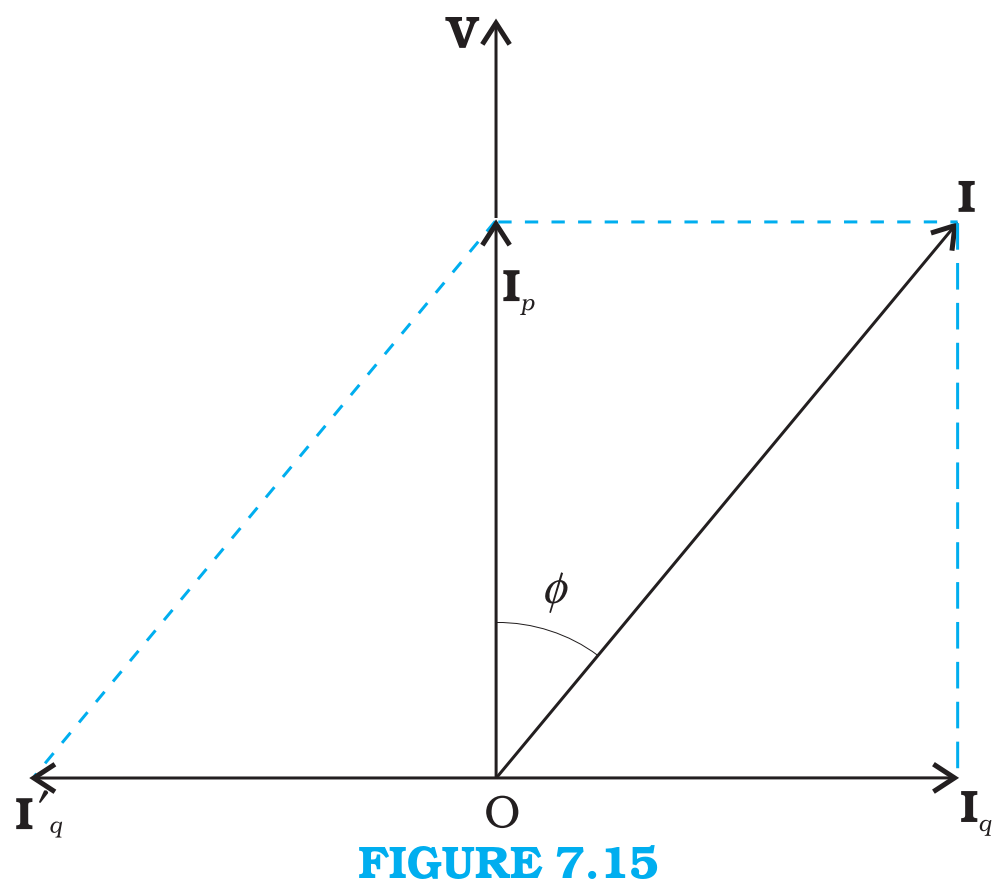
We can improve the power factor (tending to 1) by making $Z$ tend to $R$. Let us understand, with the help of a phasor diagram (Fig. 7.15)
Image
how this can be achieved. Let us resolve $I$ into two components. $I _p$ along the applied voltage $V$ and $I _q$ perpendicular to the applied voltage. $I _q$ as you have learnt in Section 7.7, is called the wattless component since corresponding to this component of current, there is no power loss. $I _{ p }$ is known as the power component because it is in phase with the voltage and corresponds to power loss in the circuit. It's clear from this analysis that if we want to improve power factor, we must completely neutralize the lagging wattless current $I _{ q }$ by an equal leading wattless current $I _q^{\prime}$. This can be done by connecting a capacitor of appropriate value in parallel so that $I _{ q }$ and $I _{ q }^{\prime}$ cancel each other and $P$ is effectively $I_{ p } V$.

Need a full question paper?

Generate a complete, print-ready paper with questions like this in minutes — across 16+ boards, with answer keys.

Start Generating Free

Similar questions

Three bulbs, each with a resistance of $180\Omega,$ are connected in parallel to an ideal battery of emf 60V. Find the current delivered by the battery when.
(a) all the bulbs are switched on, (b) two of the bulbs are switched on and (c) only one bulb is switched on.
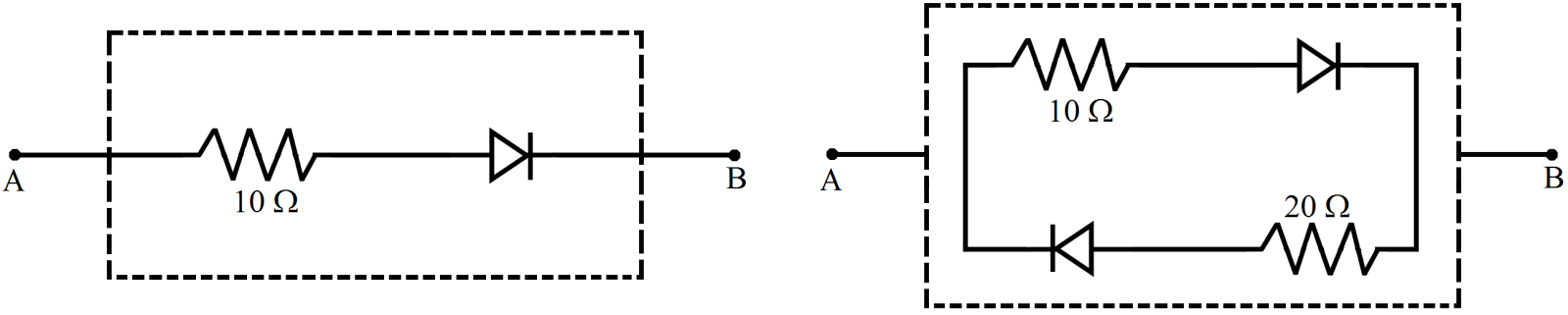
Draw the current-voltage characteristics for the device shown in figure. between the terminals A and B.
Electrons give up energy at the rate of $RI^2$ per second to the thermal energy. What time scale would one associate with energy in problem (a)? n = no of electron/volume $= 10^{29}/m^3,$ length of circuit = 10cm, cross-section $= A = (1mm)^2.$
It is now believed that protons and neutrons (which constitute nuclei of ordinary matter) are themselves built out of more elementary units called quarks. A proton and a neutron consist of three quarks each. Two types of quarks, the so called ‘up’ quark (denoted by u) of charge + (2/3) e, and the ‘down’ quark (denoted by d) of charge (–1/3) e, together with electrons build up ordinary matter. (Quarks of other types have also been found which give rise to different unusual varieties of matter.) Suggest a possible quark composition of a proton and neutron.
A point object is placed at a distance of 15cm from a convex lens. The image is formed on the other side at a distance of 30cm from the lens. When a concave lens is placed in contact with the convex lens, the image shifts away further by 30cm. Calculate the focal lengths of the two lenses.
Find out magnetic force on parallel current carrying conductors and also state their special conditions.
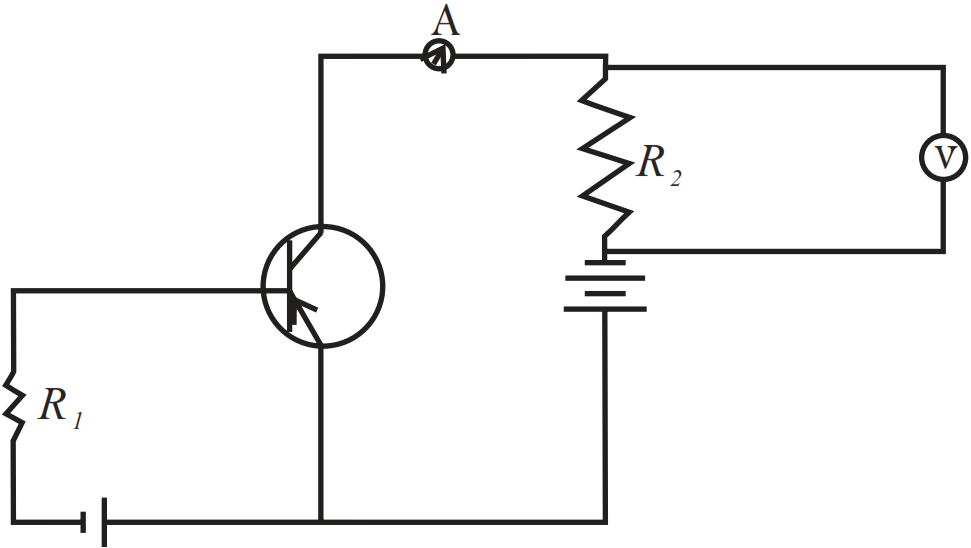
If the resistance $R_1$ is increased (Fig.), how will the readings of the ammeter and voltmeter change?
A parallel-plate capacitor of plate area A and plate separation d is charged to a potential difference V and then the battery is disconnected. A slab of dielectric constant K is then inserted between the plates of the capacitor so as to fill the space between the plates. Find the work done on the system in the process of inserting the slab.
  1. Show that the normal component of electrostatic field has a discontinuity from one side of a charged surface to another given by
$(\text{E}_2-\text{E}_1).\hat{\text{n}}=\frac{\sigma}{\in_0}$

where $\hat{\text{n}}$ is a unit vector normal to the surface at a point and σ is the surface charge density at that point. (The direction of $\hat{\text{n}}$ is from side 1 to side 2.) Hence show that just outside a conductor, the electric field is σ $\hat{\text{n}} /ε_0.$
  1. Show that the tangential component of electrostatic field is continuous from one side of a charged surface to another.
[Hint: For (a), use Gauss’s law. For, (b) use the fact that work done by electrostatic field on a closed loop is zero.]
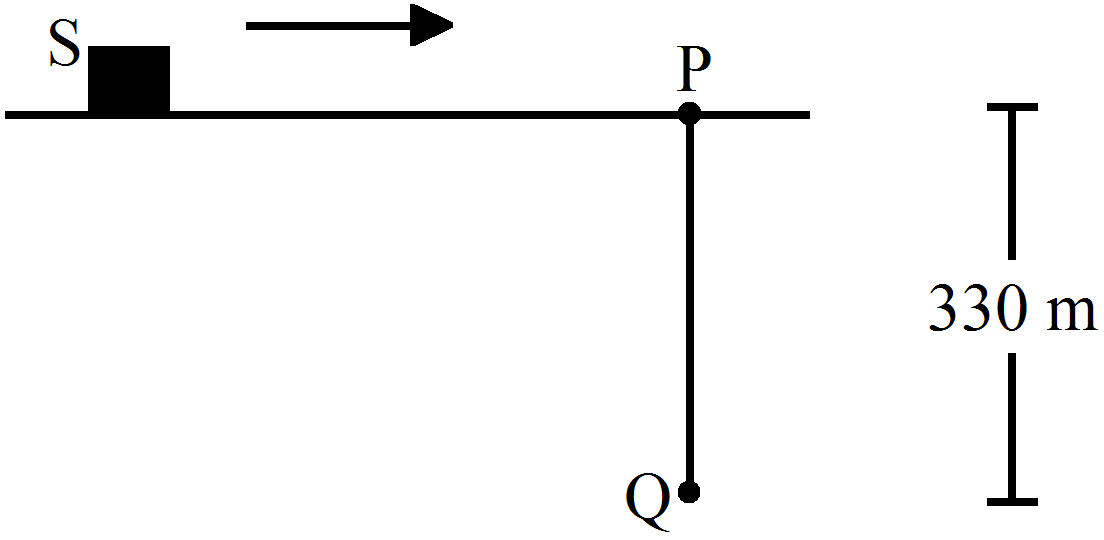
Figure, shows a source of sound moving along the X-axis at a speed of 22m/s continuously emitting a sound of frequency 2.0kHz which travels s in air at a speed of 330m/s. A listener Q stands on the Y-axis at a distance of 330 m from the origin. At t = 0, the source crosses the origin P.
  1. When does the sound emitted from the source at P reach the listener Q?
  2. What will be the frequency heard by the listener at this instant?
  3. Where will the source be at this instant?