Question
Find out magnetic force on parallel current carrying conductors and also state their special conditions.

Answer

SELF

Need a full question paper?

Generate a complete, print-ready paper with questions like this in minutes — across 16+ boards, with answer keys.

Start Generating Free

Similar questions

A paperweight in the form of a hemisphere of radius 3.0cm is used to hold down a printed page. An observer looks at the page vertically through the paperweight. At what height above the page will the printed letters near the centre appear to the observer?
Figure. shows two vessels A and B with rigid walls containing ideal gases. The pressure, temperature and the volume are $p_A, T_A, V$ in the vessel A and $p_B, T_B, V$ in the vessel B. The vessels are now connected through a small tube. Show that the pressure p and the temperature T satisfy $\frac{\text{p}}{\text{T}}=\frac{1}{2}\Big(\frac{\text{P}_\text{A}}{\text{T}_\text{A}}+\frac{\text{p}_\text{B}}{\text{T}_\text{B}}\Big)$ when equilibrium is achieved.
A monoenergetic (18 keV) electron beam initially in the horizontal direction is subjected to a horizontal magnetic field of 0.04 G normal to the initial direction. Estimate the up or down deflection of the beam over a distance of 30 cm $(m_e = 9.11 \times 10^{–19} C).$
[Note: Data in this exercise are so chosen that the answer will give you an idea of the effect of earth’s magnetic field on the motion of the electron beam from the electron gun to the screen in a TV set.]
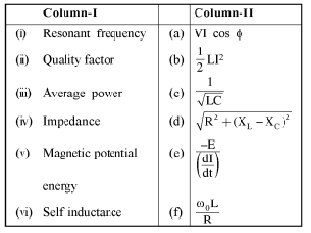
Match the following
Image
An electron is projected horizontally with a kinetic energy of 10keV. A magnetic field of strength $1.0 \times 10^{-7}T$ exists in the vertically upward direction.
  1. Will the electron deflect towards the right or left of its motion?
  2. Calculate the sideways deflection of the electron while travelling through 1m. Make appropriate approximations.
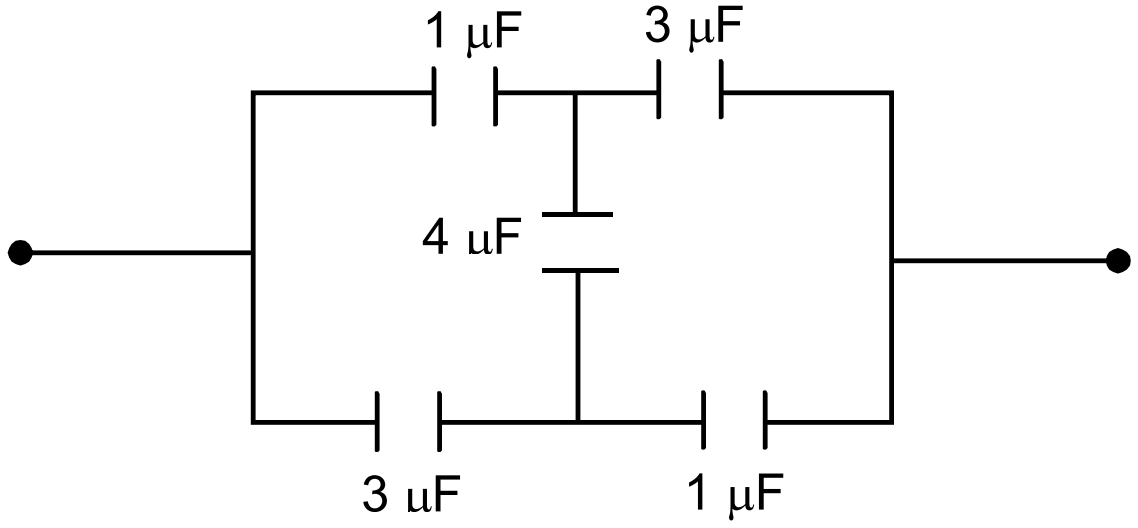
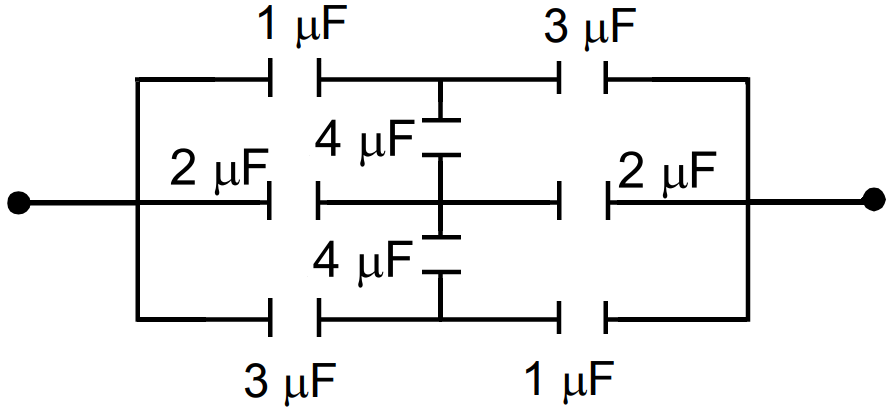
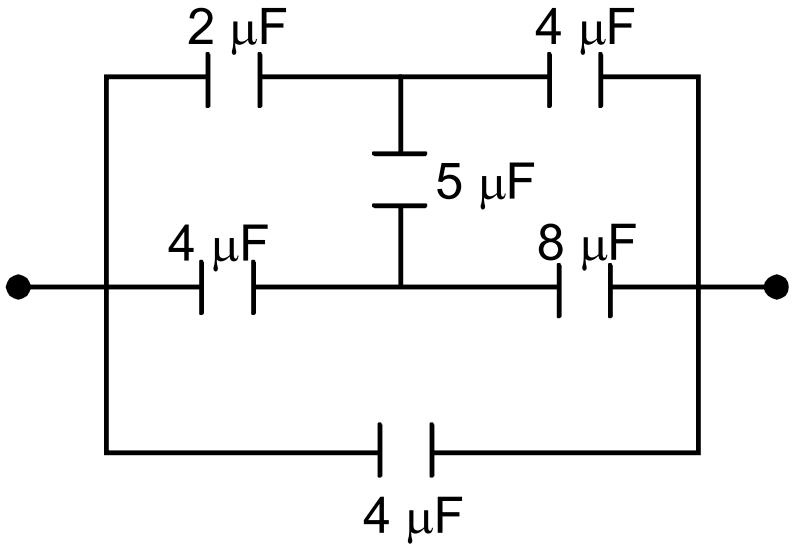
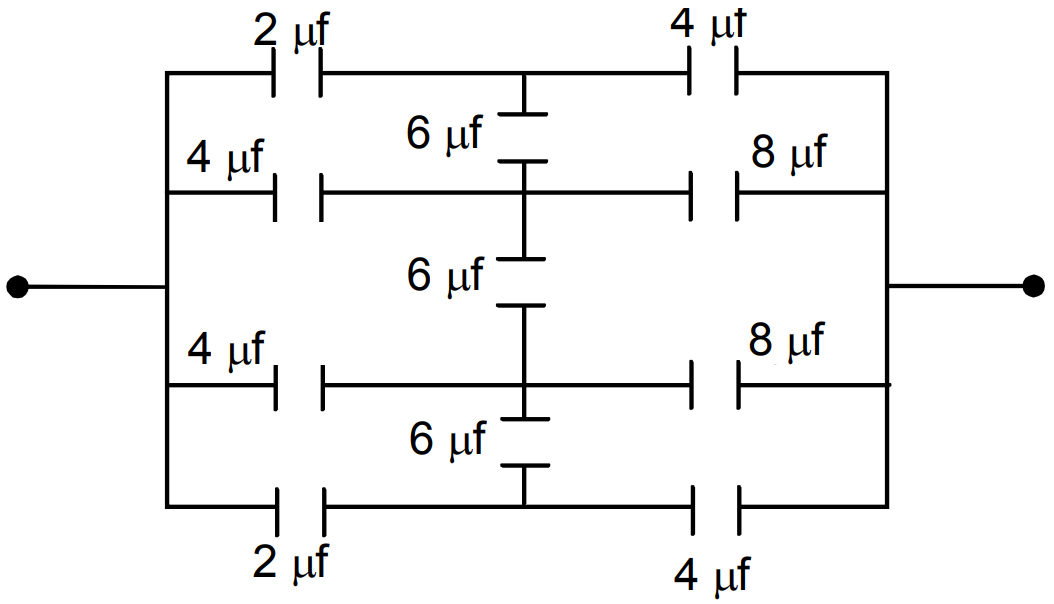
Find the equivalent capacitances of the combinations shown in figure between the indicated points.


A long cylindrical wire carries a positive charge of linear density $2.0 \times 10^{-8}Cm^{-1}.$ An electron revolves around it in a circular path under the influence of the attractive electrostatic force. Find the kinetic energy of the electron. Note that it is independent of the radius.
A car moving at a speed of 36 km/hr is taking a turn on a circular road of radius 50m. A small wooden plate is kept on the seat with its plane perpendicular to the radius of the circular road (figure In). A small block of mass 100g is kept on the seat which rests against the plate. The friction coefficient between the block and the plate is $\mu=0.58.$
  1. Find the normal contact force exerted by the plate on the block.
  2. The plate is slowly turned so that the angle between the normal to the plate and the radius of the road slowly increases. Find the angle at which the block will just start sliding on the plate.
Figure shows a heavy block kept on a frictionless surface and being pulled by two ropes of equal mass $m$. At $t = 0,$ the force on the left rope is withdrawn but the force on the right end continues to act. Let $F_1$ and $F_2$ be the magnitudes of the forces by the right rope and the left rope on the block respectively:
Three capacitors having capacitances $20\mu\text{F},\ 30\mu\text{F}$ and $40\mu\text{F}$ are connected in series with a 12V battery. Find the charge on each of the capacitors. How much work has been done by the battery in charging the capacitors?