- A$\frac{3}{2}{\text{I}}\,{\text{u}}$
- ✓$\frac{1}{2}{\text{I}}\,{\text{u}}$
- C$I \,u$
- D$2\, I\, u$
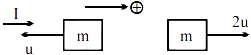
$\mathrm{I}=2 \mathrm{mu}-(-\mathrm{mu})$
$\mathrm{I}=3 \mathrm{mu} \ldots(\mathrm{i})$
According to work energy theorem
$\mathrm{W}=\Delta \mathrm{T}$
$\mathrm{W}=\mathrm{T}_{\mathrm{f}}-\mathrm{T}_{\mathrm{i}}$
$\mathrm{W}=\frac{1}{2} \mathrm{m}(2 \mathrm{u})^{2}-\frac{1}{2} \mathrm{m}(-\mathrm{u})^{2}$
$\mathrm{W}=\frac{1}{2} \mathrm{m}\left(4 \mathrm{u}^{2}\right)-\frac{1}{2} \mathrm{mu}^{2}$
$\mathrm{w}=\frac{3 \mathrm{mu}^{2}}{2}$ $...(ii)$
From equation $(i)$ and $(ii)$
$\mathrm{W}=\frac{1}{2} \mathrm{Iu}$
Generate a complete, print-ready paper with questions like this in minutes — across 16+ boards, with answer keys.
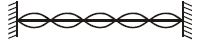
The total number of nodes and antinodes are respectively

If the mass of the ball is $0.15 \;kg$, determine the impulse (in $N\;s$) imparted to the ball. (Assume linear motion of the ball)