A force of $750 \,N$ is applied to a block of mass $102\, kg$ to prevent it from sliding on a plane with an inclination angle $30°$ with the horizontal. If the coefficients of static friction and kinetic friction between the block and the plane are $0.4 $ and $0.3$ respectively, then the frictional force acting on the block is...... $N$
Medium
Download our app for free and get started
(d) Net force along the plane = $P - mg\sin \theta $= $750 - 500$= $250\;N$
Limiting friction = ${F_l} = {\mu _s}R = {\mu _s}mg\cos \theta $
$= 0.4 × 102 × 9.8 × cos\,30 = 346\, N$
As net external force is less than limiting friction therefore friction on the body will be $250 N.$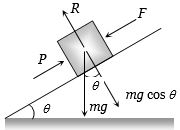

Download our appand get started for free
Experience the future of education. Simply download our apps or reach out to us for more information. Let's shape the future of learning together!No signup needed.*
Similar Questions
- 1A box is lying on an inclined plane what is the coefficient of static friction if the box starts sliding when an angle of inclination is $60^o $View Solution
- 2A block starts moving up an inclined plane of inclination $30^{\circ}$ with an initial velocity of $v_{0}$. It comes back to its initial position with velocity $\frac{v_{0}}{2} .$ The value of the coefficient of kinetic friction between the block and the inclined plane is close to $\frac{ I }{1000},$ The nearest integer to $I$ is......View Solution
- 3View SolutionA football player is moving southward and suddenly turns eastward with the same speed to avoid an opponent. The force that acts on the player while turning is :
- 4View SolutionWhich of the following statements is not true
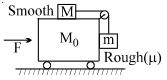
- 5Imagine $a$ situation in which the horizontal surface of block $M_0$ is smooth and its vertical surface is rough with $a$ coefficient of friction $\mu$ Identify the correct statement $(s)$View Solution
- 6View SolutionA stone tied to a string is rotated in a circle. If the string is cut, the stone flies away from the circle because
- 7When a body slides down from rest along a smooth inclined plane making an angle of $30^{\circ}$ with the horizontal, it takes time $T$. When the same body slides down from the rest along a rough inclined plane making the same angle and through the same distance, it takes time $\alpha {T}$, where $\alpha$ is a constant greater than $1 .$ The co-efficient of friction between the body and the rough plane is $\frac{1}{\sqrt{{x}}}\left(\frac{\alpha^{2}-1}{\alpha^{2}}\right)$ where ${x}=..... .$View Solution
- 8A particle of mass $m$ is executing uniform circular motion on a path of radius $r$. If $p$ is the magnitude of its linear momentum. The radial force acting on the particle isView Solution
- 9View SolutionA cube is resting on an inclined plane. What must be the value of coefficient of friction between cube and plane so that cube topples before sliding
- 10A plank is resting on a horizontal ground in the northern hemisphere of the earth at a $45^{\circ}$ latitude. Let the angular speed of the earth be $\omega$ and its radius $r_e$. The magnitude of the frictional force on the plank will beView Solution