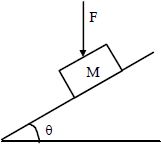
A box is lying on an inclined plane what is the coefficient of static friction if the box starts sliding when an angle of inclination is $60^o $
Easy


Download our appand get started for free
Experience the future of education. Simply download our apps or reach out to us for more information. Let's shape the future of learning together!No signup needed.*
Similar Questions
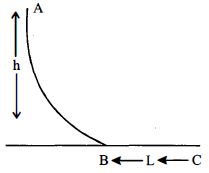
- 1A small ball of mass $m$ starts at a point $A$ with speed $v_0$ and moves along a frictionless track $AB$ as shown. The track $BC$ has coefficient of friction $\mu $. The ball comes to stop at $C$ after travelling a distance $L$ which isView Solution
- 2A block of mass $5\,kg$ is placed at rest on a table of rough surface. Now, if a force of $30\,N$ is applied in the direction parallel to surface of the table, the block slides through a distance of $50\,m$ in an interval of time $10\,s$. Coefficient of kinetic friction is (given, $g =10\,ms ^{-2}$)View Solution
- 3A block of mass $M$ is sliding down the plane. Coefficient of static friction is $\mu _s$ and kinetic friction is $\mu _k.$ Then friction force acting on the block is :-View Solution
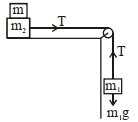
- 4Two masses $m_1 = 5\ kg$ and $m_2 = 10\ kg$, connected by an inextensible string over a frictionless pulley, are moving as shown in the figure. The coefficient of friction of horizontal surface is $0.15$. The minimum weight $m$ that should be put on top of $m_2$ to stop the motion is $...... kg$View Solution
- 5If a block moving up an inclined plane at $30^{\circ}$ with a velocity of $5 \,m / s$, stops after $0.5 s$, then coefficient of friction will be nearlyView Solution
- 6A block slides down an inclined plane of slope of angle $\theta $ with a constant velocity. It is then projected up the plane with an initial velocity $u$. The distance upto which it will rise before coming to rest isView Solution
- 7A $1.0 kg$ block of wood sits on top of an identical block of wood, which sits on top of a flat level table made of plastic. The coefficient of static friction between the wood surfaces is $\mu_1$, and the coefficient of static friction between the wood and plastic is $\mu_2$. Ahorizontal force $F$ is applied to the top block only, and this force is increased until the top block starts to move. The bottom block will move with the top block if and only ifView Solution
- 8A particle is moving along the circle $x^2 + y^2 = a^2$ in anti clock wise direction. The $x-y$ plane is a rough horizontal stationary surface. At the point $(a\, cos\theta , a\, sin\theta )$, the unit vector in the direction of friction on the particle is:View Solution
- 9A block of mass $10\, kg$ moving at $10\,m/s$ is released to slide on rough surface having coefficient of friction $0.2.$ It will stop by travelling distance ........ $m$View Solution
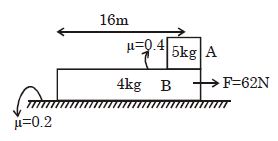
- 10Initially the whole system is at rest and now a force of $62\ N$ is applied on the block $B$ as shown in the figure. Find the time taken by $'A'$ to fall from the block $'B'$ ........... $\sec$View Solution