A galvanometer coil of resistance $50 \,\Omega$, show full deflection of $100\,\mu A$. The shunt resistance to be added to the galvanometer, to work as an ammeter of range $10\, mA$ is
Medium
Download our app for free and get started
(d) $S = \left( {\frac{{{i_g}}}{{i - {i_g}}}} \right)\, \times G$$ = \frac{{100 \times {{10}^{ - 6}}}}{{(10 \times {{10}^{ - 3}} - 100 \times {{10}^{ - 6}})}} \times 50 \times 0.5\,\Omega $ (in parallel)

Download our appand get started for free
Experience the future of education. Simply download our apps or reach out to us for more information. Let's shape the future of learning together!No signup needed.*
Similar Questions
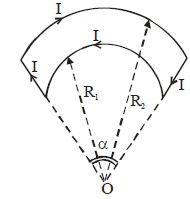
- 1The magnetic induction at the centre $O$ of the current carrying bent wire shown in the adjoining figure isView Solution
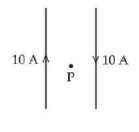
- 2Two long, straight wires carry equal currents in opposite directions as shown in figure. The separation between the wires is $5.0 \mathrm{~cm}$. The magnitude of the magnetic field at a point $P$ midway between the wires is __________$\mu \mathrm{T}$ (Given : $\mu_0=4 \pi \times 10^{-7} \mathrm{TmA}^{-1}$ )View Solution
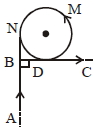
- 3A very long wire $ABDMNDC$ is shown in figure carrying current $I. AB$ and $BC$ parts are straight, long and at right angle. At $D$ wire forms a circular turn $DMND$ of radius $R. AB.$ $\mathrm{BC}$ parts are tangential to circular turn at $\mathrm{N}$ and $D$. Magnetic field at the centre of circle isView Solution
- 4A steel wire has a magnetic moment $M.$ What will be its magnetic moment if it is bent into a semi-circular arc ?View Solution
- 5Choose the correct sketch of the magnetic field lines of a circular current loop shown by the dot $ \odot $ and the cross $\otimes .$View Solution
- 6Two identical moving coil galvanometer have $10 \Omega$ resistance and full scale deflection at $2 \mu A$ current. One of them is converted into a voltmeter of $100 mV$ full scale reading and the other into an Ammeter of $1 mA$ full scale current using appropriate resistors. These are then used to measure the voltage and current in the Ohm's law experiment with $R =1000 \Omega$ resistor by using an ideal cell. Which of the following statement( $s$ ) is/are correct?View Solution
$(1)$ The measured value of $R$ will be $978 \Omega$
$(2)$ The resistance of the Voltmeter will be $100 k \Omega$.
$(3)$ The resistance of the Ammeter will be $0.02 \Omega$ (round off to $2^{\text {nd }}$ decimal place)
$(4)$ If the ideal cell is replaced by a cell having internal resistance of $5 \Omega$ then the measured value of $R$ will be more than $1000 \Omega$.
- 7View SolutionAssertion : A charge, whether stationary or in motion produces a magnetic field around it.
Reason : Moving charges produce only electric field in the surrounding space.
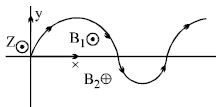
- 8At $t = 0$ a charge $q$ is at the origin and moving in the $y-$ direction with velocity $\overrightarrow v = v\,\hat j .$ The charge moves in a magnetic field that is for $y > 0$ out of page and given by $B_1 \hat z$ and for $y < 0$ into the page and given $-B_2 \hat z .$ The charge's subsequent trajectory is shown in the sketch. From this information, we can deduce thatView Solution
- 9View SolutionA particle moving in a magnetic field increases its velocity, then its radius of the circle
- 10The maximum current that can be measured by a galvanometer of resistance $40 \,\Omega$ is $10\, mA$. It is converted into a voltmeter that can read upto $50\, V$. The resistance to be connected in series with the galvanometer is ... (in $ohm$)View Solution