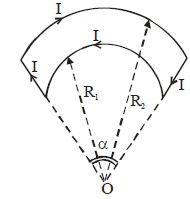
The magnetic induction at the centre $O$ of the current carrying bent wire shown in the adjoining figure is
Medium


Download our appand get started for free
Experience the future of education. Simply download our apps or reach out to us for more information. Let's shape the future of learning together!No signup needed.*
Similar Questions
- 1A galvanometer of resistance $50\, \Omega$ is connected to a battery of $3\, V$ along with a resistance of $2950\, \Omega$ in series. A full scale deflection of $30$ divisions is obtained in the galvanometer. In order to reduce this deflection to $20$ divisions, the resistance in series should be.......$Ω$View Solution
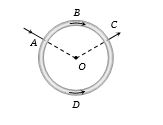
- 2A uniform wire is bent in the form of a circle of radius $R$. A current $I$ enters at $A$ and leaves at $C$ as shown in the figure :If the length $ABC$ is half of the length $ADC,$ the magnetic field at the centre $O$ will beView Solution
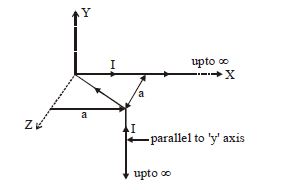
- 3View SolutionThe magnetic field at the origin due to the current flowing in the wire is
- 4A current $i$ is flowing in a conductor of length $l$. When it is bent in the form of a circular loop then its magnetic moment will be-View Solution
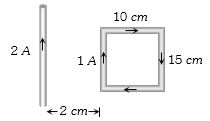
- 5View SolutionWhat is the net force on the square coil
- 6The magnetic moment of an electron $(e)$ revolving in an orbit around nucleus with an orbital angular momentum is given by :View Solution
- 7A helium nucleus makes a full rotation in a circle of radius $0.8$ metre in two seconds. The value of the magnetic field $B$ at the centre of the circle will beView Solution
- 8Two long parallel wires are at a distance of $1$ metre. Both of them carry one ampere of current. The force of attraction per unit length between the two wires isView Solution
- 9An alternating electric field, of frequency $f$, is applied across the dees $(\, radius \,\approx\, R)$ of a cyclotron that is being used to accelerate protons $(\,mass \,\approx \, m).$ The operating magnetic field $(B)$ used in the cyclotron and the kinetic energy $(K)$ of the proton beam, produced by it, are given byView Solution
- 10A particle having the same charge as of electron moves in a circular path of radius $0.5View Solution
\,cm$ under the influence of a magnetic field of $0.5\,T.$ If an electric field of $100\,V/m$ makes it to move in a straight path, then the mass of the particle is (given charge of electron $= 1.6 \times 10^{-19}\, C$ )