A galvanometer having a coil resistance of $100\ \Omega$. gives a full scale deflection, when a currect of $I\ mA$ is passed through it. The value of the resistance, which can convert this galvanometer into ammeter giving a full scale deflection for a current of $10\ A$, is :......$Ω$
JEE MAIN 2016, Medium
Download our app for free and get started
$\lg \mathrm{G}=(\mathrm{I}-\mathrm{Ig}) \mathrm{s}$
$\therefore 10^{-3} \times 100=\left(10-10^{-3}\right) \times \mathrm{S}$
$\therefore \mathrm{S} \approx 0.01 \,\Omega$

Download our appand get started for free
Experience the future of education. Simply download our apps or reach out to us for more information. Let's shape the future of learning together!No signup needed.*
Similar Questions
- 1The magnetic field is uniform for $y>0$ and points into the plane. The magnetic field is uniform and points out of the plane for $y<0$. A proton denoted by filled circle leaves $y=0$ in the $-y$-direction with some speed as shown below.Which of the following best denotes the trajectory of the proton?View Solution

- 2If the angular momentum of an electron is $\overrightarrow {J\,} $ then the magnitude of the magnetic moment will beView Solution
- 3If a wire of length $1\, meter$ placed in uniform magnetic field $1.5\, Tesla$ at angle ${30^o}$ with magnetic field. The current in a wire $10\, amp$. Then force on a wire will be.......$N$View Solution
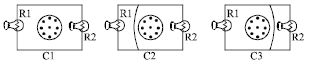
- 4A solenoid is oriented end-on so that its opening is perpendicular to the circuit containing the two light bulbs as drawn in figure $C_1.$ For figure $C_2$ and $C_3,$ a shorting wire of negligible resistance is added as shown. Assume that the magnetic field from the solenoid, shown coming out of the plane of the page, decreases uniformly with time at the same rate for each circuit. Rank the circuits for the brightness of the bulb labeled $R_1$ from brightest to dimmest.View Solution
- 5View SolutionThe magnetic field near a current carrying conductor is given by
- 6If an electron revolves around a nucleus in a circular orbit of radius $R$ with frequency $n$, then the magnetic field produced at the centre of the nucleus will beView Solution
- 7View SolutionA charged particle moves in a uniform magnetic field. The velocity of the particle at some instant makes an acute angle with the magnetic field. The path of the particle will be
- 8The magnetic moment of a current $(i)$ carrying circular coil of radius $(r)$ and number of turns $(n)$ varies asView Solution
- 9Two long straight wires are placed along $x$-axis and $y$-axis. They carry current $I_1$ and $I_2$ respectively. The equation of locus of zero magnetic induction in the magnetic field produced by them isView Solution
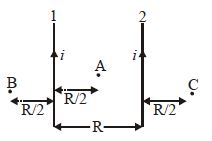
- 10Two long parallel wires are at a distance $R$ apart. They carry steady equal currents in the same directions as shown in the figure. The ratio of magnetic fields at $A, B$ and $C$ respectively, isView Solution