A particle of charge $q$ and mass $m$ starts moving from the origin under the action of an electric field $\vec E = {E_0}\hat i$ and $\vec B = {B_0}\hat i$ with velocity ${\rm{\vec v}} = {{\rm{v}}_0}\hat j$. The speed of the particle will become $2v_0$ after a time
Advanced
Download our app for free and get started
$\vec{E}=E_{0} i \| \vec{B}=B_{0} \hat{i}$
$\vec{v}=v_{0} \hat{j} \perp \vec{E}$
$\vec{v} \perp \vec{B}$
Hence, the path of the particle is a helix with speed remaining constant for the circular path in the $y z$ plane.
Magnitude of velocity of particle at any time $t: v=\sqrt{v_{x}^{2}+v_{y}^{2}+v_{z}^{2}}=\sqrt{\left(a_{x} t\right)^{2}+v_{0}^{2}}$
where $v_{y}^{2}+v_{z}^{2}=v_{0}^{2}$
Given $v=2 v_{0}$
$\Rightarrow\left(2 v_{0}\right)^{2}=v_{x}^{2}+v_{0}^{2}$
$\Rightarrow\left(v_{x}\right)^{2}=3\left(v_{0}\right)^{2}$
$\Rightarrow v_{x}=\sqrt{3} v_{0}$
$\Rightarrow a_{x} t=\sqrt{3} v_{0}$
$\Rightarrow\left(\frac{q E}{m}\right) t=\sqrt{3} v_{0}$
$\Rightarrow t=\frac{\sqrt{3} v_{0} m}{q E}$

Download our appand get started for free
Experience the future of education. Simply download our apps or reach out to us for more information. Let's shape the future of learning together!No signup needed.*
Similar Questions
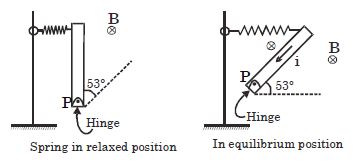
- 1A thin uniform rod with negligible mass and length $l$ is attached to the floor by a frictionless hinge at point $P$ . A horizontal spring with force constant $k$ connects the other end to wall. The rod is in a uniform magnetic field $B$ directed into the plane of paper. What is extension in spring in equilibrium when a current $i$ is passed through the rod in direction shown. Assuming spring to be in natural length initially.View Solution
- 2Consider two identical galvanometers and two identical resistors with resistance $R$. If the internal resistance of the galvanometers $R_{ C } < R / 2$View Solution
($A$) The maximum voltage range is obtained when all the components are connected in series
($B$) The maximum voltage range is obtained when the two resistors and one galvanometer are connected in series, and the second galvanometer is connected in parallel to the first galvanometer
($C$) The maximum current range is obtained when all the components are connected in parallel
($D$) The maximum current range is obtained when the two galvanometers are connected in series and the combination is connected in parallel with both the resistors
- 3The magnetic field on the axis of a circular loop of radius $100\,cm$ carrying current $I=\sqrt{2}\,A$, at point $1\,m$ away from the centre of the loop is given byView Solution
- 4A charged particle initially at rest at $O$,when released follows a trajectory as shown alongside. Such a trajectory is possible in the presence ofView Solution

- 5A circular coil has moment of inertia $0.8 \,kg m ^{2}$ around any diameter and is carrying current to roduce a magnetic moment of $20\, Am ^{2}$. The coil is kept initially in a vertical position and it can rotate freely around a horizontal diameter. When a uniform magnetic field of $4\, T$ is applied along the vertical, it starts rotating around its horizontal diameter. The angular speed the coil acquires after rotating by $60^{\circ}$ will beView Solution
- 6A particle of charge $q$ and mass $m$ is moving along the $x$ -axis with a velocity $v$ and enters a region of electric field $E$ and magnetic field $B$ as shown in figure below for which figure the net force on the charge may be zeroView Solution
- 7View SolutionWhich of the following statement is wrong
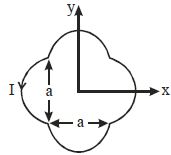
- 8A loop in form of four connected semi-circular wires carrying current $I$ lies in the $x-y$ plane as shown in the figure. The unit vector $\hat k$ is coming out of the plane of the paper. The magnetic moment of the current loop isView Solution
- 9A proton, an electron, and a Helium nucleus, have the same energy. They are in circular orbitals in a plane due to magnetic field perpendicular to the plane. Let $r_p, r_e$ and $r_{He}$ be their respective radii, thenView Solution
- 10A cell of emf $90\,V$ is connected across series combination of two resistors each of $100\,\Omega$ resistance. A voltmeter of resistance $400\,\Omega$ is used to measure the potential difference across each resistor. The reading of the voltmeter will be $.........\,V$View Solution