Question
A mass attached to a spring is free to oscillate, with angular velocity $\omega,$ in a horizontal plane without friction or damping. It is pulled to a distance x0 and pushed towards the centre with a velocity $\upsilon_0$ at time t = 0. Determine the amplitude of the resulting oscillations in terms of the parameters $\omega,$ x0 and $\upsilon_0.$ [Hint: Start with the equation $\text{x}=\text{a}\cos(\omega\text{t}+\theta)$ and note that the initial velocity is negative.]
Answer

The displacement rquation for an oscillating mass is given by:

$\text{x}=\text{A}\cos(\omega\text{t}+\theta)$

where,

A is the amplitude

x is the displacement

$\theta$ is the phase constant

Velcoity, $\text{v}=\frac{\text{dx}}{\text{dt}}=-\text{A}\omega\sin(\omega\text{t}+\theta)$

At, t = 0, x = x0

$\text{x}_0=\text{A}\cos\theta=\text{x}_0\ .....(\text{i})$

and, $\frac{\text{dx}}{\text{dt}}=-v_0=\text{A}\omega\sin\theta$

$\text{A}\sin\theta=\frac{v_0}{\omega}\ ....(\text{ii})$

Squaring and adding equations (i) and (ii), we get:

$\text{A}^2(\cos^2\theta+\sin^2\theta)=\text{x}_0^2+\Big(\frac{v_0^2}{\omega^2}\Big)$

$\therefore\ \text{A}=\sqrt{\text{x}_0^2+\Big(\frac{v_0}{\omega}\Big)^2}$

Hence, the amplitude of the resulting oscillation is $\text{x}_0^2+\Big(\frac{v_0}{\omega}\Big)^2.$

Need a full question paper?

Generate a complete, print-ready paper with questions like this in minutes — across 16+ boards, with answer keys.

Start Generating Free

Similar questions

An equilateral triangle ABC is formed by two Cu rods AB and BC and one Al rod. It is heated in such a way that temperature of each rod increases by $\Delta\text{T}$. Find change in the angle ABC. $[$Coeff. of linear expansion for 1 Cu is $\alpha_1$ Coeff. of linear expansion for 2Al is $\alpha_2]$
The transverse displacement of a string (clamped at its both ends) is given by
$
y(x, t)=0.06 \sin \left(\frac{2 \pi}{3} x\right) \cos (120 \pi t)
$
where $x$ and $y$ are in m and $t$ in s . The length of the string is $1 . 5 ~ m$ and its mass is $3 . 0 \times 1 0 ^{- 2 } ~ k g$.
Answer the following :
(a) Does the function represent a travelling wave or a stationary wave?
(b) Interpret the wave as a superposition of two waves travelling in opposite directions. What is the wavelength, frequency, and speed of each wave?
(c) Determine the tension in the string.
The displacement x (in cm) of an oscillating particle varies with time t (in seconds) according to the equation. $\text{x}=2\cos(0.5\pi\text{t}+\frac{\pi}{3})$ Find 
  1. Amplitude of oscillation.
  2. The time period of oscillation.
  3. The maximum velocity of the particle.
  4. The maximum acceleration of the particle.
A mass m is left free at a distance 3R from the surface of earth. On reaching the surface, what will be its velocity?
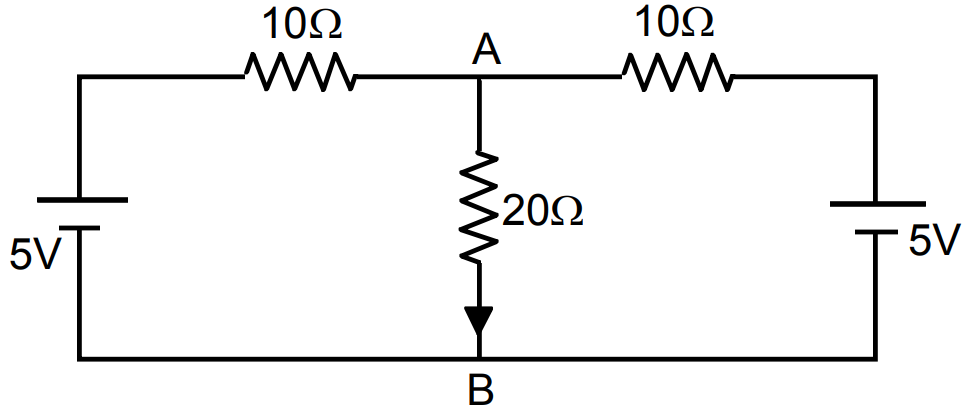
(a) Find the current in the $20\Omega$ resistor shown in the figure. (b) If a capacitor of capacitance $4\mu\text{F}$ is joined between the points A and B, what would be the electrostatic energy stored in it in steady state?

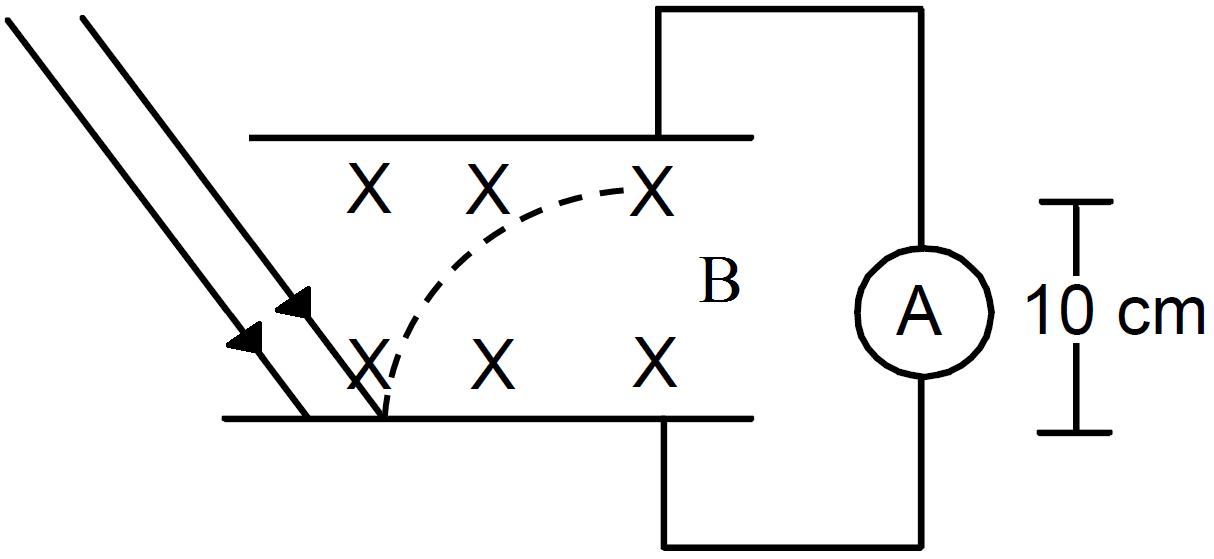
In an experiment on photoelectric effect, the emitter and the collector plates are placed et a separation of 10cm and are connected through en ammeter without any cell A magnetic field B exists parallel to the plates. The work function of the emitter is 2.39eV and the light incident on it has wavelengths between 400nm and 600nm. Find the minimum value of B for which the current registered by the ammeter is zero. Neglect any effect of space charge.

Let us take the position of mass when the spring is unstreched as $x=0$, and the direction from left to right as the positive direction of $x$-axis. Give $x$ as a function of time $t$ for the oscillating mass if at the moment we start the stopwatch $(t=0)$, the mass is
(a) at the mean position,
(b) at the maximum stretched position, and
(c) at the maximum compressed position
In what way do these functions for SHM differ from each other, in frequency, in amplitude or the intial phase?
A curved surface is shown in. The portion BCD is free of friction. There are three spherical balls of identical radii and masses. Balls are released from rest one by one from A which is at a slightly greater height than C.

With the surface AB, ball 1 has large enough friction to cause rolling down without slipping, ball 2 has a small friction and ball 3 has a negligible friction.

  1. For which balls is total mechanical energy conserved?
  2. Which ball (s) can reach D?
  3. For balls which do not reach D, which of the balls can reach back A?
A solid wire of radius 10cm carries a current 5.0A distributed uniformly over its cross-section. Find the magnetic field B at a point at a distance (a) 2cm (b) 10cm and (c) 20cm away from the axis. Sketch a graph of B versus x for 0 < x < 20cm.
Define moment of inertia of a body. Give its units and dimensions. What is the physical significance of moment of inertia?