A heated body maintained at $T\,K$ emits thermal radiation of total energy $E$ with a maximum intensity at frequency $v$ . The emissivity of the material is $0.5$ . If the temperature of the body be increased and maintained at temperature $3T\,K$ , then
$(i)$ The maximum intensity of the emitted radiation will occur at frequency $v /3$
$(ii)$ The maximum intensity of the emitted radiation will occur at frequency $3v $
$(iii)$ The total energy of emitted radiation will become $81\,E$
$(iv)$ The total energy of emitted radiation will become $27\,E$
Medium
Download our app for free and get started
The frequency at which maximum intensity of emission occurs is proportional to $T$ , while the rate of the emitted radiation is proportional to $T^4$

Download our appand get started for free
Experience the future of education. Simply download our apps or reach out to us for more information. Let's shape the future of learning together!No signup needed.*
Similar Questions
- 1View SolutionRelation between the colour and the temperature of a star is given by
- 2In Newton's experiment of cooling, the water equivalent of two similar calorimeters is $10 $ gm each. They are filled with $350 gm$ of water and $300 gm$ of a liquid (equal volumes) separately. The time taken by water and liquid to cool from ${70^o}C$ to ${60^o}C$ is $3$ min and $95$ sec respectively. The specific heat of the liquid will be ...... $Cal/gm\,^oC$View Solution
- 3A liquid cools from $50^oC$ to $45^oC$ in 5 minutes and from $45 ^o C$ to $41.5 ^o C$ in the next $5$ minutes. The temperature of the surrounding is ...... $^oC$View Solution
- 4Two spherical bodies $\mathrm{A}$ (radius $6 \mathrm{~cm}$ ) and $\mathrm{B}$ (radius $18 \mathrm{~cm}$ ) are at temperature $\mathrm{T}_1$ and $\mathrm{T}_2$, respectively. The maximum intensity in the emission spectrum of $\mathrm{A}$ is at $500 \mathrm{~nm}$ and in that of $\mathrm{B}$ is at $1500 \mathrm{~nm}$. Considering them to be black bodies, what will be the ratio of the rate of total energy radiated by $A$ to that of $B$ ?View Solution
- 5View SolutionThe wavelength of radiation emitted by a body depends upon
- 6Spheres $P$ and $Q$ are uniformly constructed from the same material which is a good conductor of heat and the radius of $Q$ is thrice the radius of $P$. The rate of fall of temperature of $P$ is $x$ times that of $Q$ when both are at the same surface temperature. The value of $x$ is :View Solution
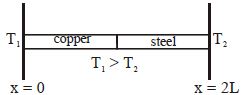
- 7A copper rod and a steel rod of equal cross-sections and lengths $(L)$ are joined side by side and connected between two heat baths as shown in the figureView Solution
If heat flows through them from $x = 0$ to $x = 2L$ at a steady rate and conductivities of the metals are $K_{cu}$ and $K_{steel}$ $(K_{cu} > K_{steel}),$ then the temperature varies as (convection and radiation are negligible)
- 8A black body at a temperature of $1640\,\,K$ has the wavelength corresponding to maximum emission equal to $1.75 \,\,\mu m.$ Assuming the moon to be a perfectly black body, the temperature of the moon, if the wavelength corresponding to maximum emission is $14.35\,\,\mu m$ is.......$K$View Solution
- 9Two spheres of the same material have radii $1\; m$ and $4\; m$ and temperatures $4000 \;K$ and $2000 \;K$ respectively. The ratio of the energy radiated per second by the first sphere to that by the second isView Solution
- 10The absolute temperatures of two black bodies are $2000 K$ and $3000 K$ respectively. The ratio of wavelengths corresponding to maximum emission of radiation by them will beView Solution