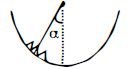
An insect crawls up a hemispherical surface very slowly. The coefficient of friction between the insect and the surface is $1/3$. If the line joining the centre of the hemispherical surface to the insect makes an angle $\alpha $ with the vertical, the maximum possible value of $\alpha $ so that the insect does not slip is given by
AIEEE 2012,IIT 2001, Difficult
Download our app for free and get started
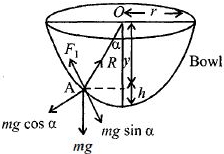
The insect crawls up the bowl upto a certain height $h$ only till the component of its weight along the bowl is balanced by limiting frictional force For li miting condition at point $A$
$R=m g \cos \alpha.....(i)$
$F_1=m g \sin \alpha.....(ii)$
Dividingeq. $(ii)$ by $(i) \tan \alpha=\frac{1}{\cot \alpha}=\frac{F_1}{R}=\mu\left[A s F_1=\mu R\right]$
$\Rightarrow \tan \alpha=\mu=\frac{1}{3}\left[\mu=\frac{1}{3}(\right.$ given $\left.)\right]$
$\therefore \cot \alpha=3$
$R=m g \cos \alpha.....(i)$
$F_1=m g \sin \alpha.....(ii)$
Dividingeq. $(ii)$ by $(i) \tan \alpha=\frac{1}{\cot \alpha}=\frac{F_1}{R}=\mu\left[A s F_1=\mu R\right]$
$\Rightarrow \tan \alpha=\mu=\frac{1}{3}\left[\mu=\frac{1}{3}(\right.$ given $\left.)\right]$
$\therefore \cot \alpha=3$

Download our appand get started for free
Experience the future of education. Simply download our apps or reach out to us for more information. Let's shape the future of learning together!No signup needed.*
Similar Questions
- 1A plank with a box on it at one end is gradually raised about the other end. As the angle of inclination with the horizontal reaches $30^o $, the box starts to slip and slides $4.0\, m $ down the plank in $4.0\, s.$ The coefficients of static and kinetic friction between the box and the plank will be, respectivelyView Solution
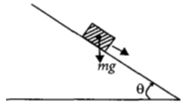
- 2The force required just to move a body up an inclined plane is double the force required just to prevent the body from sliding down. If $\mu $ is the coefficient of friction, the inclination of plane to the horizontal isView Solution
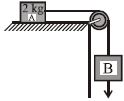
- 3The coefficient of static friction, $\mu _s$ between block $A$ of mass $2\,kg$ and the table as shown in the figure is $0.2$. What would be the maximum mass value of block $B$ so that the two blocks $B$ so that the two blocks do not move? The string and the pulley are assumed to be smooth and masseless ....... $kg$ $(g = 10\,m/s^2)$View Solution
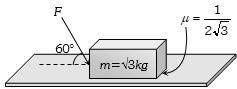
- 4What is the maximum value of the force $F$ such that the block shown in the arrangement, does not move ........ $N$View Solution
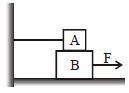
- 5A block $A$ of mass $100\, kg$ rests on another block $B$ of mass $200\, kg$ and is tied to a wall as shown in the figure. The coefficient of friction between $A$ and $B$ is $0.2$ and that between $B$ and the ground is $0.3$. The minimum force $F$ required to move the block $B$ is........ $N$ . $(g = 10\, m/s^2)$View Solution
- 6A block of mass $10\, kg$ moving at $10\,m/s$ is released to slide on rough surface having coefficient of friction $0.2.$ It will stop by travelling distance ........ $m$View Solution
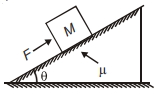
- 7A block (mass $=M kg$ ) is placed on a rough inclined plane. A force $F$ is applied parallel to the inclined (as shown in figure) such that it just starts moving upward. The value of $F$ isView Solution
- 8A block of mass $M$ is being pulled along rough horizontal surface. The coefficient of friction between the block and the surface is $\mu $. If another block of mass $M/2$ is placed on the block and it is again pulled on the surface, the coefficient of friction between the block and the surface will beView Solution
- 9Two block $(A)\,2\,kg$ and $(B)\,5\,kg$ rest one over the other on a smooth horizontal plane. The cofficient of static and dynamic friction between $(A)$ and $(B)$ is the same and equal to $0.60$. The maximum horizontal force that can be applied to $(B)$ in order that both $(A)$ and $(B)$ do not have any relative motion : $(g = 10\,m/s^2)$View Solution
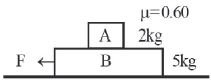
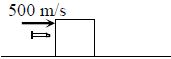
- 10A bullet of mass $20\, g$ travelling horizontally with a speed of $500 \,m/s$ passes through a wooden block of mass $10.0 \,kg$ initially at rest on a surface. The bullet emerges with a speed of $100\, m/s$ and the block slides $20 \,cm$ on the surface before coming to rest, the coefficient of friction between the block and the surface. $(g = 10\, m/s^2)$View Solution