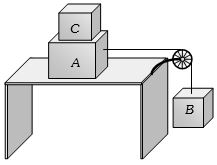
Two masses $A$ and $B$ of $10\, kg$ and $5 \,kg$ respectively are connected with a string passing over a frictionless pulley fixed at the corner of a table as shown. The coefficient of static friction of $A$ with table is $0.2$. The minimum mass of $C$ that may be placed on $A$ to prevent it from moving is ........ $kg$
Medium
Download our app for free and get started
(a) For limiting condition $\mu = \frac{{{m_B}}}{{{m_A} + {m_C}}}$ $⇒$ $0.2 = \frac{5}{{10 + {m_C}}}$
$⇒$ $2 + 0.2{m_C} = 5$ $⇒$ ${m_C} = 15\,kg$

Download our appand get started for free
Experience the future of education. Simply download our apps or reach out to us for more information. Let's shape the future of learning together!No signup needed.*
Similar Questions
- 1A solid hemisphere of weight $P$ rests with its curved surface in contact with a rough inclined plane. A weight $Q$ is placed at some point on the rim of the hemisphere to keep its plane surface horizontal then its minimum coefficient of friction isView Solution
- 2A plank is resting on a horizontal ground in the northern hemisphere of the earth at a $45^{\circ}$ latitude. Let the angular speed of the earth be $\omega$ and its radius $r_e$. The magnitude of the frictional force on the plank will beView Solution
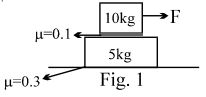
- 3The maximum $"F"$ which will not cause motion of any of the blocks. ...... $N$View Solution
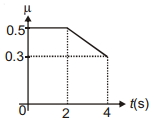
- 4A block is projected with speed $20 \,m / s$ on a rough horizontal surface. The coefficient of friction $(\mu)$ between the surfaces varies with time $(t)$ as shown in figure. The speed of body at the end of $4$ second will be ............ $m / s$ ( $g=$ $10 \,m / s ^2$ )View Solution
- 5Two masses $M$ and $m$ are attached to a vertical axis by weightless threads of combined length $l$. They are set in rotational motion in a horizontal plane about this axis with constant angular velocity $\omega $. If the tensions in the threads are the same during motion, the distance of $M$ from the axis isView Solution
- 6A horizontal force of $129.4 \,N $ is applied on a $10\, kg$ block which rests on a horizontal surface. If the coefficient of friction is $0.3$, the acceleration should be ....... $m/s^2$View Solution
- 7View SolutionIf the overbridge is concave instead of being convex, the thrust on the road at the lowest position will be
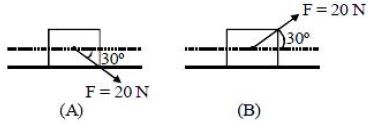
- 8A block of mass $5\, kg$ is $(i)$ pushed in case $(A)$ and $(ii)$ pulled in case $(B)$, by a force $F = 20\, N$, making an angle of $30^o$ with the horizontal, as shown in the figures. The coefficient of friction between the block and floor is $\mu = 0.2$. The difference between the accelerations of the block, in case $(B)$ and case $(A)$ will be $....... ms^{-2}$ .$(g = 10\, ms^{-2})$View Solution
- 9A motor car has a width $1.1$ m between wheels. Its centre of gravity is $0.62$ m above the ground and the coefficient of friction between the wheels and the road is $0.8$. ...... $m/s$ is the maximum possible speed, if the centre of gravity inscribes a circle of radius $15$ m ? (Road surface is horizontal)View Solution
- 10Abody is placed on a rough inclined plane of inclination $\theta$ .As the angle $\theta$ is increased from $0^o$ to $90^o$ the contact force between the block and the planeView Solution