The capacitor of capacitance $4\,\mu F$ and $6\,\mu F$ are connected in series. A potential difference of $500\;volts$ is applied to the outer plates of the two capacitor system. The potential difference across the plates of capacitor of $4\,\mu F$ capacitance is.........$volts$
Easy


Download our appand get started for free
Experience the future of education. Simply download our apps or reach out to us for more information. Let's shape the future of learning together!No signup needed.*
Similar Questions
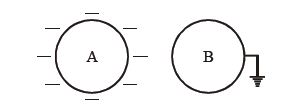
- 1Two concentric spheres $A$ and $B$ are kept very near to each other. $A$ is negatively charged and $B$ is earthed. The true statement isView Solution
$(A)$ Charge on $B$ is zero
$(B)$ Potential at $B$ is zero
$(C)$ Charge is uniformly distributed on $A$
$(D)$ Charge is non uniformly distributed on $A$
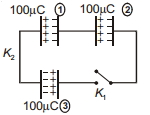
- 2Three identical charged capacitors each of capacitance $5 \,\mu F$ are connected as shown in figure. Potential difference across capacitor $(3)$, long time after the switches $K_1$ and $K_2$ are is closed, is ............ $V$View Solution
- 3If a charged spherical conductor of radius $10\,cm$ has potential $V$ at a point distant $5\,cm$ from its centre, then the potential at a point distant $15\,cm$ from the centre will beView Solution
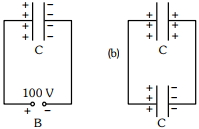
- 4A capacitor of capacitance $C =900\,pF$ is charged fully by $100\,V$ battery $B$ as shown in figure $(a)$. Then it is disconnected from the battery and connected to another uncharged capacitor of capacitance $C =900\,pF$ as shown in figure $(b)$. The electrostatic energy stored by the system $(b)$ is $\dots\dots\times 10^{-6}\,J$View Solution
- 5The electric potential at a point in free space due to charge $Q$ coulomb is $V=Q$$ \times {10^{11}}\,V$ . The electric field at that point isView Solution
- 6In the figure a potential of $+$ $1200\, V$ is given to point $A$ and point $B$ is earthed, what is the potential at the point $P$....$V$View Solution
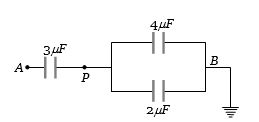
- 7Twenty seven drops of same size are charged at $220\, \mathrm{~V}$ each. They combine to form a bigger drop. Calculate the potential of the bigger drop. (In $\mathrm{~V}$)View Solution
- 8The plates of a parallel plate capacitor with no dielectric are connected to a voltage source. Now a dielectric of dielectric constant $K $ is inserted to fill the whole space between the plates with voltage source remaining connected to the capacitor.View Solution
- 9An electron of mass $m$ and charge $e$ is accelerated from rest through a potential difference $V$ in vacuum. The final speed of the electron will beView Solution
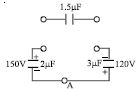
- 10Two capacitors of $2$ $\mu F$ and $3$ $\mu F$ are charged to $150$ $volt$ and $120$ $volt$ respectively. The plates of capacitor are connected as shown in the figure. A discharged capacitor of capacity $1.5$ $\mu F$ falls to the free ends of the wire. ThenView Solution