Question
A horizontal cesium plate ($\phi$ = 1.9eV) is moved vertically downward at a constant speed u in a room full of radiation of wavelength 250 run and above. What should be the minimum value of u so that the vertically upward component of velocity is nonpositive for each photoelectron?
Answer

When $\lambda=250\text{nm}$Energy of photon
$=\frac{\text{hc}}{\lambda}=\frac{1240}{250}=4.96\text{ev}$
$\therefore\text{K.E.}=\frac{\text{hc}}{\lambda}-\text{w}=4.96-1.9\text{ev.}$
Velocity to be non positive for each photo electron
The minimum value of velocity of plate should be = velocity of photo electron
$\therefore$ Velocity of photo electron $=\sqrt{\frac{2\text{KE}}{\text{m}}}$
$=\sqrt{\frac{3.06}{9.1\times10^{-31}}}$
$=\sqrt{\frac{3.06\times1.6\times10^{-19}}{9.1\times10^{-31}}}=1.04\times10^6\text{m/sec.}$

Need a full question paper?

Generate a complete, print-ready paper with questions like this in minutes — across 16+ boards, with answer keys.

Start Generating Free

Similar questions

(II) (a) Using Kirchhoff'᾿s laws obtain the equation of the balanced state in Wheatstone bridge.
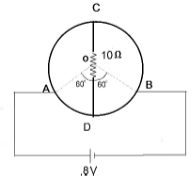
b) A wire of uniform cross-section and resistance of 12 ohm is bent in the shape of circle as shown in the figure. A resistance of 10 ohms is connected to diametrically opposite ends C and D. A battery of emf 8V is connected between A and B. Determine the current flowing through arm AD.

Image
A normal eye has retina 2cm behind the eye-lens. What is the power of the eye-lens when the eye is
  1. Fully relaxed,
  2. Most strained?
Define resonance. Explain resonant frequency and write characteristics of resonant circuit.
Total charge $-Q$ is uniformly spread along length of a ring of radius $R. A$. small test charge $+q$ of mass $m$ is kept at the centre of the ring and is given a gentle push along the axis of the ring.
  1. Show that the particle executes a simple harmonic oscillation.
  2. Obtain its time period.
​​​​​
A heavy ball is suspended from the ceiling of a motor car through a light string. A transverse pulse travels at a speed of $60\ cm/s$ on the string when the car is at rest and $62\ cm/s$ when the car accelerates on a horizontal road. Find the acceleration of the car. Take $g = 10m/s^2.$
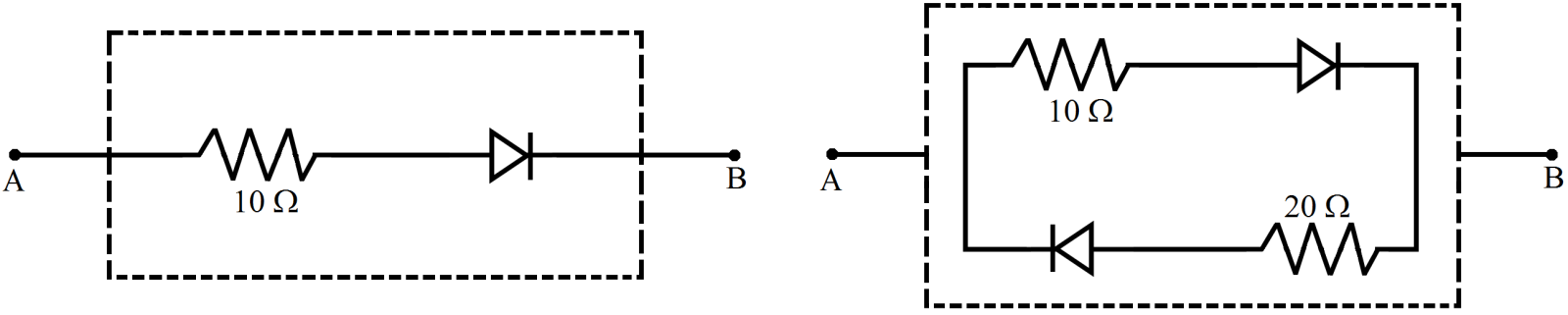
Draw the current-voltage characteristics for the device shown in figure. between the terminals A and B.
A long solenoid of radius $2\ cm$ has $100\ turns/cm$ and carries a current of $5A.$ A coil of radius $1\ cm$ having $100$ turns and a total resistance of $2\Omega$ is placed inside the solenoid coaxially. The coil is connected to a galvanometer. If the current in the solenoid is reversed in direction, find the charge flown through the galvanometer.
Suppose we want to verify the analogy between electrostatic and magnetostatic by an explicit experiment. Consider the motion of (i) electric dipole p in an electrostatic field E and (ii) magnetic dipole m in a magnetic field B. Write down a set of conditions on E, B, p, m so that the two motions are verified to be identical. (Assume identical initial conditions.)
In $1959$ Lyttleton and Bondi suggested that the expansion of the Universe could be explained if matter carried a net charge. Suppose that the Universe is made up of hydrogen atoms with a number density $N,$ which is maintained a constant. Let the charge on the proton be: $\ce{e_p = -(1 + y)e}$ where e is the electronic charge.
Find the critical value of $y$ such that expansion may start.
  1. Using Gauss Theorem show mathematically that for any point outside the shell, the field due to a uniformly charged spherical shell is same as the entire charge on the shell, is concentrated at the centre.
  2. Why do you expect the electric field inside the shell to be zero according to this theorem?
OR
A thin conducting spherical shell of radius $R$ has charge $Q$ spread uniformly over its surface. Using Gauss’s theorem, derive an expression for the electric field at a point outside the shell.
Draw a graph of electric field $E(r)$ with distance r from the centre of the shell for $0\leq\text{r}\le\infty.$
OR
Find the electric field intensity due to a uniformly charged spherical shell at a point $(i)$ outside the shell and $(ii)$ inside the shell. Plot the graph of electric field with distance from the centre of the shell.
OR
Using Gauss’s law obtain the expression for the electric field due to a uniformly charged thin spherical shell of radius $R$ at a point outside the shell. Draw a graph showing the variation of electric field with r, for $r > R$ and $r < R.$