Question
A horizontal cesium plate ($\phi$ = l.9 eV) is moved vertically downward at a constant speed u in a room full of radiation of wavelength 250 run and above. What should be the minimum value of u so that the vertically upward component of velocity is nonpositive for each photoelectron?
Answer

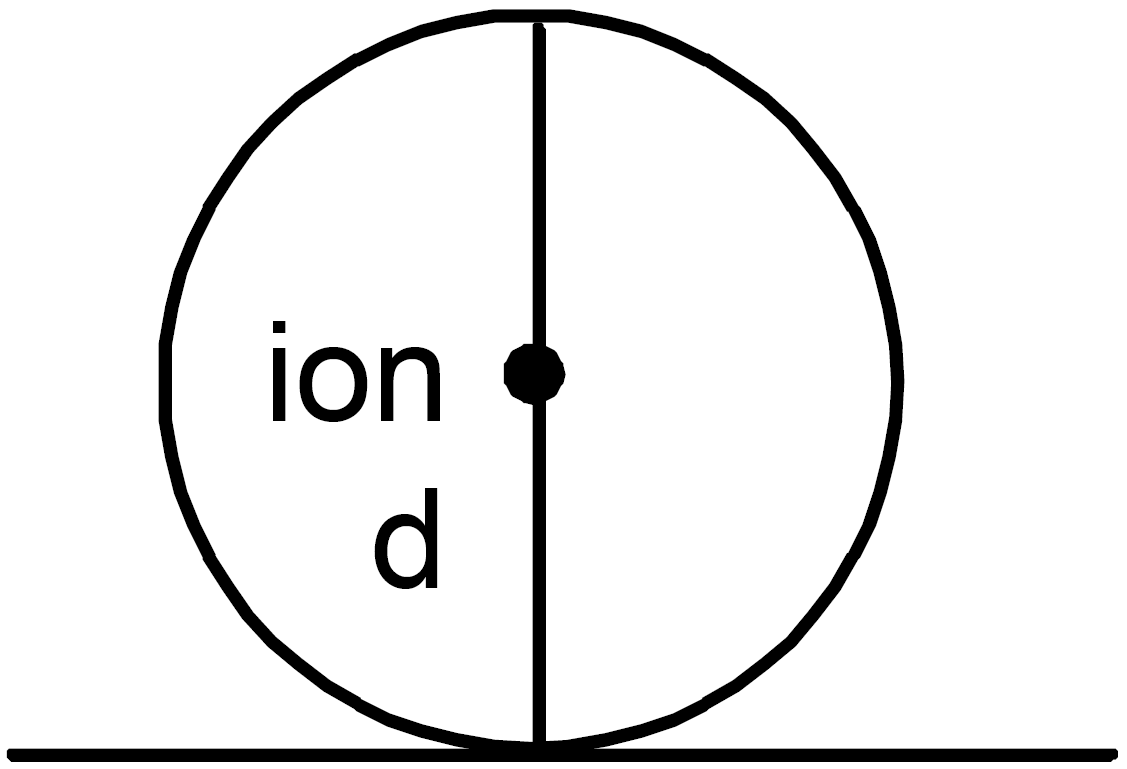
Work function $=\phi,$ distance = dThe particle will move in a circle
When the stopping potential is equal to the potential due to the singly charged ion at that point.
$\text{eV}_0=\frac{\text{hc}}{\lambda}-\phi$
$\Rightarrow\text{v}_0=\Big(\frac{\text{hv}}{\lambda}-\phi\Big)\frac{1}{\text{e}}$
$\Rightarrow\frac{\text{ke}}{2\text{d}}=\Big(\frac{\text{hc}}{\lambda}-\phi\Big)\frac{1}{\text{e}}$
$\Rightarrow\frac{\text{ke}}{\text{2d}}=\frac{\text{hc}}{\lambda}-\phi$
$\Rightarrow\frac{\text{hc}}{\lambda}=\frac{\text{ke}^2}{2\text{d}}+\phi=\frac{\text{ke}^2+2\text{d}\phi}{2\text{d}}$
$\Rightarrow\lambda=\frac{\text{hc 2d}}{\text{ke}^2+2\text{d}\phi}=\frac{2\text{hcd}}{\frac{1}{4\pi\omega_0\text{e}^2}2\text{d}\phi}=\frac{8\pi\omega_0\text{hcd}}{\text{e}^2+8\pi\omega_0\text{d}\phi}$

Need a full question paper?

Generate a complete, print-ready paper with questions like this in minutes — across 16+ boards, with answer keys.

Start Generating Free

Similar questions

  1. Derive an expression for equivalent capacitance of three capacitors when connected in series.
  2. Derive an expression for equivalent capacitance of three capacitors when connected in parallel.
A person with a normal near point (25 cm) using a compound microscope with objective of focal length 8.0 mm and an eyepiece of focal length 2.5 cm can bring an objective placed at 9.0 mm from the objective in sharp focus. What is the separation between the two lenses? Calculate the magnifying power of the microscope.
A particle is subjected to two simple harmonic motions given by $\text{x}_1=2.0\sin(100\pi\text{t})$ and $\text{x}_2=2.0\sin\Big(120\pi\text{t}+\frac{\pi}{3}\Big)$ where x is in centimeter and t in second. Find the displacement of the particle at
  1. t = 0.0125.
  2. t = 0.025.
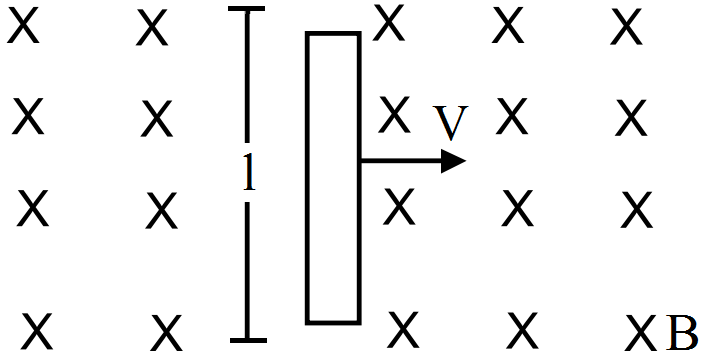
A conducting wire of length l, lying normal to a magnetic field B, moves with a velocity v, as shown in the figure.
  1. Find the average magnetic force on a free electron of the wire.
  2. Due to this magnetic force, electrons concentrate at one end, resulting in an electric field inside the wire. The redistribution stops when the electric force on the free electrons balances the magnetic force. Find the electric field developed inside the wire when the redistribution stops.
  3. What potential difference is developed between the ends of the wire?
It is found that yellow light does not eject photoelectrons from a metal. Is it advisable to try with orange light? With green light?
A long straight horizontal cable carries a current of $2.5 A$ in the direction $10^\circ$ south of west to $10^\circ$ north of east. The magnetic meridian of the place happens to be $10^\circ$ west of the geographic meridian. The earth’s magnetic field at the location is $0.33 G,$  and the angle of dip is zero. Locate the line of neutral points $($ignore the thickness of the cable$). ($At neutral points, magnetic field due to a current $-$ carrying cable is equal and opposite to the horizontal component of earth’s magnetic field.$)$
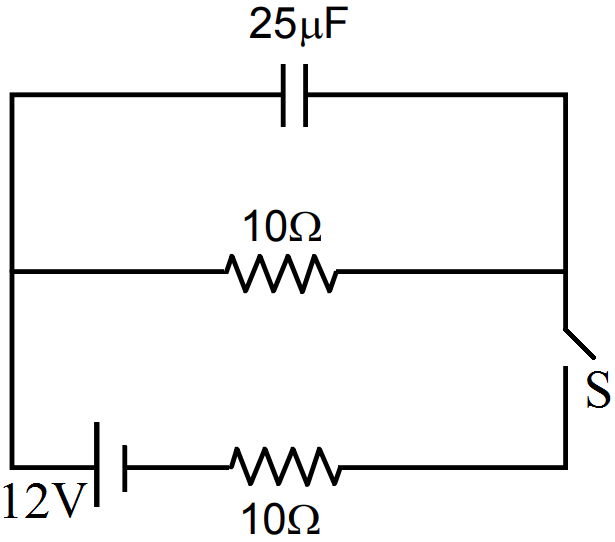
The switch S shown in figure. is kept closed for a long time and is then opened at t = 0. Find the current in the middle $1.0\Omega$ resistor at t = 1ms.
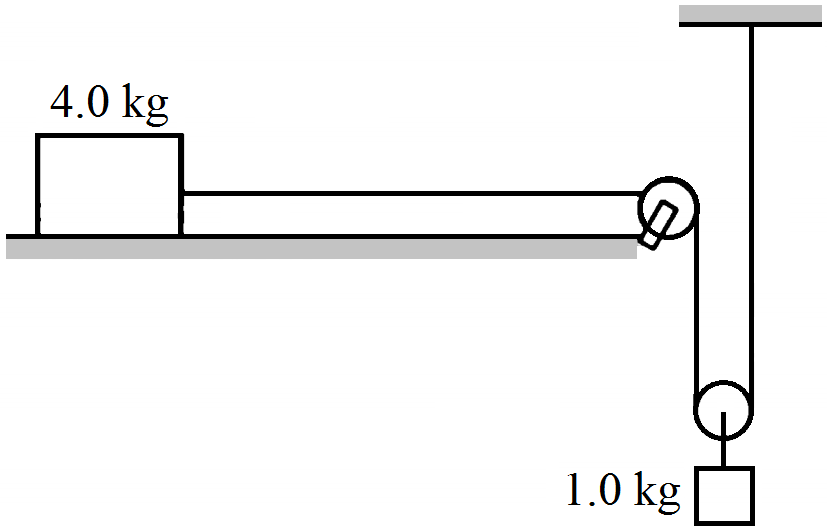
Consider the situation shown in figure. The system is released from rest and the block of mass $1.0\ kg$ is found to have a speed $0.3\ m/s$ after it has descended through a distance of $1m.$ Find the coefficient of kinetic friction between the block and the table.
A long solenoid with $15 $ turns per $\ cm$ has a small loop of area $2.0 \ cm^2$ placed inside the solenoid normal to its axis. If the current carried by the solenoid changes steadily from $2.0A$ to $4.0A$ in $0.1s,$ what is the induced emf in the loop while the current is changing?
  1. Derive an expression for the average power consumed in a series $\ce{LCR}$ circuit connected to $a.c.$ source in which the phase difference between the voltage and the current in the circuit is $\phi$.
  2. Define the quality factor in an a.c. circuit. Why should the quality factor have high value in receiving circuits? Name the factors on which it depends.