Question
A person with a normal near point (25 cm) using a compound microscope with objective of focal length 8.0 mm and an eyepiece of focal length 2.5 cm can bring an objective placed at 9.0 mm from the objective in sharp focus. What is the separation between the two lenses? Calculate the magnifying power of the microscope.
Answer

Given that:
D = 25cm
Focal length of objective lens $=f_o=8.0 mm$
∴ $f_o=0.8 cm$
Focal length of eyepiece $=f_e=2.5 cm$
$u_o=-9.0 mm=-0.9 cm$
$\begin{array}{r}\text { Distance between both lenses }= L =? \\ m=?\end{array}$
Lens formula for eyepiece :
$\frac{1}{f_e}=\frac{1}{v_e}-\frac{1}{u_e}$
or $-\frac{1}{u_e}=\frac{1}{f_e}-\frac{1}{v_e} \because v_e=- D =-25$
$=\frac{1}{2.5}-\left(-\frac{1}{25}\right)=\frac{10}{25}+\frac{1}{25}$
$=\frac{2}{5}+\frac{1}{25}=\frac{10+1}{25}$
$u_e=-\frac{25}{11} cm$
$\therefore \quad\left|u_e\right|=\left|-\frac{25}{11}\right|=\frac{25}{11} cm=2.27 cm$
For objective lens :
$\frac{1}{v_o}-\frac{1}{u_o}=\frac{1}{f_o}$
or $\frac{1}{v_o}=\frac{1}{f_o}+\frac{1}{u_o} \Rightarrow-\frac{1}{0.9}+\frac{1}{0.8}=\frac{-10}{9}+\frac{10}{8}$
$=\frac{-0.8+0.9}{072}=\frac{0.1}{072}$
or $\quad v_0=\frac{0.72}{0.1}=7.2 cm$
$\therefore \quad L =v_o+\left|u_e\right|$
$=7.2+2.27=9.47 cm$
Now magnification power of compound microscope :
$M =\frac{v_o}{\left|u_o\right|}\left(1+\frac{ D }{f_e}\right)=\frac{7.2}{0.9}\left(1+\frac{25}{2.5}\right)$
$=8 \times(1+10)=8 \times 11=88$

Need a full question paper?

Generate a complete, print-ready paper with questions like this in minutes — across 16+ boards, with answer keys.

Start Generating Free

Similar questions

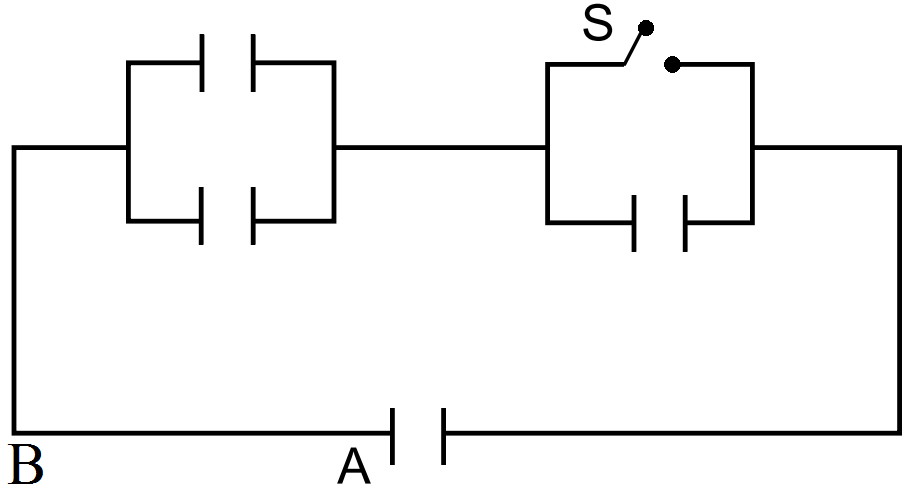
Each capacitor shown in figure has a capacitance of $5.0\mu\text{F}.$ The emf of the battery is $50V.$ How much charge will flow through $AB$ if the switch $S$ is closed?
Find the total heat produced in the loop of the previous problem during the interval $0$ to $30s$ if the resistance of the loop is $4.5\text{m}\Omega.$
An inductor of inductance 5.0H, having a negligible resistance, is connected in series with a $100\Omega$ resistor and a battery of emf 2.0V. Find the potential difference across the resistor 20ms after the circuit is switched on.
Obtain expression for root mean square value of alternating emf. Draw graph between $E$ and t and $E ^2$ and $t$ and prove that average rate of heat produced for alternating current in one complete cycle is $H = I _{\text {max }}^2 R$.
Derive a mathematical expression for the force per unit length experienced by each of the two long current carrying conductors placed parallel to each other in air. Hence define one ampere of current.Explain why two parallel straight conductors carrying current in the opposite direction kept near each other in air repel?
What is interference of light? Write two essential conditions for sustained interference pattern to be produced on the screen. Draw a graph showing the variation of intensity versus the position on the screen in Young's experiment when (a) both the slits are opened and (b) one of the slit is closed. What is the effect on the interference pattern in Young's double-slit experiment when: 32. 33.
i. Screen is moved closer to the plane of slits?
ii. Separation between two slits is increased. Explain.
Consider an excited hydrogen atom in state $n$ moving with a velocity $u(ν << c).$ It emits a photon in the direction of its motion and changes its state to a lower state $m.$ Apply momentum and energy conservation principles to calculate the frequency $ν$ of the emitted radiation. Compare this with the frequency $ν_0$ emitted if the atom were at rest.
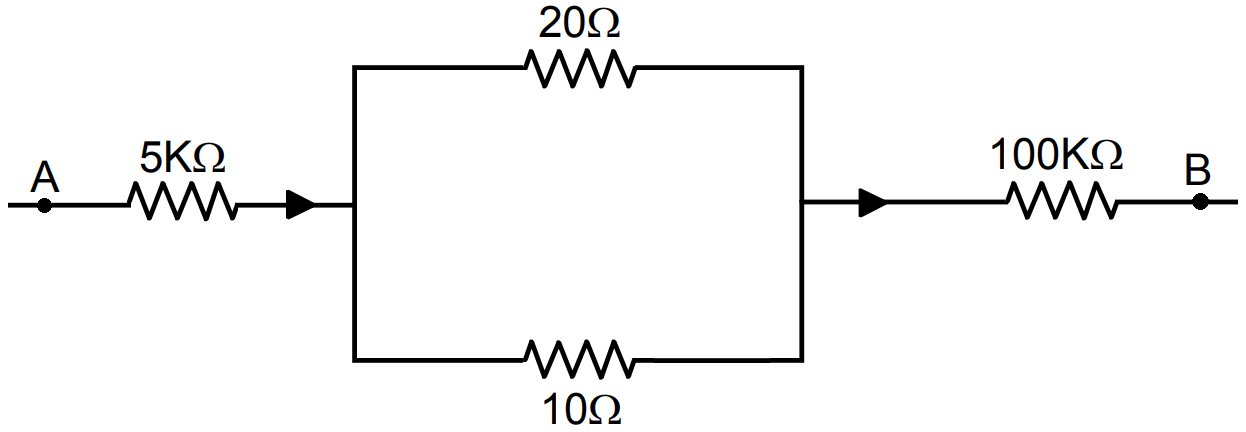
Figure. shows a part of a circuit. If a current of $12mA$ exists in the $5\text{k}\Omega$ resistor, find the currents in the other three resistors. What is the potential difference between the points $A$ and $B$?
i. With the help of a diagram, explain the principle and working of a device which produces current that reverses its direction after regular intervals of time.
ii. If a charged capacitor C is short-circuited through an inductor L, the charge and current in the circuit oscillate simple harmonically. a. In what form the capacitor and the inductor store energy? b. Write two reasons due to which the oscillations become damped.
Two cells of emf $1.5V$ and $2V$ and internal resistance $1\Omega$ and $2\Omega$ respectively are connected in parallel to pass a current in the same direction through an external resistance of $5\Omega.$
  1. Draw the circuit diagram.
  2. Using Kirchhoff’s laws, calculate the current through each branch of the circuit and potential difference across $5\Omega$ resistor.