A horizontal force of $10 \,N$ is necessary to just hold a block stationary against a wall. The coefficient of friction between the block and the wall is $0.2$. the weight of the block is ........ $N$
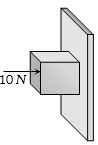
AIEEE 2003, Easy
Download our app for free and get started
(a) $F = \frac{W}{\mu }$
$\therefore W = \mu F = 0.2 \times 10 = 2N$

Download our appand get started for free
Experience the future of education. Simply download our apps or reach out to us for more information. Let's shape the future of learning together!No signup needed.*
Similar Questions
- 1A horizontal force of $40\,N$ is applied to a $5\, kg$ block which is at rest on the horizontal surface. If the coefficient of kinetic friction is $0.4$, then the acceleration of the block is ........ $m/s^2$ $(g = 10 \,m/s^2)$View Solution
- 2Concretemixture is made by mixing cement, stone and sand in a rotating cylindrical drum . If the drum rotates too fast, the ingredients remain stuck to the wall of the drum and proper mixing of ingredients does not take place. The maximum rotational speed of the drum in revolutions per minute (rpm) to ensure proper mixing is close to (Take the radius of the drum to be $1.25\, m$ and its axle to be horizontal)View Solution
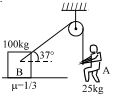
- 3Block $B$ of mass $100 kg$ rests on a rough surface of friction coefficient $\mu = 1/3$. $A$ rope is tied to block $B$ as shown in figure. The maximum acceleration with which boy $A$ of $25 kg$ can climbs on rope without making block move is:View Solution
- 4View SolutionWhen a body is moving on a surface, the force of friction is called
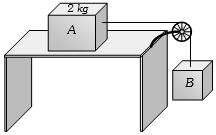
- 5The coefficient of static friction, ${\mu _s},$ between block $A$ of mass $2\, kg$ and the table as shown in the figure is $0.2$. ........ $kg$ would be the maximum mass value of block $B$ so that the two blocks do not move. The string and the pulley are assumed to be smooth and massless. $(g = 10\,m/{s^2})$View Solution
- 6Two blocks $A$ and $B$ of masses $5 \,kg$ and $3 \,kg$ respectively rest on a smooth horizontal surface with $B$ over $A$. The coefficient of friction between $A$ and $B$ is $0.5$. The maximum horizontal force (in $kg$ wt.) that can be applied to $A$, so that there will be motion of $A$ and $B$ without relative slipping, isView Solution
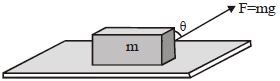
- 7A force $f$ is acting on a block of mass $m$. Coefficient of friction between block and surface is $\mu$. The block can be pulled along the surface if :-View Solution
- 8Consider a car moving on a straight road with a speed of $100\, m/s$. The distance at which car can be stopped, is ........ $m$. $[\mu_k = 0.5]$View Solution
- 9A stone of mass of $16\, kg$ is attached to a string $144 \,m$ long and is whirled in a horizontal circle. The maximum tension the string can withstand is $16$ Newton. The maximum velocity of revolution that can be given to the stone without breaking it, will be ....... $ms^{-1}$View Solution
- 10View SolutionChoose the correct statement.