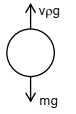
A hot air balloon is carrying some passengers, and a few sandbags of mass $1 kg$ each so that its total mass is $480 kg$. Its effective volume giving the balloon its buoyancy is $V$. The balloon is floating at an equilibrium height of $100 m$. When $N$ number of sandbags are thrown out, the balloon rises to a new equilibrium height close to $150 m$ with its volume $V$ remaining unchanged. If the variation of the density of air with height $h$ from the ground is $\rho(h)=\rho_0 e^{-\frac{h}{h_0}}$, where $\rho_0=1.25 kg m ^{-3}$ and $h _0=6000 m$, the value of $N$ is. . . . .
IIT 2020, Medium


Download our appand get started for free
Experience the future of education. Simply download our apps or reach out to us for more information. Let's shape the future of learning together!No signup needed.*
Similar Questions
- 1Two solids $A$ and $ B$ float in water. It is observed that $A$ floats with $\frac{1}{2}$ of its body immersed in water and $ B$ floats with $\frac{1}{4}$ of its volume above the water level. The ratio of the density of $ A$ to that of $B$ isView Solution
- 2An inverted tube barometer is kept on a lift with a moving downward with a deceleration $\alpha $ . The density of mercury is $\rho$ and acceleration due to gravity is $g$ . If the atmospheric pressure be $P_0$ thenView Solution
- 3A tiny spherical oil drop carrying a net charge $q$ is balanced in still air with a vertical uniform electric field of strength $\frac{81 \pi}{7} \times 10^5 \mathrm{Vm}^{-1}$. When the field is switched off, the drop is observed to fall with terminal velocity $2 \times 10^{-3} \mathrm{~ms}^{-1}$. Given $\mathrm{g}=9.8 \mathrm{~ms}^{-2}$, viscosity of the air $=1.8 \times 10^{-5} \mathrm{Ns} \mathrm{m}^{-2}$ and the density of oil $=$ $900 \mathrm{~kg} \mathrm{~m}^{-3}$, the magnitude of $\mathrm{q}$ isView Solution
- 4What is the pressure on a swimmer $20 \,m$ below the surface of water ........ $atm$View Solution
- 5If velocity of flow is $4 \,m / s$, then velocity head is .........$m$View Solution
- 6View SolutionSelect the correct statement regarding stream line flow
- 7We have two (narrow) capillary tubes $T_1$ and $T_2$. Their lengths are $l_1$ and $l_2$ and radii of cross-section are $r_1$ and $r_2$ respectively. The rate of flow of water under a pressure difference $ P$ through tube $T_1$ is $8cm ^3/sec$. If $l_1 = 2l_2$ and $ r_1 =r_2$, what will be the rate of flow when the two tubes are connected in series and pressure difference across the combination is same as before $ (= P)$View Solution
- 8A cylindrical tank of height $0.4\,m$ is open at the top and has a diameter $0.16\,m$ . Water is filled in it up to a height of $0.16\,m$ . How long it will take to empty the tank through a hole of radius $5 \times 10^{-3}\,m$ in its bottom .......... $\sec$View Solution
- 9A fluid is flowing through a horizontal pipe of varying cross-section, with speed $v\;ms^{-1}$ at a point where the pressure is $P$ Pascal. At another point where pressure is $\frac{ P }{2}$ Pascal its speed is $V\;ms^{-1}$. If the density of the fluid is $\rho\, kg\, m ^{-3}$ and the flow is streamline, then $V$ is equal toView Solution
- 10The density of the atmosphere at sea level is $1.29 \;kg / m ^{3} .$ Assume that it does not change with altitude. Then how high (in $km$) would the atmosphere extend?View Solution