We have two (narrow) capillary tubes $T_1$ and $T_2$. Their lengths are $l_1$ and $l_2$ and radii of cross-section are $r_1$ and $r_2$ respectively. The rate of flow of water under a pressure difference $ P$ through tube $T_1$ is $8cm ^3/sec$. If $l_1 = 2l_2$ and $ r_1 =r_2$, what will be the rate of flow when the two tubes are connected in series and pressure difference across the combination is same as before $ (= P)$
Diffcult
Download our app for free and get started
(b)$V = \frac{{\pi {{\Pr }^4}}}{{8\eta l}} = \frac{{8c{m^3}}}{{\sec }}$
For composite tube
$ = \frac{2}{3} \times 8 = \frac{{16}}{3}\frac{{c{m^3}}}{{\sec }}$
For composite tube
$ = \frac{2}{3} \times 8 = \frac{{16}}{3}\frac{{c{m^3}}}{{\sec }}$
${V_1} = \frac{{P\pi {r^4}}}{{8\eta \left( {l + \frac{l}{2}} \right)}} = \frac{2}{3}\frac{{\pi {{\Pr }^4}}}{{8\eta l}}$ $ = \frac{2}{3} \times 8 = \frac{{16}}{3}\frac{{c{m^3}}}{{\sec }}$
$\left[ {\because \;\;{l_1} = l = 2{l_2}\;{\text{or}}\;{l_2} = \frac{l}{2}} \right]$

Download our appand get started for free
Experience the future of education. Simply download our apps or reach out to us for more information. Let's shape the future of learning together!No signup needed.*
Similar Questions
- 1A spherical marble of radius $1\, cm$ is stuck in a circular hole of radius slightly smaller than its own radius (for calculation purpose, both can be taken same) at the bottom of a bucket of height $40 \,cm$ and filled with water up to $10 \,cm$. If the mass of the marble is $20 \,g$, then the net force on the marble due to water is close toView Solution

- 2$Assertion :$ The buoyant force on a submerged rigid object can be considered to be acting at the centre of mass of the object.View Solution
$Reason :$ For a rigid body a force field distributed uniformly through its volume can be considered to be acting at the centre of mass of the body. - 3A vertical tank, open at the top, is filled with a liquid and rests on a smooth horizontal surface.$A$ small hole is opened at the centre of one side of the tank. The area of cross-section of the tank is $N$ times the area of the hole, where $N$ is a large number. Neglect mass of the tank itself. The initial acceleration of the tank isView Solution
- 4A solid metallic sphere of radius $r$ is allowed to fall freely through air. If the frictional resistance due to air is proportional to the cross-sectional area and to the square of the velocity, then the terminal velocity of the sphere is proportional to which of the following?View Solution
- 5A very large block of ice of the size of a volleyball court and of uniform thickness of $8 \,m$ is floating on water. A person standing near its edge wishes to fetch a bucketful of water using a rope. The smallest length of rope required for this is about ............... $m$View Solution
- 6A plastic circular disc of radius $R$ is placed on a thin oil film, spread over a flat horizontal surface. The torque required to spin the disc about its central vertical axis with a constant angular velocity is proportional toView Solution
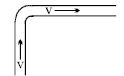
- 7A fire hydrant delivers water of density $\rho $ at a volume rate $L$. The water travels vertically upward through the hydrant and then does $90^o$ turn to emerge horizontally at speed $V$. The pipe and nozzle have uniform cross-section throughout. The force exerted by the water on the corner of the hydrant isView Solution
- 8A liquid of density $\rho $ is coming out of a hose pipe of radius $a$ with horizontal speed $v$ and hits a mesh. $50\%$ of the liquid passes through the mesh unaffected. $25\%$ looses all of its momentum and $25\%$ comes back with the same speed. The resultant pressure on the mesh will beView Solution
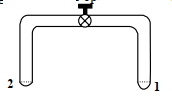
- 9A glass tube of uniform internal radius ( $\mathrm{r}$ ) has a valve separating the two identical ends. Initially, the valve is in a tightly closed position. End $1$ has a hemispherical soap bubble of radius $\mathrm{r}$. End $2$ has sub-hemispherical soap bubble as shown in figure. Just after opening the valve,View Solution
Figure: $Image$
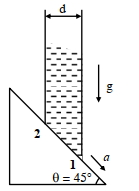
- 10A cylindrical tube, with its base as shown in the figure, is filled with water. It is moving down with a constant acceleration $a$ along a fixed inclined plane with angle $\theta=45^{\circ} . P_1$ and $P_2$ are pressures at points 1 and 2 , respectively, located at the base of the tube. Let $\beta=\left(P_1-P_2\right) /(\rho g d)$, where $\rho$ is density of water, $d$ is the inner diameter of the tube and $g$ is the acceleration due to gravity. Which of the following statement($s$) is(are) correct?View Solution
$(A)$ $\beta=0$ when $a= g / \sqrt{2}$
$(B)$ $\beta>0$ when $a= g / \sqrt{2}$
$(C)$ $\beta=\frac{\sqrt{2}-1}{\sqrt{2}}$ when $a= g / 2$
$(D)$ $\beta=\frac{1}{\sqrt{2}}$ when $a= g / 2$