Question
A large steel wheel is to be fitted on to a shaft of the same material. At $27°C$, the outer diameter of the shaft is $8.70cm$ and the diameter of the central hole in the wheel is $8.69cm$. The shaft is cooled using ‘dry ice’. At what temperature of the shaft does the wheel slip on the shaft? Assume coefficient of linear expansion of the steel to be constant over the required temperature range: asteel = $1.20 \times 10^{–5} K^{–1}$.
Answer

The given temperature, T = 27°C can be written in Kelvin as: 27 + 273 = 300K
Outer diameter of the steel shaft at T, $d_1 = 8.70cm$
Diameter of the central hole in the wheel at T, $d_2 = 8.69cm$
Coefficient of linear expansion of steel, $\alpha_{\text{steel}}=1.20\times10^{-5}\text{K}^{-1}$
After the shaft is cooled using ‘dry ice’, its temperature becomes $T_1$.
The wheel will slip on the shaft, if the change in diameter, $\triangle\text{d}=8.69-8.70$
Temperature $T_1$, can be calculated from the relation:
$\triangle\text{d}=\text{d}_1\alpha_{\text{steel}}(\text{T}_1-\text{T})$
$0.01 = 8.70 \times 1.20 \times 10^{–5} (T_1 – 300)$
$(T_1 – 300) = 95.78$
$\therefore T_1= 204.21K$
$= 204.21 – 273.16$
$= –68.95^\circ C$
Therefore, the wheel will slip on the shaft when the temperature of the shaft is –69°C.

Need a full question paper?

Generate a complete, print-ready paper with questions like this in minutes — across 16+ boards, with answer keys.

Start Generating Free

Similar questions

Light is incident from glass $(\mu=1.50)$ to water $(\mu=1.33).$ Find the range of the angle of deviation for which there are two angles of incidence.
An aircraft is flying at a height of 3400m above the ground. If the angle subtended at a ground observation point by the aircraft positions 10.0s apart is 30°, what is the speed of the aircraft?
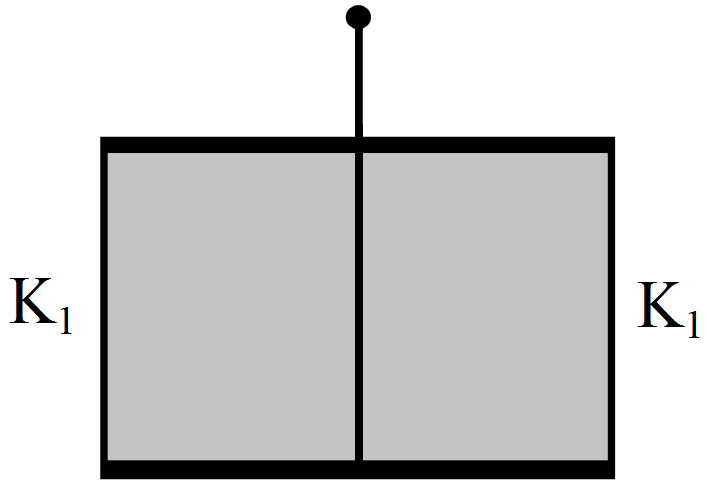
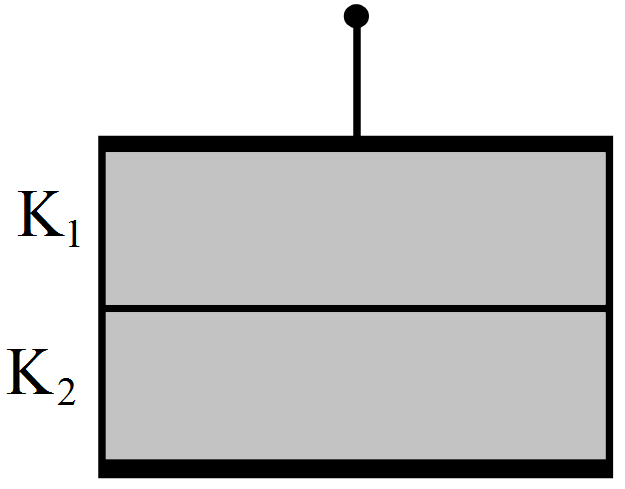
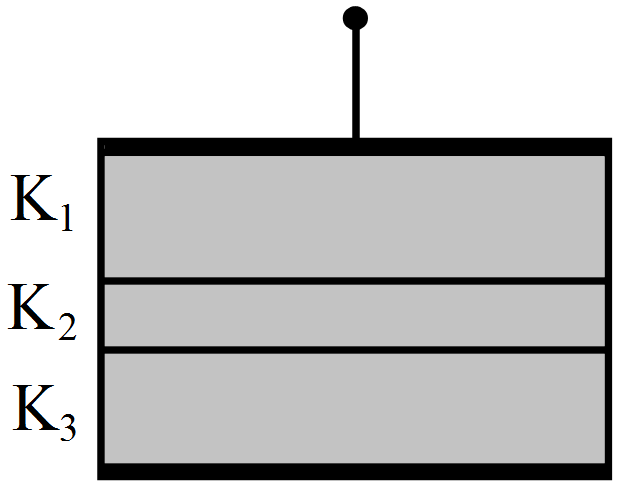
Find the capacitances of the capacitors shown in figure. The plate area is A and the separation between the plates is d. Different dielectric slabs in a particular part of the figure are of the same thickness and the entire gap between the plates is filled with the dielectric slabs.


A three-wheeler starts from rest, accelerates uniformly with 1m $s^{–2}$ on a straight road for 10s, and then moves with uniform velocity. Plot the distance covered by the vehicle during the nth second $(n = 1, 2, 3….)$ versus n. What do you expect this plot to be during accelerated motion : a straight line or a parabola?
In a series RC circuit with an AC source, $\text{R}=300\Omega,\text{C}=25\mu\text{F},\in_0=50\text{V}$ and $\nu=\frac{50}{\pi}\text{Hz}.$ Find the peak current and the average power dissipated in the circuit.
A metal bar of length L and area of cross-section A, is rigidly clamped between two walls. The Young's modulus of its material is Y and the coefficient of linear expansion is $\alpha.$ The bar is heated so that its temperature is increased from 0 to $\theta^\circ\text{C}.$ Find the force exerted at the ends of the bar.
Two charges $2.0 \times 10^{-6}C$ and $1.0 \times 10^{-6}C$ are placed at a separation of 10cm. Where should a third charge be placed such that it experiences no net force due to these charges?
A disc revolves with a speed of $33\frac{1}{3}\text{rev/min},$ and has a radius of $15cm$. Two coins are placed at $4cm$ and $14cm$ away from the centre of the record. If the co-efficient of friction between the coins and the record is $0.15$, which of the coins will revolve with the record?
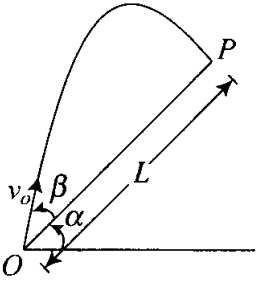
A particle is projected in air at an angle $\beta$ to a surface which itself is inclined at an angle $\alpha$ to the horizontal (Fig.).
  1. β at which range will be maximum.
(Hint: This problem can be solved in two different ways:
  1. Point P at which particle hits the plane can be seen as intersection of its trajectory (parobola) and straight line. Remember particle is projected at an angle $(\alpha+\beta)$ w.r.t. horizontal.
  2. We can take x-direction along the plane and y-direction perpendicular to the plane. In that case resolve g (acceleration due to gravity) in two differrent components, $g_x$ along the plane and $g_y$ perpendicular to the plane. Now the problem can be solved as two independent motions in x and y directions respectively with time as a common parameter.)
Explain the principle of moments.