MCQ
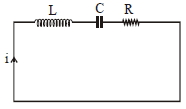
A $LCR$ circuit behaves like a damped harmonic oscillator. Comparing it with a physical springmass damped oscillator having damping constant $\mathrm{b}$, the correct equivalence would be:
  • $\mathrm{L} \leftrightarrow \mathrm{m}, \mathrm{C} \leftrightarrow \frac{1}{\mathrm{k}}, \mathrm{R} \leftrightarrow \mathrm{b}$
  • B
    $\mathrm{L} \leftrightarrow \frac{1}{\mathrm{b}}, \mathrm{C} \leftrightarrow \frac{1}{\mathrm{m}}, \mathrm{R} \leftrightarrow \frac{1}{\mathrm{k}}$
  • C
    $\mathrm{L} \leftrightarrow \mathrm{m}, \mathrm{C} \leftrightarrow \mathrm{k}, \mathrm{R} \leftrightarrow \mathrm{b}$
  • D
    $\mathrm{L} \leftrightarrow \mathrm{k}, \mathrm{C} \leftrightarrow \mathrm{b}, \mathrm{R} \leftrightarrow \mathrm{m}$
Answer

Correct option: A.
$\mathrm{L} \leftrightarrow \mathrm{m}, \mathrm{C} \leftrightarrow \frac{1}{\mathrm{k}}, \mathrm{R} \leftrightarrow \mathrm{b}$
a
By $kVL$

$-\mathrm{L} \frac{\mathrm{di}}{\mathrm{dt}}-\frac{\mathrm{q}}{\mathrm{C}}-\mathrm{iR}=0$

$\mathrm{L} \frac{\mathrm{d}^{2} \mathrm{q}}{\mathrm{dt}^{2}}+\frac{1}{\mathrm{C}} \mathrm{q}+\mathrm{R} \frac{\mathrm{dq}}{\mathrm{dt}}=0$

for damped oscillator

net force $=-\mathrm{kx}-\mathrm{bv}=\mathrm{ma}$

$\frac{m d^{2} x}{d t^{2}}+k x+\frac{b d x}{d t}=0$

by comparing : Equivalence is

$\mathrm{L} \rightarrow \mathrm{m}: \mathrm{C} \rightarrow \frac{1}{\mathrm{K}} ; \mathrm{R} \rightarrow \mathrm{b}$

Need a full question paper?

Generate a complete, print-ready paper with questions like this in minutes — across 16+ boards, with answer keys.

Start Generating Free

Similar questions

A scooter going due east at $10\, ms^{-1}$ turns right through an angle of $90^°$. If the speed of the scooter remains unchanged in taking turn, the change is the velocity of the scooter is
A hot air balloon with a payload rises in the air. Assume that the balloon is spherical in shape with diameter of $11.7 \,m$ and the mass of the balloon and the payload (without the hot air inside) is $210 \,kg$. Temperature and pressure of outside air are $27^{\circ} C$ and $1 atm =10^5 \,N / m ^2$, respectively. Molar mass of dry air is $30 \,g$. The temperature of the hot air inside is close to .......... $^{\circ} C$ [The gas constant, $R=8.31 \,JK ^{-1} mol ^{-1}$ ]
A liquid will not wet the surface of a solid, if the angle of contact is:
During superposition of two waves of nearly equal frequencies, beats frequency is defined as the
Consider the equations $\text{P}=\lim_\limits{\triangle\text{s}\rightarrow0}\frac{\text{F}}{\triangle\text{s}}$ and $\text{P}_1-\text{P}_2-\text{pgz}$ In an elevator accelerating upward.
 
The position of a particle moving in the $xy-$plane at any time $t$ is given by $x = (3{t^2} - 6t)$ metres, $y = ({t^2} - 2t)$ metres. Select the correct statement about the moving particle from the following
The temperature of equal masses of three different liquids $A, B$ and $C$ are $12°C, 19°C$ and $28°C$ respectively. The temperature when $A$ and $B$ are mixed is $16°C$ and when $B$ and $C$ are mixed is $23°C$. The temperature when $A$ and $C$ are mixed is........ $^oC$
For free expansion of the gas which of the following is true
A sphere is rotating about a diameter:
$List I$ describes thermodynamic processes in four different systems. $List II$ gives the magnitudes (either exactly or as a close approximation) of possible changes in the internal energy of the system due to the process.

$List-I$ $List-II$
($I$) $10^{-3} kg$ of water at $100^{\circ} C$ is converted to steam at the same temperature, at a pressure of $10^5 Pa$. The volume of the system changes from $10^{-6} m ^3$ to $10^{-3} m ^3$ in the process. Latent heat of water $=2250 kJ / kg$. ($P$) $2 kJ$
($II$) $0.2$ moles of a rigid diatomic ideal gas with volume $V$ at temperature $500 K$ undergoes an isobaric expansion to volume $3 V$. Assume $R=8.0 Jmol ^1 K^{-1}$. ($Q$) $7 kJ$
($III$) On mole of a monatomic ideal gas is compressed adiabatically from volume $V=\frac{1}{3} m^3$ and pressure $2 kPa$ to volume $\frac{v}{8}$ ($R$) $4 kJ$
($IV$) Three moles of a diatomic ideal gas whose molecules can vibrate, is given $9 kJ$ of heat and undergoes isobaric expansion. ($S$) $5 kJ$
  ($T$) $3 kJ$

Which one of the following options is correct?