A lift is moving downwards with an acceleration equal to acceleration due to gravity. A body of mass $m$ kept on the floor of the lift is pulled horizontally. If the coefficient of friction is $\,\mu $, then the frictional resistance offered by the body is
Easy


Download our appand get started for free
Experience the future of education. Simply download our apps or reach out to us for more information. Let's shape the future of learning together!No signup needed.*
Similar Questions
- 1At time $t=0$, a disk of radius $1 m$ starts to roll without slipping on a horizontal plane with an angular acceleration of $\alpha=\frac{2}{3} rad s ^{-2}$. A small stone is stuck to the disk. At $t=0$, it is at the contact point of the disk and the plane. Later, at time $t=\sqrt{\pi} s$, the stone detaches itself and flies off tangentially from the disk. The maximum height (in $m$ ) reached by the stone measured from the plane is $\frac{1}{2}+\frac{x}{10}$. The value of $x$ is. . . . . . .[Take $g=10 m s ^{-2}$.]View Solution
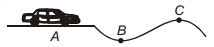
- 2View SolutionA vehicle is moving on a track with constant speed as shown in figure. The apparent weight of the vehicle is
- 3A marble block of mass $2\, kg$ lying on ice when given a velocity of $6 \,m/s$ is stopped by friction in $10\,s$. Then the coefficient of friction isView Solution
- 4A motorcycle is going on an overbridge of radius $R$. The driver maintains a constant speed. As the motorcycle is ascending on the overbridge, the normal forces on it isView Solution
- 5A block of mass $m$ is placed on a surface having vertical cross section given by $y=x^2 / 4$. If coefficient of friction is $0.5$ , the maximum height above the ground at which block can be placed without slipping is:View Solution
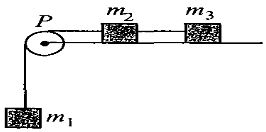
- 6A system consists of three masses $m_1 , m_2$ and $m_3$ connected by a string passing over a pulley $P.$ The mass $m_1$ hangs freely and $m_2$ and $m_3$ are on a rough horizontal table $($the coefficient of friction $= \mu ).$ The pulley is frictionless and of negligible mass. The downward acceleration of mass $m_1$ is $(Assume\, m = m_2 = m_3 = m)$View Solution
- 7View SolutionWhich of the following is self adjusting in nature?
- 8When a body slides down from rest along a smooth inclined plane making an angle of $30^{\circ}$ with the horizontal, it takes time $T$. When the same body slides down from the rest along a rough inclined plane making the same angle and through the same distance, it takes time $\alpha {T}$, where $\alpha$ is a constant greater than $1 .$ The co-efficient of friction between the body and the rough plane is $\frac{1}{\sqrt{{x}}}\left(\frac{\alpha^{2}-1}{\alpha^{2}}\right)$ where ${x}=..... .$View Solution
- 9The magnitude of the centripetal force acting on a body of mass $m$ executing uniform motion in a circle of radius $r$ with speed $v$ isView Solution
- 10A person with his hands in his pockets is skating on ice at the velocity of $10 \,m/s$ and describes a circle of radius $50\, m$. What is his inclination with verticalView Solution