A long cylindrical pipe of radius $20 \,cm$ is closed at its upper end and has an airtight piston of negligible mass as shown. When a $50 \,kg$ mass is attached to the other end of the piston, it moves down. If the air in the enclosure is cooled from temperature $T$ to $T-\Delta T$, the piston moves back to its original position. Then $\Delta T / T$ is close to (Assuming air to be an ideal gas, $g=10 \,m / s ^2$, atmospheric pressure is $10^5 \,Pa$ )
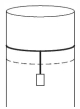
KVPY 2017, Advanced
Download our app for free and get started
(c)
Initial pressure in cylinder is atmospheric pressure $p_0$.
When mass $m$ is attached to piston, then pressure $=p_0-\frac{m g}{A}$.
As, temperature remains constant during expansion
$\Rightarrow p_i V_i=p_f V_f$
$\Rightarrow p_0 V_i=\left(p_0-\frac{m g}{A}\right) \cdot V_f$
$\Rightarrow \frac{V_f}{V_i}=\frac{p_0}{\left(p_0-\frac{m g}{A}\right)}$
$\frac{V_i}{V_f}=1-\frac{m g}{p_0 A} \Rightarrow \frac{m g}{p_0 A}=1-\frac{V_i}{V_f}$
$\Rightarrow \frac{m g}{p_0 A}=V_f-V_i=\frac{\Delta V}{V_f}$
Now, when temperature is reduced by $\Delta T$, the volume of gas again contracts to its original volume.
$\Rightarrow \frac{V}{T}=$ constant
or $\quad \frac{\Delta V}{V}=\frac{\Delta T}{T}$
$\Rightarrow \frac{\Delta T}{T}=\frac{\Delta V}{V_f}=\frac{m g}{p_0 A}$
$\Rightarrow \frac{\Delta T}{T}=\frac{m g}{p_0 A}$
$=\frac{50 \times 10}{10^5 \times 3.14 \times(0.2)^2}$
$=\frac{5}{3.14 \times 4} \times \frac{10^2}{10^5 \times 10^{-2}}$
$=0.4 \times 10^{-1}=0.04$

Download our appand get started for free
Experience the future of education. Simply download our apps or reach out to us for more information. Let's shape the future of learning together!No signup needed.*
Similar Questions
- 1$Assertion :$ Adiabatic expansion is always accompanied by fall in temperature.View Solution
$Reason :$ In adiabatic process, volume is inversely proportional to temperature. - 2An ideal gas expands in such a manner that its pressure and volume can be related by equation $P{V^2} = $ constant. During this process, the gas isView Solution
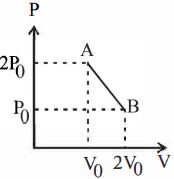
- 3'$n$' moles of an ideal gas undergoes a process $A \rightarrow B$ as shown in the figure. The maximum temperature of the gas during the process will beView Solution
- 4View SolutionThe thermodynamic process, in which internal energy of the system remains constant is ...........
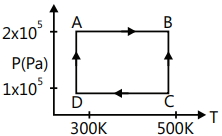
- 5Two moles of helium gas are taken over the cycle $ABCDA$, as shown in the $P-T$ diagram. Assuming the gas to be ideal the work done on the gas in taking it from $A $ to $B$ is ...... $R$View Solution
- 6A carnot engine with its cold body at $17\,^oC$ has $50\%$ effficiency. If the temperature of its hot body is now increased by $145\,^oC$, the efficiency becomes...... $\%$View Solution
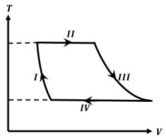
- 7One mole of a monatomic ideal gas undergoes a cyclic process as shown in the figure (where $V$ is the volume and $T$ is the temperature). Which of the statements below is (are) true?View Solution
(image)
$(A)$ Process $I$ is an isochoric process $(B)$ In process $II$, gas absorbs heat
$(C)$ In process $IV$, gas releases heat $(D)$ Processes $I$ and $III$ are $not$ isobaric
- 8A gas taken through cyclic process $ABCA$ is shown in figure. If $2.4\,cal.$ of heat is given in the process, what is value of $J$ ...... $J/cal$ (mechanical equivalent of heat)?View Solution
- 9A reversible engine has an efficiency of $\frac{1}{4}$. If the temperature of the sink is reduced by $58^{\circ} {C}$, its efficiency becomes double. Calculate the temperature of the sink. (In $^{\circ} {C}$)View Solution
- 10A thermally insulated rigid container contains an ideal gas heated by a filament of resistance $100 \,\Omega$ through a current of $1\,A$ for $5$ min then change in internal energy is...... $kJ$View Solution