A long solenoid of length $L$ has a mean diameter $D$. It has $n$ layers of windings of $N$ $turns$ each. If it carries a current ‘$i$’ the magnetic field at its centre will be
Easy
Download our app for free and get started
(c) Magnetic field due to solenoid is independent of diameter (Because $B = {\mu _0}ni$).

Download our appand get started for free
Experience the future of education. Simply download our apps or reach out to us for more information. Let's shape the future of learning together!No signup needed.*
Similar Questions
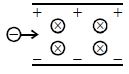
- 1An electron enters the space between the plates of a charged capacitor as shown. The charge density on the plate is $\sigma $. Electric intensity in the space between the plates is $E$. A uniform magnetic field $B$ also exists in that space perpendicular to the direction of $E$. The electron moves perpendicular to both $\vec E$ and $\vec B$ without any change in direction. The time taken by the electron to travel a distance $\ell $ is the space isView Solution
- 2The magnetic field $d\overrightarrow B $ due to a small current element $d\overrightarrow {l\,} $ at a distance $\overrightarrow {r\,} $ and element carrying current $i$ isView Solution
- 3A charged particle moves with velocity $v$ in a uniform magnetic field $\overrightarrow B $. The magnetic force experienced by the particle isView Solution
- 4An electron (mass $= 9 \times 10^{-31}\,kg$. Charge $= 1.6 \times 10^{-19}\,C$) whose kinetic energy is $7.2 \times 10^{-18}$ $joule$ is moving in a circular orbit in a magnetic field of $9 \times 10^{-5} \,weber/m^2$. The radius of the orbit is.....$cm$View Solution
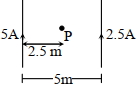
- 5For adjoining fig., The magnetic field at point, $P$ will beView Solution
- 6A proton and an $\alpha -$ particle (with their masses in the ratio of $1 : 4$ and charges in the ratio of $1:2$ are accelerated from rest through a potential difference $V$. If a uniform magnetic field $(B)$ is set up perpendicular to their velocities, the ratio of the radii $r_p : r_{\alpha }$ of the circular paths described by them will beView Solution
- 7View SolutionIf the current is doubled, the deflection is also doubled in
- 8A uniform magnetic field of $2 \times 10^{-3} \mathrm{~T}$ acts along positive $\mathrm{Y}$-direction. A rectangular loop of sides $20$ $\mathrm{cm}$ and $10 \mathrm{~cm}$ with current of $5 \mathrm{~A}$ is $\mathrm{Y}-\mathrm{Z}$ plane. The current is in anticlockwise sense with reference to negative $\mathrm{X}$ axis. Magnitude and direction of the torque is :View Solution
- 9A long solenoid carrying a current produces a magnetic field $B$ along its axis. If the current is doubled and the number of turns per cm is halved, the new value of the magnetic field isView Solution
- 10A charge particle is moving in a uniform magnetic field $(2 \hat{i}+3 \hat{j}) T$. If it has an acceleration of $(\alpha \hat{i}-4 \hat{j}) m / s ^{2}$, then the value of $\alpha$ will be.View Solution