The cyclotron frequency of an electron grating in a magnetic field of $1\, T$ is approximately
AIIMS 2004, Medium
Download our app for free and get started
(d) Cyclotron frequency $v = \frac{{Bq}}{{2\pi m}}$
$ \Rightarrow v = \frac{{1 \times 1.6 \times {{10}^{ - 19}}}}{{2 \times 3.14 \times 9.1 \times {{10}^{ - 31}}}} = 2.79 \times {10^{10}}{H_z}$
$ = 27.9 \times {10^9}HZ \cong \;28\;GHz$
$ \Rightarrow v = \frac{{1 \times 1.6 \times {{10}^{ - 19}}}}{{2 \times 3.14 \times 9.1 \times {{10}^{ - 31}}}} = 2.79 \times {10^{10}}{H_z}$
$ = 27.9 \times {10^9}HZ \cong \;28\;GHz$

Download our appand get started for free
Experience the future of education. Simply download our apps or reach out to us for more information. Let's shape the future of learning together!No signup needed.*
Similar Questions
- 1A moving coil galvanometer has $50$ turns and each turn has an area $2 \times 10^{-4} m ^2$. The magnetic field produced by the magnet inside the galvanometer is $0.02 T$. The torsional constant of the suspension wire is $10^{-4} N m rad ^{-1}$. When a current flows through the galvanometer, a full scale deflection occurs if the coil rotates by $0.2$ rad. The resistance of the coil of the galvanometer is $50 \Omega$. This galvanometer is to be converted into an ammeter capable of measuring current in the range $0-1.0 A$. For this purpose, a shunt resistance is to be added in parallel to the galvanometer. The value of this shunt resistance, in ohms, is. . . . . .View Solution
- 2The current in the windings on a toroid is $2.0\,A$. There are $400$ $turns$ and the mean circumferential length is $40\,cm$. If the inside magnetic field is $1.0\,T$, the relative permeability is near toView Solution
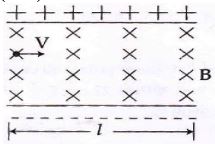
- 3An electron moves straight inside a charged parallel plate capacitor of uniform charge density. The space between the plates is filled with uniform magnetic field of intensity $B ,$ as shown in the figure, Neglecting effect of gravity, the time of straight line motion of the electron in the capacitor isView Solution
- 4A loop is moulded by a constant length current carrying wire and placed in external magnetic field, then torque acts on it does not depends uponView Solution
$(a)$ Shape of loop
$(b)$ Area of loop.
$(c)$ Current in loop
$(d)$ External magnetic field.
- 5A galvanometer, whose resistance is $50\,ohm,$ has $25$ divisions in it. When a current of $4\times 10^{-4}\,A$ passes through it, its needle (pointer) deflects by one division. To use this galvanometer as a voltmeter of range $2.5\,V,$ it should be connected to a resistance of.......$ohm$View Solution
- 6A galvanometer having coil resistance $10 \ \Omega$ shows a full scale deflection for a current of $3 \mathrm{~mA}$. For it to measure a current of $8 \mathrm{~A}$, the value of the shunt should be:View Solution
- 7A charged particle moves along circular path in a uniform magnetic field in a cyclotron. The kinetic energy of the charged particle increases to $4$ times its initial value. What will be the ratio of new radius to the original radius of circular path of the charged particleView Solution
- 8Two long and parallel straight wires $A$ and $B$ carrying currents of $8.0\, A$ and $5.0\, A$ in the same direction are separated by a distance of $4.0\, cm$. Estimate the force on a $10\, cm$ section of wire $A$View Solution
- 9View SolutionThe current is flowing in south direction along a power line. The direction of magnetic field above the power line (neglecting earth's field) is
- 10A long solenoid has $100\,turns/m$ and carries current $i.$ An electron moves with in the solenoid in a circle of radius $2·30\,cm$ perpendicular to the solenoid axis. The speed of the electron is $0·046\,c$ ($c =$ speed of light). Find the current $i$ in the solenoid (approximate).....$A$View Solution