A long straight wire, carrying current $I$ is bent at its mid-point to form an angle of $45^{\circ}$. Induction of magnetic field (in tesla) at point $P$, distant $R$ from point of bending is equal to
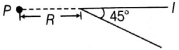
AIIMS 2018, Diffcult
Download our app for free and get started
$\therefore B($ at $P)=\frac{\mu_{0} I}{4 \pi d}\left(\cos \theta_{1}-\cos \theta_{2}\right)$
In given case,
$d=R \sin 45^{\circ}=\frac{R}{\sqrt{2}}$
$\theta_{1}=135^{\circ}, \theta_{2}=180^{\circ}$
$\therefore B($ at $P)=\frac{\mu_{0} I}{4 \pi\left(\frac{R}{\sqrt{2}}\right)}\left[\cos 135^{\circ}-\cos 180^{\circ}\right]$
$=\frac{\mu_{0} I}{4 \pi R} \sqrt{2}\left(\frac{-1}{\sqrt{2}}-(-1)\right)$
$=\frac{\mu_{0} I}{4 \pi R} \sqrt{2}\left(\frac{\sqrt{2}-1}{\sqrt{2}}\right)$
or $B($ at $P)=\frac{\mu_{\rho} I}{4 \pi R}(\sqrt{2}-1) T$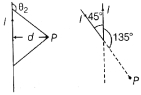

Download our appand get started for free
Experience the future of education. Simply download our apps or reach out to us for more information. Let's shape the future of learning together!No signup needed.*
Similar Questions
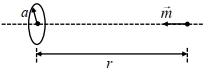
- 1A special metal $S$ conducts electricity without any resistance. A closed wire loop, made of $S$, does not allow any change in flux through itself by inducing a suitable current to generate a compensating flux. The induced current in the loop cannot decay due to its zero resistance. This current gives rise to a magnetic moment which in turn repels the source of magnetic field or flux. Consider such a loop, of radius $a$, with its center at the origin. A magnetic dipole of moment $m$ is brought along the axis of this loop from infinity to a point at distance $r \gg a)$ from the center of the loop with its north pole always facing the loop, as shown in the figure below.View Solution
The magnitude of magnetic field of a dipole $m$, at a point on its axis at distance $r$, is $\frac{\mu_0}{2 \pi} \frac{m}{r^3}$, where $\mu_0$ is the permeability of free space. The magnitude of the force between two magnetic dipoles with moments, $m_1$ and $m_2$, separated by a distance $r$ on the common axis, with their north poles facing each other, is $\frac{k m_1 m_2}{r^4}$, where $k$ is a constant of appropriate dimensions. The direction of this force is along the line joining the two dipoles.
($1$) When the dipole $m$ is placed at a distance $r$ from the center of the loop (as shown in the figure), the current induced in the loop will be proportional to
$(A)$ $\frac{m}{r^3}$ $(B)$ $\frac{m^2}{r^2}$ $(C)$ $\frac{m}{r^2}$ $(D)$ $\frac{m^2}{r}$
($2$) The work done in bringing the dipole from infinity to a distance $r$ from the center of the loop by the given process is proportional to
$(A)$ $\frac{m}{r^5}$ $(B)$ $\frac{m^2}{r^5}$ $(C)$ $\frac{m^2}{r^6}$ $(D)$ $\frac{m^2}{r^7}$
Give the answer or qution ($1$) and ($2$)
- 2In a toroid the number of turns per unit length is $1000$ and current through it is $\frac{1}{4 \pi}$ ampere. The magnetic field produced inside (in $weber / m ^2$ ) will beView Solution
- 3View SolutionTesla is the unit of
- 4A proton of mass $m$ and charge $+e$ is moving in a circular orbit in a magnetic field with energy $1\, MeV$. What should be the energy of $\alpha - $particle (mass = $4m$ and charge = $+ 2e),$ so that it can revolve in the path of same radius.......$MeV$View Solution
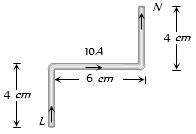
- 5A current carrying wire $LN$ is bent in the from shown below. If wire carries a current of $10\, A$ and it is placed in a magnetic field of $5\,T$ which acts perpendicular to the paper outwards then it will experience a force.........$N$View Solution
- 6A square loop of area $25\,cm ^2$ has a resistance of $10\,\Omega$. The loop is placed in uniform magnetic field of magnitude $40.0 T$. The plane of loop is perpendicular to the magnetic field. The work done in pulling the loop out of the magnetic field slowly and uniformly in $1.0 sec$, will be $..........\times 10^{-3}$View Solution
- 7An infinitely long hollow conducting cylinder with radius $R$ carries a uniform current along its surface. Choose the correct representation of magnetic field $(B)$ as a function of radial distance $(r)$ from the axis of cylinderView Solution
- 8A particle of mass $m$ and charge $q$ is thrown from origin at $t = 0$ with velocity $2\hat{i}$ + $3\hat{j}$ + $4\hat{k}$ units in a region with uniform magnetic field $\vec B$ = $2\hat{i}$ units. After time $t =\frac{{\pi m}}{{qB}}$ , an electric field is switched on such that particle moves on a straight line with constant speed. $\vec E$ may beView Solution
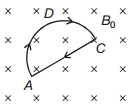
- 9Figure shows a conducting loop $A D C A$ carrying current $i$ and placed in a region of uniform magnetic field $B_0$. The part $A D C$ forms a semicircle of radius $R$. The magnitude of force on the semicircle part of the loop is equal toView Solution
- 10A semi circular arc of radius $r$ and a straight wire along the diameter, both are carrying same current $i.$ Find out magnetic force per unit length on the small element $P$, which is at the centre of curvature.View Solution
