In a toroid the number of turns per unit length is $1000$ and current through it is $\frac{1}{4 \pi}$ ampere. The magnetic field produced inside (in $weber / m ^2$ ) will be
Easy
Download our app for free and get started
(c)
$n=1000 \quad I=\frac{1}{4 \pi} A$
$B=\mu_0 n i=4 \pi \times 10^{-7}(1000) \times \frac{1}{4 \pi}$
$B=10^{-4}( T )$

Download our appand get started for free
Experience the future of education. Simply download our apps or reach out to us for more information. Let's shape the future of learning together!No signup needed.*
Similar Questions
- 1A thin circular disk of radius $R$ is uniformly charged with density $\sigma>0$ per unit area. The disk rotates about its axis with a uniform angular speed $\omega$. The magnetic moment of die disk isView Solution
- 2The cyclotron frequency of an electron grating in a magnetic field of $1\, T$ is approximatelyView Solution
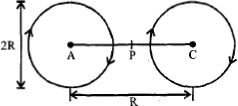
- 3A Helmholtz coil has pair of loops, each with $N$ turns and radius $R$. They are placed coaxially at distance $R$ and the same current $I$ flows through the loops in the same direction. The magnitude of magnetic field at $P$, midway between the centres $A$ and $C$, is given by (Refer to figure)View Solution
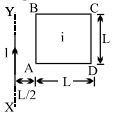
- 4A square loop $ABCD$, carrying a current $i,$ is placed near and coplanar with a long straight conductor $XY$ carrying a current $I,$ the net force on the loop will beView Solution
- 5The dipole moment of a circular loop carrying a current $I$, is $m$ and the magnetic field at the centre of the loop is $B_1$ . When the dipole moment is doubled by keeping the current constant, the magnetic field at the centre of the loop is $B_2$ . The ratio $\frac{{{B_1}}}{{{B_2}}}$ isView Solution
- 6A uniform conducting wire of length is $24 {a}$, and resistance ${R}$ is wound up as a current carrying coil in the shape of an equilateral triangle of side $'a'$ and then in the form of a square of side $'a'.$ The coil is connected to a voltage source ${V}_{0}$. The ratio of magnetic moment of the coils in case of equilateral triangle to that for square is $1: \sqrt{y}$ where $y$ is ..... .View Solution
- 7A moving coil galvanometer, having a resistance $G$, produces full scale deflection when a current $I_g$ flows through it. This galvanometer can be converted into $(i)$ an ammeter of range $0$ to $I_0 (I_0 > I_g)$ by connecting a shunt resistance $R_A$ to it and $(ii)$ into a voltmeter of range $0$ to $V(V = GI_0)$ by connecting a series resistance $R_V$ to it. Then,View Solution
- 8A metal ring of radius $r = 0.5 \,\,m $ with its plane normal to a uniform magnetic field $B$ of induction $0.2 T$ carries a current $I = 100\,\, A$. The tension in newtons developed in the ring is:View Solution
- 9An $\alpha$ particle is moving along a circle of radius $R$ with a constant angular velocity $\omega $. Point $A$ lies in the same plane at a distance $2R$ from the centre. Point $A$ records magnetic field produced by $\alpha$ particle. If the minimum time interval between two successive times at which $A$ records zero magnetic field is $‘t’,$ find the angular speed $\omega $, in terms of $t.$View Solution
- 10A thin wire of length $l$ is carrying a constant current. The wire is bent to form a circular coil. If radius of the coil, thus formed, is equal to $R$ and number of turns in it is equal to $n$, then which of the following graphs represent $(s)$ variation of magnetic field induction $(b)$ at centre of the coilView Solution