A long wire carries a steady current. It is bent into a circle of one turn and the magnetic field at the centre of the coil is $B$. It is then bent into a circular loop of $n$ $turns$. The magnetic field at the centre of the coil will be
AIEEE 2004,NEET 2016, Easy
Download our app for free and get started
(b) Magnetic field at the center of single turn loop $B = \frac{{{\mu _0}}}{{4\pi }}.\frac{{2\pi i}}{r}$, magnetic field at the center of $n-$turn loop
${B_n} = \left( {\frac{{{\mu _0}}}{{4\pi }}.\frac{{2\pi i}}{{r/n}}} \right) \times n \Rightarrow {B_n} = {n^2}B$
${B_n} = \left( {\frac{{{\mu _0}}}{{4\pi }}.\frac{{2\pi i}}{{r/n}}} \right) \times n \Rightarrow {B_n} = {n^2}B$

Download our appand get started for free
Experience the future of education. Simply download our apps or reach out to us for more information. Let's shape the future of learning together!No signup needed.*
Similar Questions
- 1View SolutionIf an ammeter is connected in parallel to a circuit, it is likely to be damaged due to excess
- 2View SolutionChoose the correct statement
- 3A galvanometer gives full scale deflection with $0.006$ A current. By connecting it to a $4990 \ \Omega$ resistance, it can be converted into a voltmeter of range $0-30 \ V$. If connected to a $\frac{2 n }{249} \Omega$ resistance, it becomes an ammeter of range $0-1.5 \ A$. The value of $n$ is:View Solution
- 4An electron (mass = $9.0 × $${10^{ - 31}}$ $kg$ and charge =$1.6 \times {10^{ - 19}}$ $coulomb$) is moving in a circular orbit in a magnetic field of $1.0 \times {10^{ - 4}}\,weber/{m^2}.$ Its period of revolution isView Solution
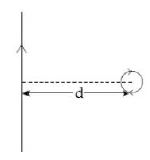
- 5An infinitely long current carrying wire and a small current carrying loop are in the plane of the paper as shown. the radius of the loop is $a$ and distance of its centre from the wire is $d (d >> a)$. If the loop applies a force $F$ on the wire thenView Solution
- 6A plastic disc of radius $R$ has a charge $q$ uniformly distributed over its surface. If the disc is rotated at an angular frequency $\omega$ about it axis, the induction at the center of the disc is :-View Solution
- 7A long straight wire carries a current of $\pi \,amp.$ The magnetic field due to it will be $5 \times {10^{ - 5}}{\rm{ }}\,weber/{m^{\rm{2}}}$ at what distance from the wire $[{\mu _o} = $ permeability of air]View Solution
- 8The strength of the magnetic field at a point $r$ near a long straight current carrying wire is $B$. The field at a distance $\frac{r}{2}$ will beView Solution
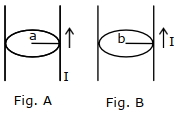
- 9Figure $A$ and $B$ shown two long straight wires of circular cross-section ($a$ and $b$ with $a$ $<$ $b$), carrying current $I$ which is uniformly distributed across the cross-section. The magnitude of magnetic field $B$ varies with radius $r$ and can be represented asView Solution
- 10A current $i$ flows in a circular coil of radius $r$. If the coil is placed in a uniform magnetic field $B$ with its plane parallel to the field, magnitude of the torque that acts on the coil isView Solution