If an ammeter is connected in parallel to a circuit, it is likely to be damaged due to excess
Easy


Download our appand get started for free
Experience the future of education. Simply download our apps or reach out to us for more information. Let's shape the future of learning together!No signup needed.*
Similar Questions
- 1Which one of the following modifications may ncrease the sensitivity of moving coil galvanometer?View Solution
$1^{st}$ Way : By using spring of smaller torsion constant.
$2^{nd}$ Way : By using a smaller coil
$3^{rd}$ Way : By using a stronger magnet
$4^{th}$ Way : By using a coil having fewer number of turns. - 2In the following hexagons, made up of two different material $P$ and $Q,$ current enters and leaves from points $X$ and $Y$ respectively. In which case the magnetic field at its centre is not zero.View Solution
- 3The radius of a circular loop is $r$ and a current $i$ is flowing in it. The equivalent magnetic moment will beView Solution
- 4The number of turns per unit length of a long solenoid is $10$ . If its average radius is $5 \,cm$ and it carries a current of $10 \,A$, then the ratio of flux densities obtained at the centre and at the end on the axis will beView Solution
- 5The resistance of an ammeter is $13\, \Omega$ and its scale is graduated for a current upto $100$ $amps$. After an additional shunt has been connected to this ammeter it becomes possible to measure currents upto $750$ $ampere$ by this meter. The value of shunt-resistance isView Solution
- 6View SolutionConsider the following statements regarding a charged particle in a magnetic field . Which of the statements are true :
- 7An ammeter and a voltmeter of resistance $R$ are connected in series to an electric cell of negligible internal resistance. Their readings are $A$ and $V$ respectively. If another resistance $R$ is connected in parallel with the voltmeterView Solution
- 8View SolutionA negative charge is coming towards the observer. The direction of the magnetic field produced by it will be (as seen by observer)
- 9A circular coil of $20$ $turns$ and radius $10\, cm$ is placed in uniform magnetic field of $0.10\, T$ normal to the plane of the coil. If the current in coil is $5\, A$, then the torque acting on the coil will be...... $Nm$View Solution
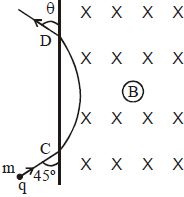
- 10A particle of mass $m = 1.67 \times 10^{-27}\, kg$ and charge $q = 1.6 \times 10^{-19} \, C$ enters a region of uniform magnetic field of strength $1$ $tesla$ along the direction shown in the figure. The speed of the particle is $10^7\, m/s.$ The magnetic field is directed along the inward normal to the plane of the paper. The particle enters the field at $C$ and leaves at $D.$ Then the angle $\theta$ must be :-.........$^o$View Solution