Question
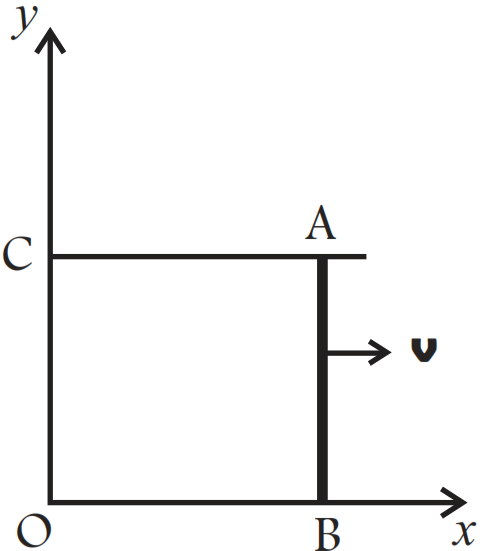
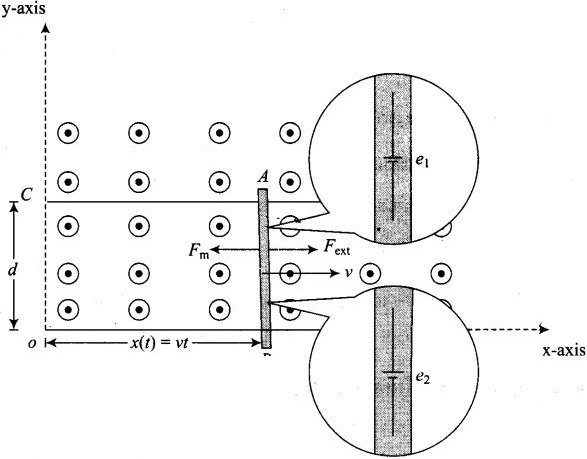
A magnetic field $\text{B}=\text{B}_0\sin(\omega\text{t})\hat{\text{k}}$ covers a large region where a wire AB slides smoothly over two parallel conductors separated by a distance d (Fig.). The wires are in the x-y plane. The wire AB (of length d) has resistance R and the parallel wires have negligible resistance. If AB is moving with velocity v, what is the current in the circuit. What is the force needed to keep the wire moving at constant velocity?
Answer

Key concept: In this problem the emf induced across AB is motional emf due to its motion, and emf induced by change in magnetic flux linked with the loop change due to change of magnetic field.
Due to motion: e = Blv
Due to change in magnetic flux: $\text{e}=-\text{N}\frac{\text{d}(\phi_\text{B})}{\text{dt}}$
First we have to analyse the situation as shown in the figure, Let the parallel wires are at y = 0 and y = d and placed along x-axis. Wire AB is along y-axis.
Let us redraw the diagram as shown below.

At t = 0, wire AB starts from x = 0 and moves with a velocity v. Let at time t, wire is at x(t) = vt
(where, x(t) is the dispacement as a function of time).
Now, the motional emf across AB is
$\text{e}_1=\frac{\text{B}}{\text{v}}$
$\Rightarrow\ \text{e}_1=\big(\text{B}_0\sin\omega\text{t}\big)\text{vd}(-\hat{\text{j}})$
and emf due to change in field (along OBAC)
$\text{e}_2=-\frac{\text{d}(\phi_\text{B})}{\text{dt}}$
$\phi_\text{B}=(\text{B}_0\sin\omega\text{t})(\text{x}(\text{t})\text{d}) \ \ (\text{where, area A}=\text{xd})$
$\text{e}_2=-\text{B}_0\omega\cos\omega\text{tx}(\text{t})\text{d}$
Total emf in the circuit = emf due to change in field (along OBAC) + the motional emf across AB
$\text{e}_1+\text{e}_2=-\text{B}_0\text{d}\big[\omega\text{x}\cos(\omega\text{t})+\text{v}\sin(\omega\text{t})\big]$
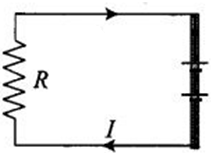
The equivalent electrical diagram is shown in the diagram below.

Electric current in clockwise direction is given by
$=\frac{\text{B}_0\text{d}}{\text{R}}(\omega\text{x}\cos\omega\text{t}+\text{v}\sin\omega\text{t})$
The force acting on the conductor is given by $\text{F}=\text{ilB}\sin90^\circ=\text{ilB}$.
Substituting the values,
$\vec{\text{F}_\text{M}}=\frac{\text{B}_0\text{d}}{\text{R}}(\omega\text{t}\cos\omega\text{t}+\text{v}\sin\omega\text{t})(\text{d})(\text{B}_0\sin\omega\text{t})(-\hat{\text{j}})$
External force needed on wire is along positive x-axis to keep moving it with constant velocity is given by,
$\vec{\text{F}}_\text{ext}=\frac{\text{B}_0\text{d}}{\text{R}}(\omega\text{t}\cos\omega\text{t}+\text{v}\sin\omega\text{t})\sin\omega\text{t}$
This is the required expression for force.

Need a full question paper?

Generate a complete, print-ready paper with questions like this in minutes — across 16+ boards, with answer keys.

Start Generating Free

Similar questions

A 20cm long conducting rod is set into pure translation with a uniform velocity of $10cm/s^{-1}$ perpendicular to its length. A uniform magnetic field of magnitude 0.10T exists in a direction perpendicular to the plane of motion.
  1. Find the average magnetic force on the free electrons of the rod.
  2. For what electric field inside the rod, the electric force on a free elctron will balance the magnetic force? How is this electric field created?
  3. Find the motional emf between the ends of the rod.
Two convex lenses, each of focal length 10cm, are placed at a separation of 15cm with their principal axes coinciding,
  1. Show that a light beam coming parallel to the principal axis diverges as it comes out of the lens system.
  2. Find the location of the virtual image formed by the lens system of an object placed far away.
  3. Find the focal length of the equivalent lens.
(Note that the sign of the focal length is positive although the lens system actually diverges a parallel beam incident on it).
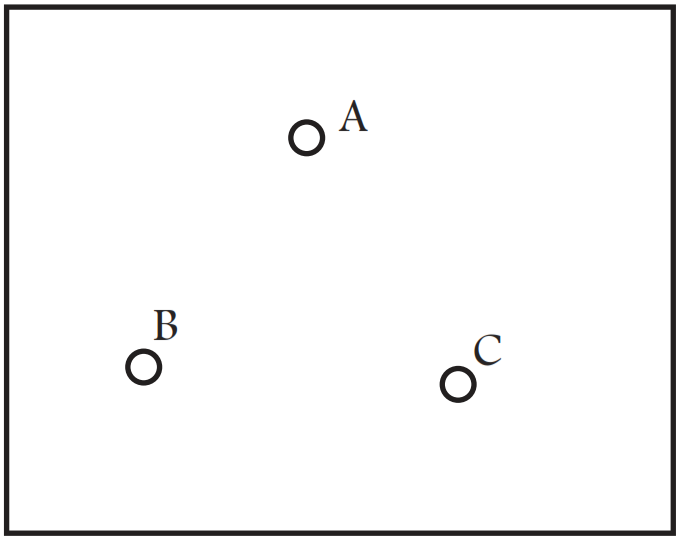
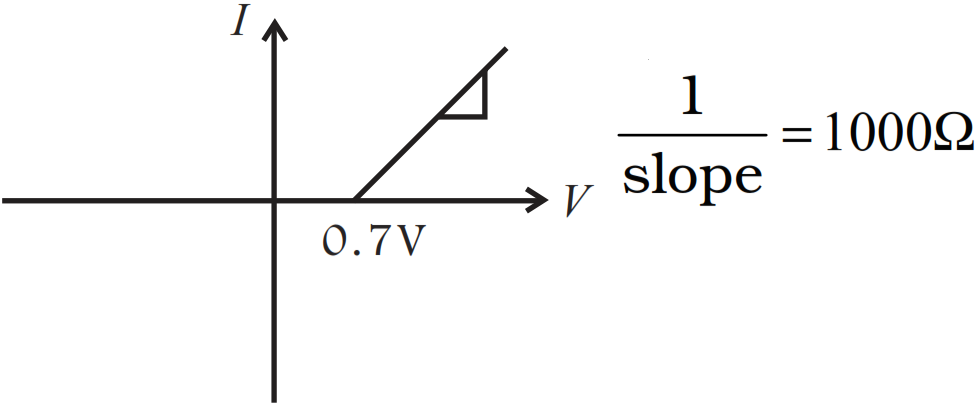
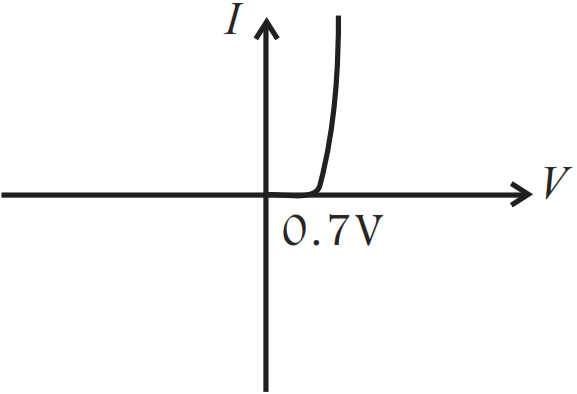
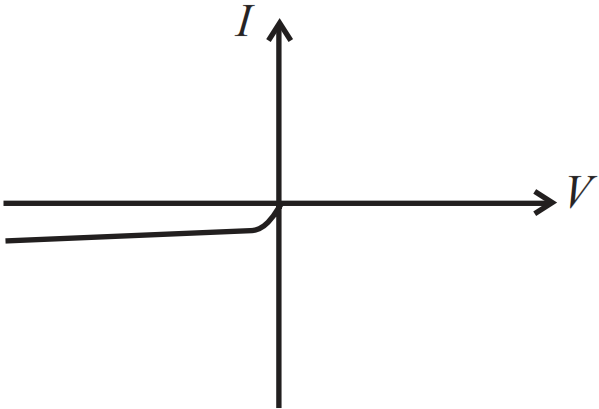
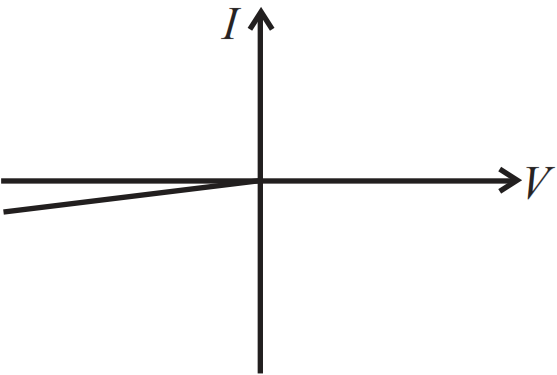
Consider a box with three terminals on top of it as shown in Fig (a):

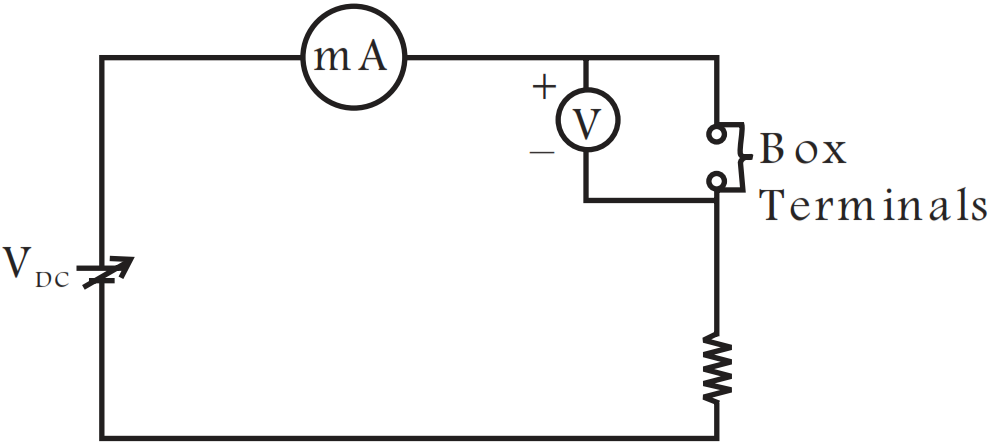
Three components namely, two germanium diodes and one resistor are connected across these three terminals in some arrangement. A student performs an experiment in which any two of these three terminals are connected in the circuit shown in Fig. (b).

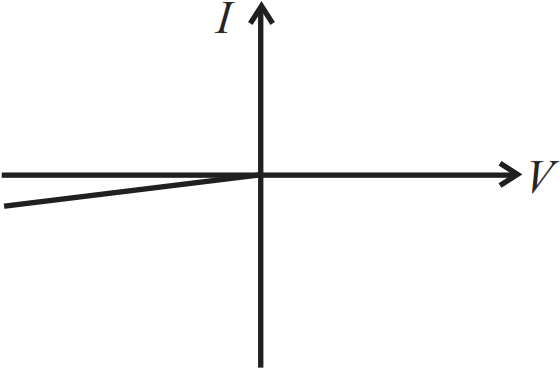
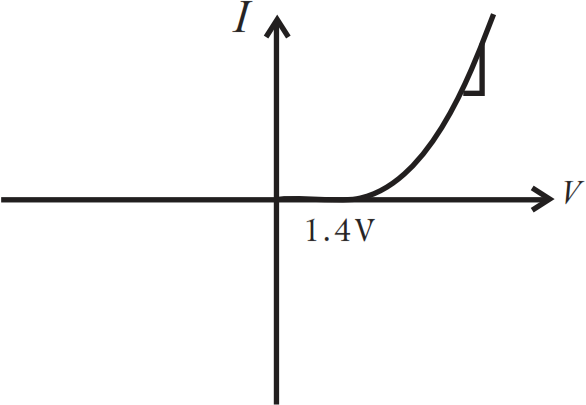
The student obtains graphs of current-voltage characteristics for unknown combination of components between the two terminals connected in the circuit. The graphs are
  1. When A is positive and B is negative,
  1. When A is negative and B is positive,
  1. When B is negative and C is positive,
  1. When B is positive and C is negative,
  1. When A is positive and C is negative,
  1. When A is negative and C is positive,

From these graphs of current - voltage characteristic shown in Fig. (c) to (h), determine the arrangement of components between A, B and C.
A rod of length L has a total charge Q distributed uniformly along its length. It is bent in the shape of a semicircle. Find the magnitude of the electric field at the centre of curvature of the semicircle.
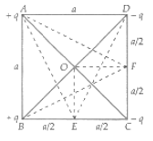
Four charges $+ q ,+ q ,- q$ and $- q$ are placed respectively at the corners $A , B , C$ and $D$ of a square of side a arranged in the given order. Calculate the electric potential at the centre $O$ . If A a $E$ and $F$ are the midpoints of sides $BC$ and $CD$ respectively, what will be the work done in carrying a charge e from $O$ to $E$ and from $O$ to $F$ ?
Image
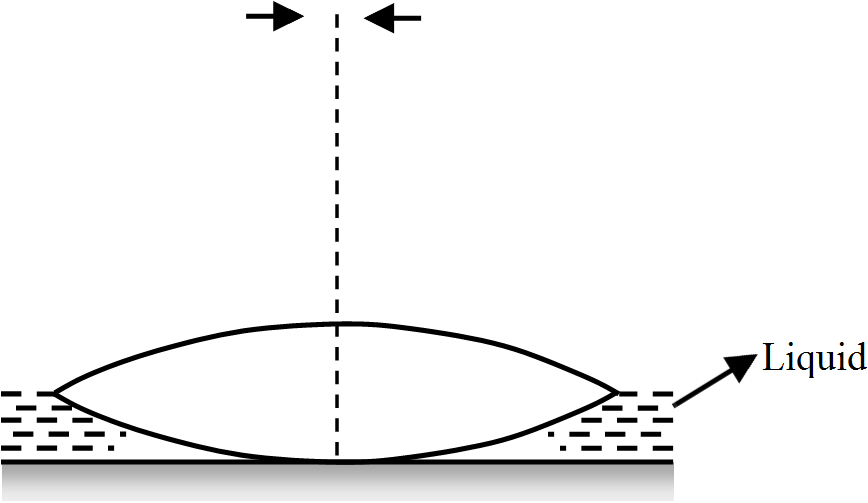
  1. An equiconvex lens with radii of curvature of magnitude r each, is put over a liquid layer poured on top of a plane mirror. A small needle, with its tip on the principal axis of the lens, is moved along the axis until its inverted real image coincides with the needle itself. The distance of the needle from the lens is measured to be 'a'. On removing the liquid layer and repeating the experiment the distance is found to be 'b'.
Given that two values of distances measured represent the focal length values in the two cases, obtain a formula for the refractive index of the liquid.
  1. If r = 10cm, a = 15cm, b = 10cm, find the refractive index of the liquid.
A heavy but uniform rope of length L is suspended from a ceiling.
  1. Write the velocity of a transverse wave travelling on the string as a function of the distance from the lower.
  2. If the rope is given a sudden sideways jerk at the bottom, how long will it take for the pulse to reach the ceiling?
  3. A particle is dropped from the ceiling at the instant the bottom end is given the jerk. Where will the particle meet the pulse ?
A converging lens of focal length 15cm and a converging mirror of focal length 10cm are placed 50cm apart with common principal axis. A point source is placed in between the lens and the mirror at a distance of 40cm from the lens. Find the locations of the two images formed.
An electric current flows in a wire from north to south. What will be the direction of the magnetic field due to this wire at a point east of the wire? West of the wire? Vertically above the wire? Vertically below the wire?
What are energy bands? How are these formed? Distinguish between a conductor, an insulator and a semiconductor on the basis of energy band diagram.